Gambonanza Guide
Gambonanza Beginner Guide & Tips
Learn how to play Gambonanza with beginner tips for win conditions, stock, promotion, shops, mini-games, tiles, bosses, crumble, and special pieces.
Gambonanza looks like chess at first, but it is not played like normal chess. Your goal is not checkmate. Your goal is to capture every enemy piece while keeping at least one of your own pieces alive.
That single rule changes everything. Pawns can become win conditions. Kings can be sacrificed. Shops and mini-games can reshape your run. Special enemy pieces can stop obvious captures. Tiles can save a queen, create a temporary copy, trap an enemy, or break your board apart.
This beginner guide explains the core systems you need to understand before chasing advanced Gambit combos, queen-farming setups, or boss-specific strategies.
Quick Start
A Gambonanza run starts on a very small board. Early boards can begin as a compact 5×5-style setup with only a few pieces, which is why every square matters much more than in normal chess.
A full clear is best understood as a run of around 25 boards. The tutorial footage describes the goal as reaching the around game 25, but for beginner planning, the safer rule is simpler: expect a long run with regular boss checkpoints, and do not spend as if the current board is your last one.
The beginner resource plan is simple:
| Run point | What to think about |
|---|---|
| Early boards | Preserve pieces, promote pawns, learn safe captures. |
| Before game 5 of a stage | Save enough money and stock to handle a boss. |
| After a boss | Rebuild lost pieces and expand your board if needed. |
| Mid run | Buy around your strongest Gambits, tiles, and promoted pieces. |
| Late run | Avoid risky trades unless you have recovery tools. |
The most important habit is to stop thinking one board at a time. A trade that wins the current board can still ruin the next four boards.
What Is Gambonanza?
Gambonanza is a chess roguelike. It uses familiar chess movement rules, but the goal and run structure are different.
Instead of playing one standard chess match, you clear a sequence of enemy boards. Between boards, you earn money, buy pieces, choose Gambits, place special tiles, play mini-games, and prepare for harder formations.
The most important beginner rule is:
Do not play for checkmate. Play to remove every enemy piece.
Enemy kings are just targets. Your own king is not sacred in the same way it is in chess. If a king dies, that can be acceptable as long as your run survives and you still have enough pieces to keep clearing boards.
Win and Lose Conditions
To win a board, capture every enemy piece.
To lose, have no active pieces left on your board.
That creates a very different mindset from standard chess:
| Situation | In normal chess | In Gambonanza |
|---|---|---|
| Enemy king exposed | Checkmate matters most. | The king is only one more enemy piece. |
| Your king is captured | You lose. | You may continue if other pieces remain. |
| Trading pieces | Often positional. | Dangerous if it weakens future boards. |
| Sacrifices | Used for checkmate or advantage. | Useful only if your run can recover. |
| Pawns | Usually low-value pieces. | One of the easiest paths into queens. |
The biggest beginner mistake is winning one board by losing too many permanent pieces. If a normal piece is captured and you do not have a tile, Gambit, or reward that brings it back, you should treat that piece as gone.
Special Enemy Pieces
Some enemy pieces have special properties. These matter because they can completely change your capture order.
Elite Pieces
Elite pieces usually cannot be captured until they are the last enemy piece left.
If you try to take an Elite piece too early and the game does not allow it, that is usually not a bug. It means you need to clear the supporting pieces first.
Beginner response:
- Identify the Elite piece before you commit to a trade.
- Remove nearby pawns, bishops, rooks, knights, or queens first.
- Do not spend your best piece trying to force an illegal capture.
- Keep at least one long-range attacker ready for the final capture.
Elite pieces are especially dangerous when they protect other enemies. You may need to use the rest of the enemy formation against them by forcing movement, opening lines, or waiting only when it does not trigger a worse board state.
Crumbler Pieces
Crumbler pieces can trigger board crumble when you capture other pieces.
This means a normal-looking capture can suddenly make tiles fall away. If one of your important pieces is standing on a tile that crumbles, you can lose that piece even if the capture itself looked safe.
Beginner response:
- Check whether any enemy has a Crumbler-style modifier before starting a capture chain.
- Move queens and key pieces away from risky tiles before taking optional captures.
- Capture the Crumbler piece early if it is safe, or delay greedy captures until your important pieces are protected.
- Avoid long capture chains if one random crumble can destroy your only win condition.
Crumbler pieces are one reason Gambonanza rewards slow planning. The best move is not always the capture with the highest immediate value.
Pieces and Stock Explained
Your board pieces are the pieces currently active on the board.
Your stock is your reserve outside the board. Stock matters because you can sometimes place a piece from stock during a board if you have room.
Stock gives you emergency options:
- add a blocker
- create a new capture route
- replace a lost attacker
- set up a sacrifice
- bring in a queen, rook, bishop, knight, king, or pawn at the right moment
However, stock is not always safe. Some bosses restrict stock usage. Also, placing a piece during a board can still consume your action or create a new threat against you.
A good beginner habit is to keep at least one useful backup piece in stock before every fifth game of a stage. If your only plan depends on one queen, one bad board can end the run.
Pawn Promotion
Pawns are one of the strongest beginner tools because they can promote when they reach the far side of the board.
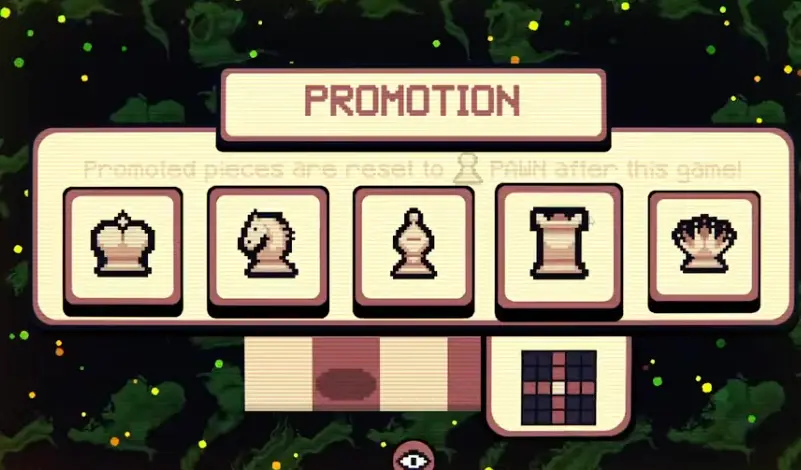
For most beginner runs, queen promotion is the safest default choice. A queen gives you long-range control, cleans up scattered pieces, and stops dangerous enemy pawns before they promote.
Good pawn promotion habits:
- clear diagonal threats before pushing a pawn
- avoid promoting into a square that is immediately attacked
- protect promoted queens with other pieces or special tiles
- do not sacrifice your only queen unless she can return to stock
- use pawns as both attackers and future win conditions
Promotion is powerful, but it is not free. A promoted queen is still a piece you can lose permanently if you throw it into an unsafe capture.
Gambits Explained
Gambits are passive rule-changing effects. They are one of the main roguelike systems in Gambonanza.
A Gambit can change how captures work, how pieces are rewarded, how tiles behave, or how your economy grows.
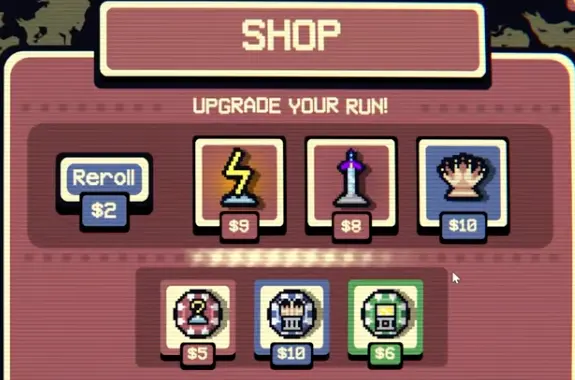
A beginner-friendly example is Thunder’s Gambit, which makes pawn captures skip the enemy turn. This is easy to understand because it gives pawns direct tempo: capture with a pawn, deny the enemy response, and sometimes chain more progress safely.
You can hold only a limited number of Gambits, so avoid buying every Gambit just because it appears. New players should prioritize Gambits that match their current pieces and board plan.
Good early Gambits usually do one of these things:
- make pawn captures safer
- help pawns promote
- reward queen captures
- generate extra pieces
- protect important pieces
- improve money without forcing risky play
- help you survive crumble or boss boards
A Gambit is not good just because it is rare. It is good when your current run can trigger it reliably.
Shop, Interest, and Tokens
After boards, you can spend money in the shop. The shop can offer:
- chess pieces
- Gambits
- tile tokens
- Gambit tokens
- chess piece tokens
- mini-game tokens
- board upgrades
- rerolls
- shop locks
Money is not just for buying power. Money is also a recovery tool.
You can earn interest from saved money, so spending everything immediately is often a mistake. Keeping enough money before a boss lets you rebuild after a bad board and still buy key pieces, tokens, or upgrades.
Use the shop with a simple priority system:
| Priority | Buy when… |
|---|---|
| Key pieces | You are low on active pieces or need a queen, rook, bishop, knight, king, or pawn. |
| Board upgrades | You have useful pieces but not enough room to deploy them. |
| Strong Gambits | The Gambit fits your current pieces, tiles, or economy. |
| Tile tokens | You understand where the tile should go. |
| Mini-game tokens | The possible reward can change your run and you can afford the variance. |
| Rerolls | The shop is bad and you have enough money to keep interest healthy. |
If you are not sure what to buy, buy stability first. A boring pawn, board upgrade, or replacement piece can be better than a flashy Gambit you cannot trigger.
Mini-Games
Mini-games are a separate upgrade system inside Gambonanza. They are not just visual flavor. They can give you run-changing rewards, especially when you already know what kind of upgrade your build needs.
In the available gameplay footage, mini-games are introduced through the shop and token system: the tutorial explains that you can buy tokens for mini-games in the shop, alongside special tiles, legendary Gambits, chess pieces, and board upgrades.
That means beginners should usually think of mini-games as a between-board reward/shop decision, not as something you solve during normal piece movement on the board.
Known mini-game styles include:
| Mini-game | How you usually access it | What to expect | Beginner strategy |
|---|---|---|---|
| Pachinko | Usually through a shop/token reward. | A luck-heavy drop-style reward game. | Treat it as high variance. Play when you can accept a random result, not when you need one exact piece. |
| Slot machine | Usually through a shop/token reward. | A spin-based reward game with payout variance. | Use it when the possible reward pool fits your build. Do not chase spins if you need guaranteed money for a boss. |
| Gachapon | Usually through a shop/token reward. | A capsule-style reward game that can produce major upgrades. | Good when many possible outcomes help you, especially Gambits, pieces, or rare rewards. |
Mini-games are strongest when your run has flexibility. If you need exactly one queen to survive the next board, buying a guaranteed chess piece may be safer. If you already have a stable board and spare money, mini-games can give you the kind of upgrade that pushes a normal run into a broken one.
Beginner rule:
Use mini-games for upside, not emergency recovery.
If your run is falling apart, buy the piece, board space, or defensive tile you know you need first.If a mini-game appears after buying or selecting a token, treat it like a reward conversion step: you are spending shop value for a chance at a stronger upgrade. If your run needs a guaranteed pawn, queen, board slot, or defensive tile, buy the guaranteed option first.
Tiles Explained
Tiles are special board modifiers. They can protect pieces, create copies, generate money, trap enemies, or change how trades work.
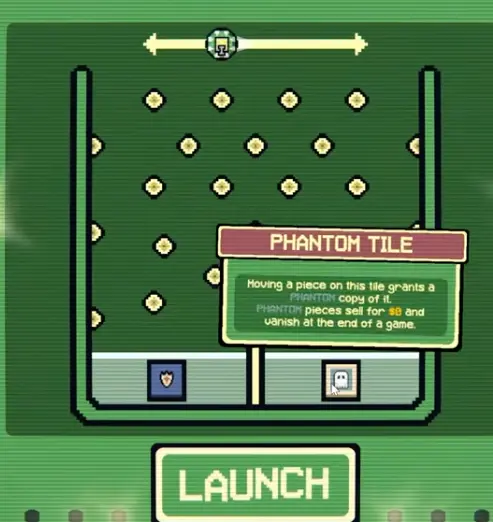
Important beginner tiles include:
| Tile | What it does | Beginner use |
|---|---|---|
| Phantom Tile | Creates a temporary phantom copy when a piece moves onto it. | Safe sacrifices, emergency blockers, queen-copy plays. |
| Blessed Tile | A captured blessed piece can return to stock. | Risky queen or rook captures. |
| Protective Tile | Protects a piece for one turn. | Safer queen placement and boss boards. |
| Trap Tile | Traps an enemy piece. | Stops dangerous queens, rooks, bishops, or knights. |
| Gold Tile | Creates money value from pieces. | Economy and long-term scaling. |
| Crumbling Tile | Can collapse or remove board space. | Dangerous, but sometimes removes enemy routes. |
For beginners, Blessed and Protective effects are usually easier to use than complicated copy engines. Phantom is strong too, but remember that phantom copies are temporary unless another effect changes the interaction.
A simple tile plan is:
- Put protective or blessed effects near common fight zones.
- Use them before sacrificing valuable pieces.
- Avoid placing important pieces on unstable or crumbling areas.
- Do not chase tile combos before you understand basic trades.
Blessed + Promotion Interaction
There is a player-reported interaction where a promoted pawn can become much more valuable if it is blessed before being captured.
Blessed + Promotion Interaction
Treat this interaction as patch-sensitive and possibly unintended.
Some players have reported that when a promoted pawn becomes blessed and is then captured, it may return to stock as its promoted form instead of reverting to a pawn. In practice, this can make a promoted queen behave like a permanent queen reward, which is why players sometimes discuss “free queen” or queen-farming setups around Blessed tiles.
However, this should not be written as a stable beginner strategy. A developer reply on Steam described this behavior as a bug that would be fixed, so use this note mainly to understand why older screenshots, videos, or community posts may show promoted pawns turning into permanent high-value pieces.
For normal beginner play, the reliable lesson is simpler:
Blessed tiles are best used on pieces you cannot afford to lose, especially queens, rooks, or promoted pieces.
This can effectively turn pawns into permanent queens and is one reason players discuss queen-farming or infinite-queen-style strategies.
Treat this as patch-sensitive. It has been reported as unintended behavior, so do not build a beginner strategy that depends on it always working. For normal play, the safe lesson is still useful:
Blessed tiles are strongest when used on pieces you cannot afford to lose.
Crumble vs Stalemate Counter
Crumble and Stalemate Counter are not the same thing.
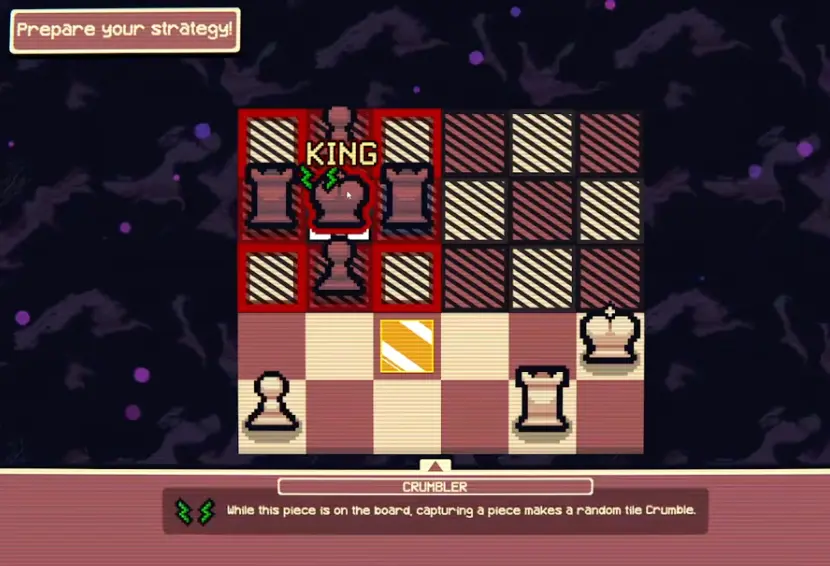
Crumble is a board-collapse mechanic. If turns pass without captures, crumble pressure can rise. At its peak, parts of the board can collapse. This can remove enemy pieces, but it can also destroy your own pieces or cut off your routes.
Stalemate Counter is an anti-stall mechanic. If the game reaches repeated no-progress states, the counter can rise. If it reaches its limit, the run can end.
Use three rules:
- Do not wait without a purpose. Waiting can trigger crumble, enemy movement, or Stalemate Counter pressure.
- Keep one active capture route open. Queens, rooks, bishops, knights, and stock pieces can all break dead positions.
- Protect key pieces before crumble starts. A queen on a collapsing tile is not safe just because no enemy attacks it.
Crumble can save you when it destroys enemy pieces, but beginners should treat it as danger first and opportunity second.
Boss Basics
Bosses change the normal rules of a board. Some bosses restrict stock. Some hide formations. Some scramble information. Some punish captures or force you to deal with special enemy modifiers.
Because a run is organized around stages, you should expect boss-style pressure around the fifth game of a stage. That means the fourth game is often your last chance to stabilize before a major check.
Before a boss, try to have:
- at least one flexible long-range piece
- enough stock to recover from a bad trade
- enough money to rebuild afterward
- a safe pawn promotion plan
- one way to protect or recover a valuable piece
- no strategy that depends on only one exact starting square
An early example is Hikarul the Banished, where stock usage can be restricted during the game. If you rely entirely on deploying reserve pieces mid-fight, that kind of boss can punish you immediately.
Another example is a hidden-formation boss such as Judith Polgeisha, where you cannot fully plan around the enemy setup before the board begins. For that kind of fight, flexible attackers are better than fragile one-line plans.
Boss boards are not just harder because they have stronger pieces. They are harder because they attack your assumptions.
Beginner Mistakes
| Mistake | Why it hurts | Better habit |
|---|---|---|
| Playing for checkmate | Checkmate is not the goal. | Clear every enemy piece. |
| Ignoring run length | You may spend too much before a boss. | Plan around roughly 25 boards and fifth-game boss pressure. |
| Sacrificing too many permanent pieces | You still need to survive future boards. | Trade only when your run can recover. |
| Ignoring Elite pieces | You may not be allowed to capture them early. | Clear other enemies first. |
| Ignoring Crumbler pieces | Safe-looking captures can trigger board collapse. | Move key pieces before risky capture chains. |
| Buying random Gambits | A Gambit is only useful if your run can trigger it. | Buy around your pieces and tiles. |
| Spending all money | You may need money to recover later. | Preserve interest and boss recovery money. |
| Using mini-games as emergency recovery | Mini-games can be high variance. | Use them when you can afford uncertain outcomes. |
| Throwing away queens | Queens are your easiest board-control pieces. | Use Blessed, Protective, or Phantom setups. |
| Letting enemy pawns promote | A small pawn can become a major threat. | Block or capture promotion threats early. |
| Forgetting stock limits | Some bosses restrict reserve-piece play. | Prepare your active board before bosses. |
FAQ
Is Gambonanza just chess?
No. Gambonanza uses chess movement, but the goal and structure are different. You are clearing roguelike boards with shops, Gambits, tiles, stock pieces, mini-games, bosses, money, and long-term survival.
How long is one Gambonanza run?
A full clear goes through the around game 25, so you should think of a complete run as roughly 25 boards. This matters because you need enough pieces, money, and stock to survive more than one fight.
How often do bosses appear?
Boss-style pressure appears around the fifth game of a stage. Before that point, avoid spending all your money unless the purchase directly improves your boss plan.
Why can’t I capture some enemy pieces?
The enemy piece may be an Elite piece. Elite pieces usually need to be captured last, so clear the rest of the board before trying to take them.
What are Crumbler pieces?
Crumbler pieces are dangerous enemies that can trigger board crumble when other pieces are captured. Before starting a capture chain, check whether a Crumbler modifier can collapse tiles under your important pieces.
What happens in mini-games?
Mini-games can give you run-changing upgrades. Pachinko, slot machine, and Gachapon-style games are useful when you have spare money or tokens, but they can be too uncertain if you need one guaranteed piece before a boss.
Which mini-game should beginners prioritize?
Use the mini-game whose possible rewards help your current run. If your run is unstable, skip gambling-style rewards and buy a guaranteed piece, board upgrade, or defensive tile first.
What is the best beginner tile?
Blessed and Protective tiles are the safest beginner choices because they help protect valuable pieces. Phantom tiles are also strong, but their copies are usually temporary unless another effect changes that interaction.
Why do some players talk about Blessed tiles creating permanent queens?
Some players have reported a patch-sensitive interaction where a blessed promoted pawn returns to stock as its promoted form after capture. This has been described by a developer as a bug, so treat it as community-reported behavior rather than a stable beginner strategy.
What is the starting board size?
Early Gambonanza boards are very small, often beginning around a compact 5×5 setup with only a few pieces. This is why board upgrades, safe squares, and piece placement matter so much.
Can I play Gambonanza on mobile?
This guide focuses on the PC/Steam version. If a mobile version or port becomes available later, some UI details or balance may differ.
Continue Reading in the Gambonanza Guide Cluster
This article is part of our Gambonanza strategy cluster. Use these guides to keep learning the game's core systems and routes.
A first-clear Gambonanza strategy covering early pawns, queen promotion, shop choices, mini-games, Elite pieces, Crumblers, bosses, and common mistakes.
Build GuideGambonanza Pawn and Queen Build GuideLearn how to build around pawns, promotion, queen carry, multiple queens, Blessed and Protective tiles, Phantom copies, and queen farming in Gambonanza.
Tiles GuideGambonanza Tiles GuideLearn how Phantom, Ghost, Blessed, Protective, Trap, Gold, Cursed, and Crumbling tiles work in Gambonanza, plus Chemist tile-copy tips.
Gambits GuideGambonanza Early Gambits Tier ListA practical early Gambits tier list for Gambonanza, covering Thunder, Falling Crown, Chemist, Valkyrie, Banana Peel, Silver Fork, Demon, Jump, Beth, and key combos.
Boss GuideGambonanza Boss Guide and ModifiersLearn Gambonanza boss timing, key boss modifiers, cursed tiles, Elite pieces, Crumblers, and what to buy before boss fights.