Gambonanza Guide
Gambonanza Early Gambits Tier List
A practical early Gambits tier list for Gambonanza, covering Thunder, Falling Crown, Chemist, Valkyrie, Banana Peel, Silver Fork, Demon, Jump, Beth, and key combos.
Gambits are the main reason Gambonanza stops feeling like normal chess.
A good early Gambit can make pawns safer, skip enemy turns, copy tiles, create money, protect valuable pieces, or turn simple movement into a build engine. A bad early Gambit is not always weak, but it may be too specific for your current pieces, tiles, or economy.
This guide gives you a practical early Gambits tier list for first clears and early strategy. It is not a full all-Gambits database. It focuses on Gambits you are likely to care about early, plus a few key combo pieces worth recognizing when they appear.
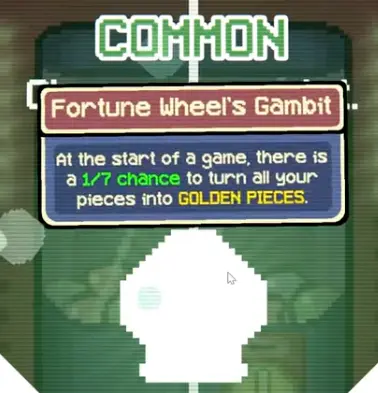
Early Gambits Tier List
| Tier | Gambit | Core effect | Best fit | Skip when… |
|---|---|---|---|---|
| S | Thunder’s Gambit | Pawn captures skip the enemy turn. | Pawn chains, promotion routes, first clears. | You have no pawns or pawn plan. |
| S | Chemist’s Gambit | Copies the first triggered tile onto a random tile. | Blessed, Protective, Gold, Trap, Phantom tile builds. | Your tiles are badly placed or weak. |
| S | Falling Crown’s Gambit | Waiting promotes one of your pawns. | Pawn-to-queen builds. | Waiting is unsafe or crumble pressure is high. |
| S | Valkyrie’s Gambit | Landing a queen turns one pawn into another random piece. | Queen carry, pawn economy, multi-piece scaling. | You have no pawns or no safe queen landing. |
| A | Berserker’s Gambit | First-turn capture grants money. | Safe openers and early economy. | Your first capture is risky or forced. |
| A | Beth’s Gambit | Queen last-hit grants money. | Queen builds and cleanup economy. | You do not have queens or reliable promotion. |
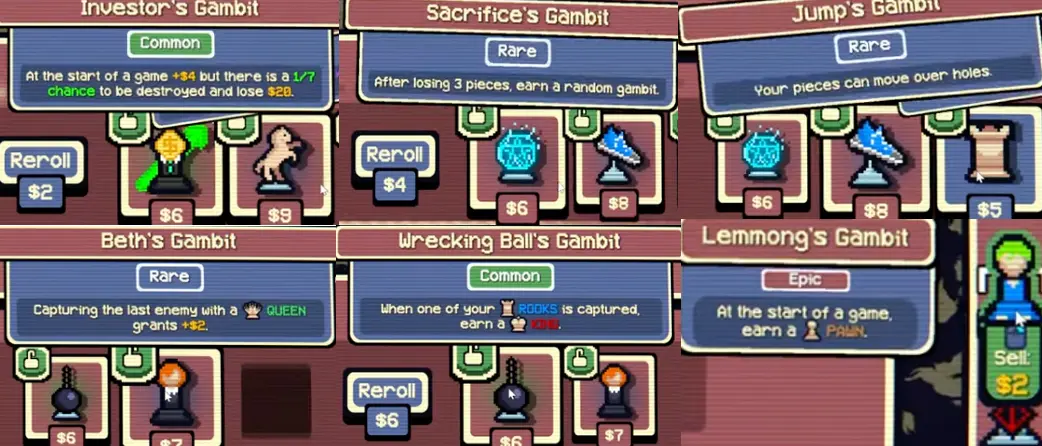
| A | Jump’s Gambit | Pieces can move over holes. | Crumble-heavy boards and late-run mobility. | You still lack basic pieces or board control. |
| A | Banana Peel + Silver Fork + Demon | Skip-turn stacking package. | Tempo builds that deny enemy moves. | You need guaranteed survival, not chance-based value. |
| B | Throne’s Gambit | Promotion grants a king. | Promotion builds that want support pieces. | You expected it to replace queen promotion. |
| B | Wrecking Ball’s Gambit | Losing a rook grants a king. | Rook sacrifice or support-piece setups. | Your rook is your only strong attacker. |
| B | Resurrection Stone’s Gambit | Phantom tiles may grant default pieces instead. | Phantom/Ghost tile builds. | You do not have Phantom tile access. |
Use this tier list as a first-clear priority guide, not as a universal ranking. A B-tier Gambit can be excellent in the right build, while an S-tier Gambit can be useless if your board cannot trigger it.
How to Choose Early Gambits
The most important beginner rule is:
Buy the Gambit your current run can trigger, not the one that sounds strongest in theory.
Use this quick checklist before buying:
| Question | Why it matters |
|---|---|
| Can I trigger this often? | A rare effect may do nothing for several boards. |
| Does it protect or replace value? | Survival matters more than flashy scaling. |
| Does it help pawns promote? | Pawn-to-queen is one of the safest first-clear plans. |
| Does it give money without bad trades? | Economy helps you recover after hard boards. |
| Does it match my tiles? | Tile-copy and tile-trigger effects can become engines. |
| Does it solve holes, crumble, or boss pressure? | Some Gambits become stronger later in a run. |
Shop appearance rates are not clearly exposed in-game, so do not plan around seeing one exact Gambit. Use rarity, cost, current board state, and trigger reliability as your practical decision tools.
Quick Effects and Cost Reference
| Gambit | Rarity | Cost | Trigger / probability |
|---|---|---|---|
| Thunder’s Gambit | Legendary | $9 | Capturing with a pawn skips the enemy turn. |
| Falling Crown’s Gambit | Epic | $10 | Waiting promotes one of your pawns. |
| Chemist’s Gambit | Common | $6 | Copies the first triggered tile in a game onto a random tile. |
| Valkyrie’s Gambit | Common | $7 | Landing a queen turns one of your pawns into another random piece. |
| Berserker’s Gambit | Common | $6 | Capturing a piece on your first turn grants money. |
| Beth’s Gambit | Rare | $7 | Capturing the last enemy with a queen grants money. |
| Jump’s Gambit | Rare | $8 | Your pieces can move over holes. |
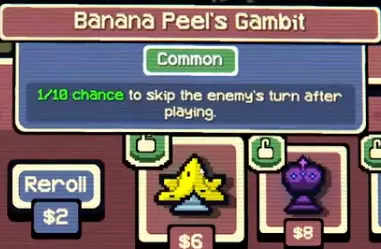
| Banana Peel’s Gambit | Common | $6 | 1/10 chance to skip the enemy turn after playing. |
| Silver Fork’s Gambit | Rare | $7 | After moving a knight, 1/2 chance to skip the enemy turn if it can capture 2+ pieces. |
| Demon’s Gambit | Rare | $8 | When one of your pieces is captured on a black tile, skip the enemy turn. |
| Throne’s Gambit | Common | $6 | On promotion, earn a king. |
| Wrecking Ball’s Gambit | Common | $6 | When one of your rooks is captured, earn a king. |
| Resurrection Stone’s Gambit | Rare | $6 | Phantom tiles have a 1/4 chance to grant a default piece instead of a phantom one. |
The table above is meant for quick shop decisions. If a future patch changes a tooltip, trust the current in-game wording first.
Known Unlock Notes
Most early Gambits are best treated as shop or token finds unless the game shows a specific unlock requirement. The currently useful unlock notes to remember are:
| Gambit | Known unlock note |
|---|---|
| Beth’s Gambit | Unlocked by capturing the last enemy with a queen multiple times. |
| Resurrection Stone’s Gambit | Connected to triggering Phantom tiles. |
Do not over-plan around unlocks during your first clear. Build around what the shop actually gives you.
Best Early Pairings
This is the part to skim when you are in the shop.
| Pairing | Why it works |
|---|---|
| Thunder + Falling Crown | Pawns get tempo from captures and scaling from waiting. |
| Thunder + Berserker | A safe first-turn pawn capture can generate both tempo and money. |
| Chemist + Blessed | More recovery squares for queens, rooks, and promoted pieces. |
| Chemist + Protective | More safe entry squares for dangerous captures. |
| Chemist + Gold | More economy routes if the board is stable. |
| Valkyrie + spare pawns | Queen landing converts unused pawns into stronger random pieces. |
| Beth + queen promotion | Queen finishers become money. |
| Jump + crumble-heavy boards | Holes become less likely to trap your key pieces. |
| Banana Peel + Silver Fork + Demon | Skip-turn stacking increases the chance enemies lose turns. |
| Throne + promotion build | Promotion gives support kings while you still manually choose queens. |
| Resurrection Stone + Phantom tiles | Phantom tile triggers can sometimes become permanent value. |
A good pairing should make the run easier to play immediately. If a combo requires three more pieces, two more tiles, and a perfect shop, it is not an early-game priority.
S-Tier Gambits
Thunder’s Gambit
Effect: Capturing with a pawn skips the enemy turn.
Thunder is one of the best beginner Gambits because it turns cheap pawns into tempo pieces. Pawn captures become safer, promotion routes become easier to protect, and some early boards can be cleared before the enemy gets a meaningful response.
Best use:
- pawn chains
- early captures
- promotion routes
- first-clear runs
- boards where enemy responses are dangerous
The main mistake is forcing bad pawn captures. Thunder makes good pawn captures better; it does not make every pawn trade safe.
Chemist’s Gambit
Effect: Copies the first triggered tile in a game onto a random tile.

Chemist is one of the strongest early scaling Gambits because it turns one good tile into a board plan.
Best first triggers:
| Tile | Why copying it is strong |
|---|---|
| Blessed | More recovery squares for valuable pieces. |
| Protective | More safe entry squares. |
| Gold | More economy routes. |
| Trap | More ways to stop dangerous enemies. |
| Phantom | More copy points for temporary attackers or blockers. |
The key rule is simple:
After buying Chemist, make your first tile trigger the tile you most want duplicated.
If you accidentally trigger a weak or badly placed tile first, Chemist can waste its value for that board.
For deeper tile examples, read the Gambonanza Tiles Guide.
Falling Crown’s Gambit
Effect: Waiting promotes one of your pawns.
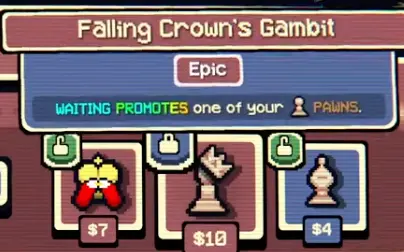
Falling Crown is powerful because it turns a safe wait into queen-building value. If no important piece is threatened, a wait can become a promotion tool instead of a wasted turn.
It is strongest when:
- you have pawns left
- the enemy cannot punish the wait
- you are building toward queens
- the board is not about to collapse
- Stalemate Counter pressure is not rising
Do not wait just because the Gambit exists. Wait only when the board can afford it.
Valkyrie’s Gambit
Effect: Landing a queen turns one of your pawns into another random piece.
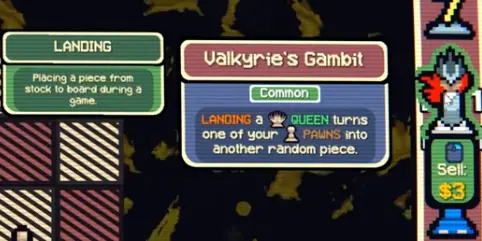
Valkyrie’s Gambit is an excellent bridge between pawn economy and queen carry. Instead of needing every pawn to reach promotion, queen landing can convert spare pawns into stronger random pieces.
It is strongest when:
- you have spare pawns
- you can land a queen safely
- you have board space for the new piece
- your run already wants to use queens often
- most random outcomes would still help
Be careful with the word landing. Moving, landing, placing from stock, and promoting may not always mean the same thing. If Valkyrie does not trigger, check whether your queen action matched the tooltip.
A-Tier Gambits
Berserker’s Gambit
Effect: Capturing a piece on your first turn grants money.
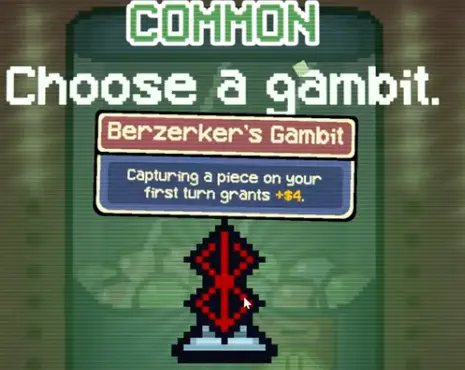
Berserker is strong because early money is flexible. It can become a pawn, a board upgrade, a tile token, a replacement piece, or a recovery plan after a boss.
The best Berserker turns are captures you already wanted to make. Do not let the money bait you into a first-turn sacrifice that loses your best piece.
Beth’s Gambit
Effect: Capturing the last enemy with a queen grants money.
Beth is a natural queen-build economy Gambit. If your run already promotes pawns into queens, Beth pays you for clean queen finishers.
It is strongest when:
- you already have a queen
- you have a reliable promotion route
- your queen can safely take the last enemy
- Elite pieces do not block the finisher plan
Beth is not a reason to force unsafe queen captures. It is a reward for a plan that already works.
Jump’s Gambit
Effect: Your pieces can move over holes.
Jump is not always urgent on the first few boards, but it becomes very valuable once crumble starts creating holes. It helps queens, rooks, bishops, and support pieces keep reaching targets when the board breaks apart.
Take Jump when holes are already costing you routes. Skip it when your real problem is that you do not have enough pieces.
Skip-Turn Package: Banana Peel + Silver Fork + Demon
This is the cleanest skip-turn package to recognize early.
The App Store editorial recommendation points to Banana Peel, Silver Fork, and Demon as a combination that increases the odds of skipping enemy turns. The logic is simple: enemies cannot win if they keep losing opportunities to move.
| Gambit | Trigger | Reliability |
|---|---|---|
| Banana Peel’s Gambit | 1/10 chance to skip the enemy turn after playing. | Low, but broad. |
| Silver Fork’s Gambit | After moving a knight, 1/2 chance to skip if it can capture 2+ pieces. | Strong if you use knights well. |
| Demon’s Gambit | When one of your pieces is captured on a black tile, skip the enemy turn. | Strong when sacrifices are planned. |
This package works best when your board already has tempo pressure. Add Thunder’s Gambit if you also have pawns, because Thunder gives a direct pawn-capture skip instead of a chance-based trigger.
Do not rely on chance-based skips as your only defense. They are best as a bonus layer on top of good positioning.
B-Tier Gambits: Situational Picks
Throne’s Gambit
Effect: On promotion, earn a king.
Throne is useful in promotion builds, but it should not change your normal beginner promotion choice. In most Pawn / Queen builds, you still manually promote into queens. The king is a support reward.
For more promotion planning, read the Gambonanza Pawn and Queen Build Guide.
Wrecking Ball’s Gambit
Effect: When one of your rooks is captured, earn a king.
Wrecking Ball is a synergy pick. It can help if rooks are already part of your sacrifice or support plan. It is weak if your rook is your only long-range attacker and losing it breaks the board.
Resurrection Stone’s Gambit
Effect: Phantom tiles have a 1/4 chance to grant a default piece instead of a phantom one.
This is a strong Phantom/Ghost tile upgrade, but it belongs in runs that already have Phantom tile access. Do not take it early if you have no way to trigger Phantom tiles.
Because Phantom, Blessed, and promoted-piece interactions can be patch-sensitive, trust the current tooltip in your run before building everything around a copy interaction.
Common Gambit Mistakes
| Mistake | Why it hurts | Fix |
|---|---|---|
| Treating the tier list as absolute | Some Gambits are build-specific. | Buy for your current board, not just the tier. |
| Buying every rare Gambit | Rarity does not guarantee usefulness. | Check trigger reliability first. |
| Ignoring probability | A 1/10 chance is not a stable defense. | Use chance effects as bonus value. |
| Forcing combos too early | You may lack the pieces, tiles, or money to support them. | Build stability before engines. |
| Triggering the wrong tile with Chemist | You may duplicate a weak tile. | Trigger your best tile first. |
| Waiting for Falling Crown when unsafe | Enemy movement, crumble, or Stalemate Counter can punish you. | Wait only when the board is stable. |
| Buying Valkyrie with no pawns | The queen landing effect has nothing useful to convert. | Take it when you have spare pawns. |
| Taking Jump too early with no pieces | Mobility does not help if you cannot fight. | Buy pieces and board stability first. |
| Using Demon as random sacrifice value | Skip-turn value does not matter if the trade ruins the run. | Sacrifice only with a clear follow-up. |
FAQ
Is this a full Gambits tier list?
No. This is an early-game and first-clear tier list. Gambonanza has far more Gambits than this page covers, and many become stronger only after you unlock specific tiles, bosses, pieces, or late-run synergies.
How many Gambits can I hold?
In tutorial footage, the game explains that you can hold up to five Gambits at a time. Because slots are limited, replacing a low-impact Gambit with one that fits your current run can be better than keeping every early pickup.
Can Gambits be removed or replaced?
Yes, Gambits can be sold or swapped as part of run management. Do this when a Gambit no longer matches your board, or when a new Gambit gives better value for your current pieces and tiles.
Are shop appearance rates known?
Not clearly. Rarity and cost are visible, but exact shop appearance rates are not something beginners should plan around. Build around what appears, not around one exact Gambit you hope to see later.
Should I prioritize Gambits or tiles first?
Buy the one your current run can use immediately. If you already have Chemist, tile quality becomes much more important. If you have no stable pieces, buy pieces or board space before chasing a Gambit engine.
What triggers first: a Gambit or a tile?
Read the exact wording. Some effects care about moving, landing, placing from stock, capturing, waiting, or triggering a tile. If the interaction is unclear, test it with a low-value piece before risking your queen.
Are probability Gambits reliable?
Only if the probability is high enough or you have several overlapping chances. Banana Peel’s 1/10 chance is useful as bonus tempo, but it should not be your only plan for surviving a dangerous board.
What is the best beginner Gambit?
Thunder’s Gambit is one of the safest beginner picks because pawn captures skipping enemy turns supports the basic first-clear plan. Chemist, Falling Crown, and Valkyrie’s Gambit can be stronger if your run already supports their triggers.
Continue Reading in the Gambonanza Guide Cluster
This article is part of our Gambonanza strategy cluster. Use these guides to keep learning the game's core systems and routes.
Learn how to play Gambonanza with beginner tips for win conditions, stock, promotion, shops, mini-games, tiles, bosses, crumble, and special pieces.
First Win GuideHow to Win Your First Gambonanza RunA first-clear Gambonanza strategy covering early pawns, queen promotion, shop choices, mini-games, Elite pieces, Crumblers, bosses, and common mistakes.
Build GuideGambonanza Pawn and Queen Build GuideLearn how to build around pawns, promotion, queen carry, multiple queens, Blessed and Protective tiles, Phantom copies, and queen farming in Gambonanza.
Tiles GuideGambonanza Tiles GuideLearn how Phantom, Ghost, Blessed, Protective, Trap, Gold, Cursed, and Crumbling tiles work in Gambonanza, plus Chemist tile-copy tips.
Boss GuideGambonanza Boss Guide and ModifiersLearn Gambonanza boss timing, key boss modifiers, cursed tiles, Elite pieces, Crumblers, and what to buy before boss fights.