Slay The Spire 2 Guide
When to Skip Cards in Slay the Spire 2: Avoid Deck Bloat
Learn exactly when to skip card rewards in Slay the Spire 2. Master deck building, the rare counter, Enchantments, and act-by-act drafting to avoid dead draws.
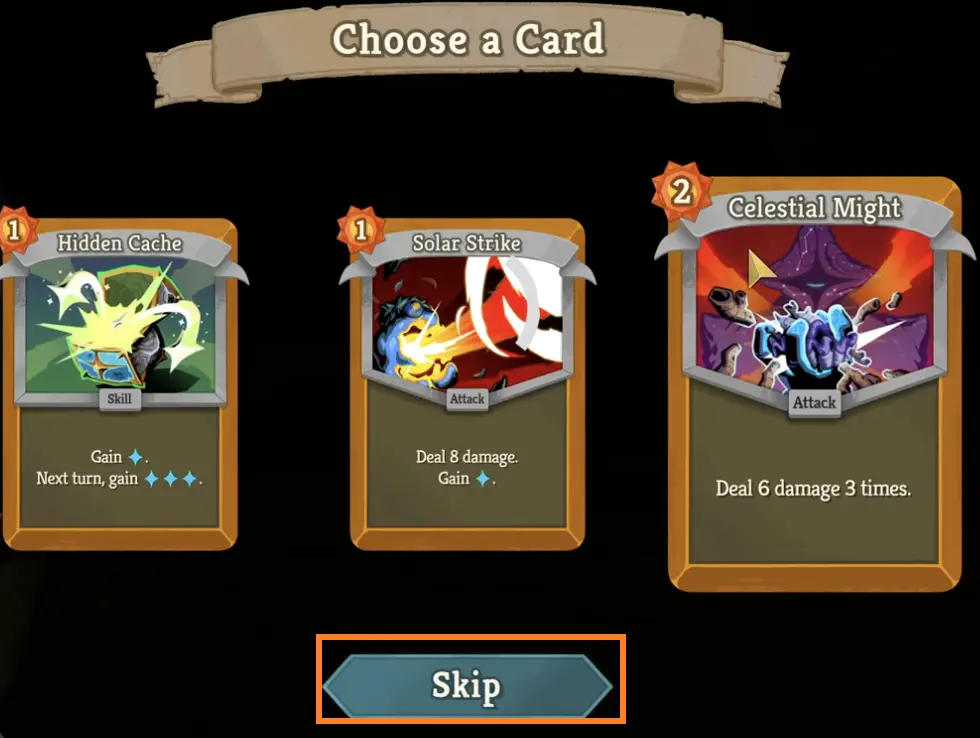
Skipping cards is not a backup option in Slay the Spire 2. It is one of the main ways you control your deck.
The reward screen is tempting because every card looks like progress. But every card you add also makes your best cards slightly harder to find. A card can be strong in general and still be wrong for your current deck, current act, current relics, and next elite.
Slay the Spire 2 also makes skipping more interesting than it first looks. Skipped rewards still interact with the game’s rare-card reward counter, Enchantments can change the value of a card, and Token cards such as Shiv or Soul affect combat without entering your permanent deck.
This guide explains when to skip, when to take the card, how skip logic changes by act, and how to repair a messy “soup deck” before it ruins the run.
For broader fundamentals, start with the Slay the Spire 2 Beginner Guide.
Fast Answer
| Question | Best short answer |
|---|---|
| Should you skip cards? | Yes. Skipping keeps your best cards easier to draw. |
| When should you skip? | Skip when none of the cards solve your next problem or improve your real win condition. |
| Is skipping a wasted reward? | No. Skipping protects deck quality, and current Early Access references indicate skipped rewards still affect rare-card reward progression. |
| What changes in STS2? | Rare counter, Enchantments, Colorless cards, Token cards, Quest Cards, and character resources make reward evaluation less automatic. |
| What is deck bloat? | Too many low-impact cards, dead synergy pieces, or duplicated roles. |
| What should beginners avoid? | Taking speculative cards before the deck can survive the next three fights. |
The Main Rule: Solve the Next Problem
Before taking a card, ask:
Will this card make my next three fights easier?
If the answer is no, skipping is often correct.
That does not mean tiny decks are always best. In early Act 1, starter decks are weak, so you usually need cards. But after the deck has damage, block, and a direction, every new card needs to justify the slot it takes.
A card reward should do at least one of these:
| Good reason to take a card | What it usually means |
|---|---|
| Solves the next elite or boss | frontloaded damage, AoE, Weak, Vulnerable, scaling |
| Improves consistency | draw, discard, exhaust, card selection |
| Supports your actual relics | not theoretical relics you hope to find later |
| Enables your current engine | poison, shivs, stars, doom, or summons you already use |
| Fixes a clear weakness | block, damage, scaling, energy use, or card flow |
If it does none of these, skip.
Why Skipping Is Stronger in Slay the Spire 2
In the first Slay the Spire, skip logic was already important: fewer weak cards means better average draws.
In Slay the Spire 2, three extra mechanics make skipping even more strategic.
1. Rare Counter: Skipping Is Not Wasted
Current public Early Access references document a rare-card pity system for Slay the Spire 2: combat card rewards use a hidden rare-card counter, and reward rolls that do not show a rare card increase the chance of seeing one later.
The important skip lesson is simple:
Skipping a bad reward is not the same as losing all value from that reward screen.
The reward was still generated, your deck stayed cleaner, and the rare counter logic has already done its work in the background. In other words, skipping three bad cards can be an active deck-quality decision, not just “missing value.”
Because Slay the Spire 2 is still in Early Access, exact numbers may change between patches. Treat the principle as stable unless patch notes say the reward system changed.
2. Enchantments Change the Card, Not the Role
Enchantments are run-long card modifiers. An Enchanted card should be evaluated as a whole package: base card plus modifier.
But the Enchantment does not automatically make the card good.
Ask three questions:
- Would I take the base card without the Enchantment?
- Does the Enchantment solve a real problem?
- Does this card still fit my deck’s role balance?
A mediocre attack with a useful Enchantment may be worth taking early. A dead combo piece with a flashy Enchantment can still be a dead combo piece.
Do not let the modifier distract you from the role.
3.Colorless and Token Cards: Do Not Evaluate Them the Same Way
Slay the Spire 2 has more ways to create cards during combat, which makes skip decisions less obvious than in Slay the Spire 1.
Colorless cards can be real draftable cards, temporary combat tools, or cards generated by other effects. Do not take a Colorless card only because it looks unusual. Ask the same question as always: does it solve your next fights, improve consistency, or support your current relics?
Token cards are different. Token cards such as Shiv and Soul are generated by other cards, relics, or combat effects. They do not enter your permanent deck as normal card reward picks.
This means you should evaluate the card that creates the Token, not the Token as if it were a normal draftable reward card.
For example:
- A Shiv payoff is bad if your deck does not reliably create Shivs.
- A Soul payoff is bad if your deck does not reliably create or use Souls.
- A card that creates temporary cards may be strong even if it does not increase permanent deck size.
The skip question is not “is the Token good?”
The real question is:
Is the permanent card that creates or uses this Token worth one slot in my deck?
Act-by-Act Skip Strategy
Skip standards change as the run progresses.
| Act | Default card-reward attitude | Usually take | Usually skip |
|---|---|---|---|
| Act 1 | Add cards to escape the starter deck | damage, AoE, Weak, Vulnerable, efficient block | slow scaling, unsupported combos, extra copies of solved roles |
| Act 2 | Start filtering hard | cards that fit your established engine or answer dangerous fights | average attacks, redundant block, speculative payoffs |
| Act 3 | Be extremely selective | boss answers, consistency, scaling, energy/card-flow fixes | almost anything that does not improve the final plan |
By the end of Act 1, your deck should usually have an identity. It does not need to be perfect, but it should know how it plans to win: burst, poison, shivs, stars, doom, or another engine.
Once that identity exists, the skip button becomes stronger. Adding a “pretty good” card that does not support the plan is often worse than drawing your real cards faster.
When You Should Usually Skip
Skip When the Card Does Not Improve a Needed Role
Most skip decisions come down to role balance.
Common deck problems include:
- not enough damage
- not enough block
- no scaling
- no draw or card flow
- no answer to multi-enemy fights
- too many starter cards
- too many cards that need setup
If a card does not improve one of your real problems, it is probably filler.
This also applies when a role is already solved. Early attacks are important, but the fifth average attack after Act 1 may only delay your block, draw, and scaling. Extra block can also be wrong if your deck survives longer but never kills anything.
A good card becomes a bad pick when it adds volume without solving a new problem.
Skip When the Card Creates Upgrade Debt
Some cards are only strong after an upgrade.
That is not automatically bad. But if your deck already has several cards that need campfire upgrades, another upgrade-hungry card can make the deck weaker for a long time.
Ask:
Is this card good now, or am I adding another future chore?
If it needs an upgrade and you already have better upgrade targets, skip.
Skip When the Card Needs Support You Do Not Have
Speculative picks are dangerous.
Bad speculative picks usually sound like this:
- “This will be great if I find poison.”
- “This will be great if I get more stars.”
- “This will be great if I find discard.”
- “This will be great if I get the perfect relic.”
Sometimes speculation is correct. But if your deck is still weak, the safer play is usually to take a card that helps now or skip.
Do not draft the deck you wish you had. Draft the deck you actually have.
When You Should Take the Card
Skipping is powerful, but beginners can overcorrect.
Take Early Damage in Act 1
Most starter decks need damage quickly.
In Act 1, a solid attack is often correct because it helps you:
- kill hallway enemies faster
- fight elites
- avoid repeated chip damage
- reach the boss with enough HP
Do not skip early damage just because you want a clean deck. A clean deck that cannot kill elites is not a good deck.
Take Block or Weak When You Cannot Stabilize
If normal fights keep taking large chunks of HP, you need mitigation.
Good defensive cards are worth taking when they let you:
- survive elites
- upgrade instead of rest
- play setup cards safely
- reduce potion dependence
Weak often counts as block because it reduces incoming damage before you spend energy on defense.
Take Draw When You Have Strong Cards
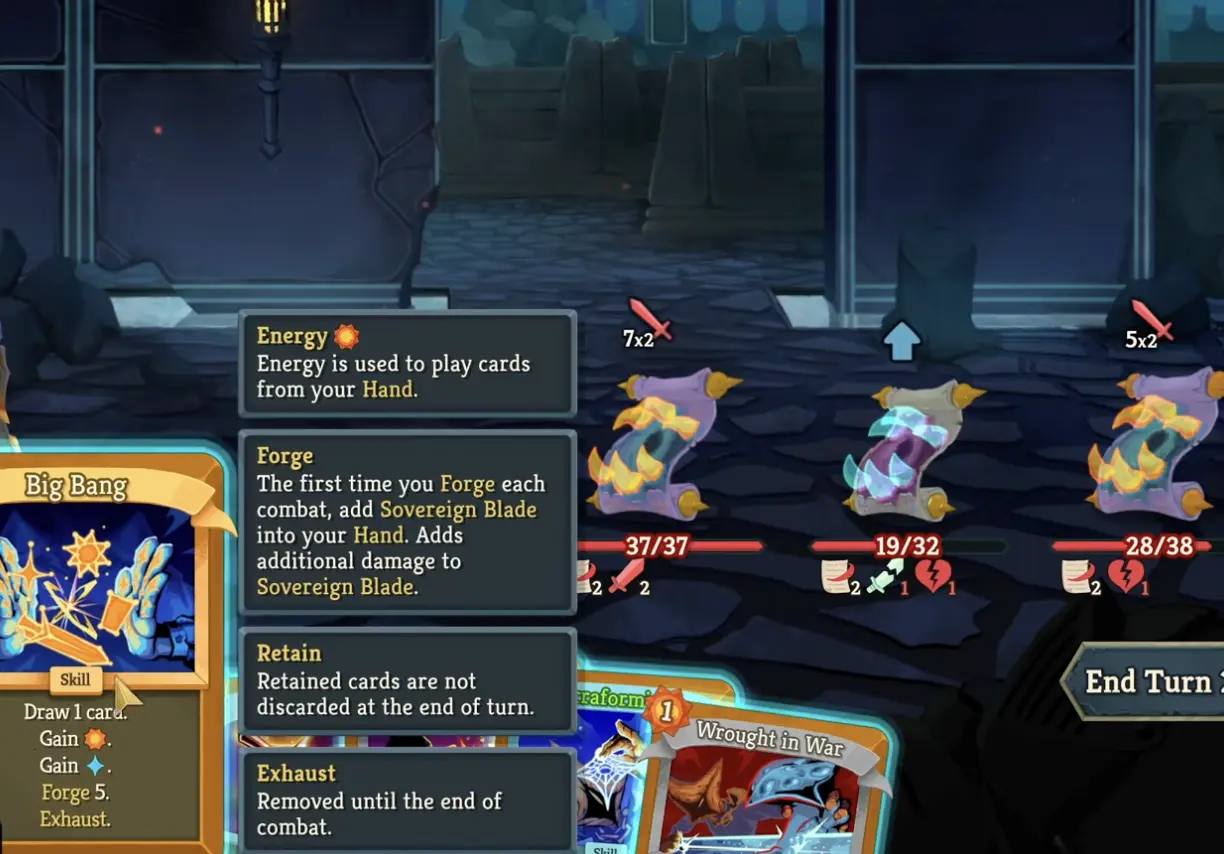
Draw gets better when your deck already has good cards.
Take draw or card flow when:
- you often have spare energy
- your upgraded cards are hard to find
- your deck relies on a key scaling card
- you still have many starter cards
- your engine wants to cycle quickly
If you have energy but no good cards to play, your problem is not energy. It is card flow.
Take Scaling Before Long Fights
Eventually, frontloaded damage is not enough.
Before bosses and long elites, your deck needs a way to grow stronger during the fight. Scaling can come from Strength, poison, stars, doom, powers, relic engines, repeated cycling, exhaust, discard, or summons.
The timing matters. Scaling is good when your deck can survive long enough to use it.
How to Repair a Soup Deck
A “soup deck” is a deck with no clear direction: a few attacks, a few block cards, one random payoff, one unsupported keyword, and no consistent way to win.
Do not panic. Repair it in this order.
1. Draft Only for the Next Three Fights
Stop asking what the deck could become.
Ask what kills you next:
- elite burst
- multi-enemy fight
- lack of block
- lack of damage
- boss scaling check
For the next few reward screens, only take cards that solve that immediate problem. Skip everything else, even if it looks interesting.
2. Stop Adding New Keywords
One poison card, one star card, and one summon card do not make a strategy. They make confusion.
Until the deck has a stable core, avoid adding a new resource or keyword unless the card is strong without support.
3. Remove the Worst Starter or Dead Card
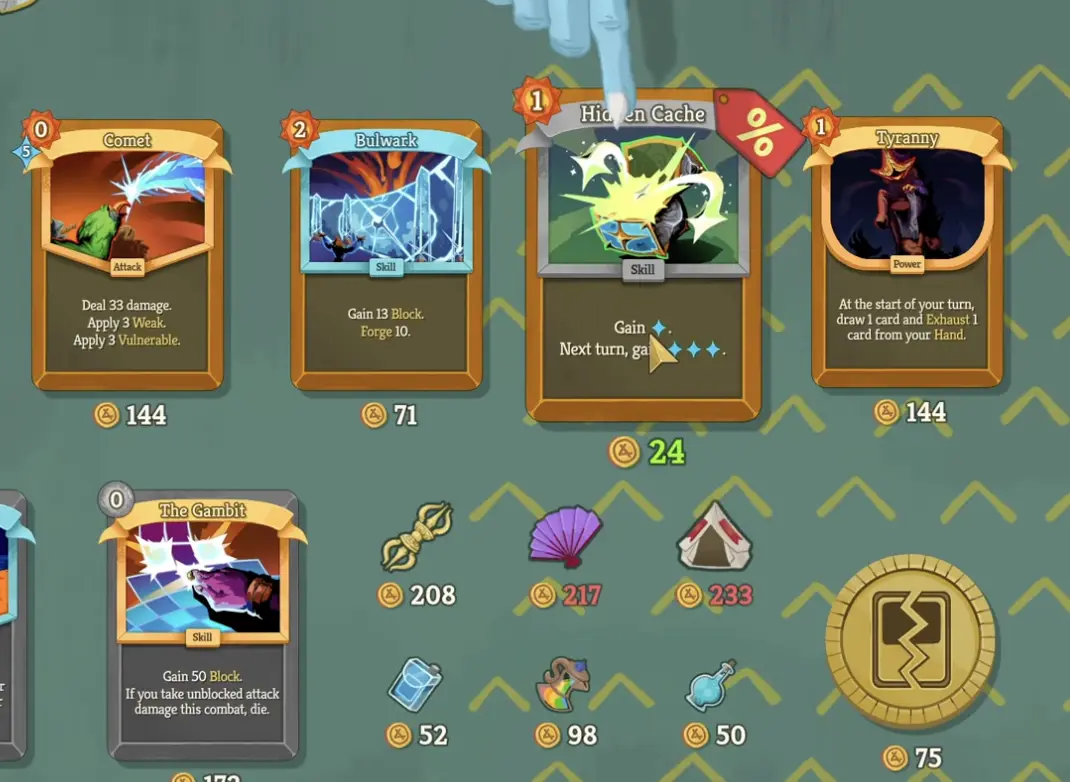
At the next shop, compare every purchase against removal.
Remove the card that most often makes you sigh when you draw it. Usually that is a basic Strike, but it can also be an unsupported payoff, a Curse, or an early card that no longer fits.
Skipping prevents new problems. Removal cleans up old ones.
4. Upgrade the Card That Gives Direction
A messy deck often becomes playable once one card becomes clearly better than the rest.
Upgrade the card that:
- improves damage immediately
- enables your main engine
- gives reliable block
- improves draw or card flow
- makes the next elite safer
Do not spread upgrades across random cards. Create a center of gravity for the deck.
Deck Size: Use Feel, Not a Fixed Number
There is no perfect deck size.
A 20-card deck can be excellent if most cards are high-impact. A 12-card deck can be terrible if it cannot block or scale.
Use these signs instead:
| Sign | Meaning |
|---|---|
| You keep drawing starter cards | You need removals or better card quality. |
| You have energy left every turn | You may need draw or higher-impact cards. |
| You cannot find block on danger turns | Your deck is inconsistent or too attack-heavy. |
| You cannot kill elites | You need damage, scaling, or better potion use. |
| You draw setup cards but die before using them | Your deck is too slow. |
| You skip many rewards and still win fights | Your deck is probably focused. |
Character-Specific Skip Traps
Different characters punish different bad picks. Keep this table short and practical.
| Character | Common skip trap | What to do instead |
|---|---|---|
| Ironclad | taking average attacks after damage is already solved | skip toward Vulnerable, scaling, draw, or boss answers |
| Silent | taking attacks that do not support poison, shivs, discard, or draw | prioritize card flow and cards that connect to the chosen plan |
| Defect | taking too many cards that only become good after upgrades | avoid upgrade debt unless campfires are available |
| Regent | taking star-cost payoffs without star generation | take star generation first, payoff second |
| Necrobinder | taking summon or Osty pieces without the support to use them | draft around the engine you actually have, not every synergy label |
Common Beginner Mistakes
| Mistake | Better habit |
|---|---|
| Taking a card because it is rare | Rare does not mean correct. |
| Taking every card with a matching keyword | One keyword card is not an archetype. |
| Taking too many “eventually good” cards | Future power does not matter if the next elite kills you. |
| Refusing to skip in Act 1 | Take early power, but skip bad rewards. |
| Ignoring Enchantments | Evaluate the base card and modifier together. |
| Misreading Token cards | Judge the generator/payoff, not the Token as deck bloat. |
| Building with no boss plan | By late Act 1 or early Act 2, know how the deck wins long fights. |
Simple Card Reward Checklist
Before clicking a card, ask:
- Does this solve my next elite or boss?
- Does this fix damage, block, draw, scaling, or card flow?
- Does this work with my current relics and Enchantments?
- Does this need an upgrade I cannot afford?
- Does this need support I do not have?
- Does this make my best cards harder to find?
- Would I rather remove a starter card?
If the card fails the first three questions and triggers any of the last four warnings, skip.
FAQ
Should I skip cards in Slay the Spire 2?
Yes. Skipping is one of the most important deck-building tools. It keeps your deck consistent and prevents weak cards from delaying your best cards.
Is skipping a card reward wasted?
No. Skipping protects your deck from filler. Current Early Access references also indicate skipped rewards still affect rare-card reward progression, though exact reward-system numbers may change during Early Access.
Is a small deck always better?
No. A small deck is only good if it can block, deal damage, and scale. A larger deck with high-impact cards can be much stronger than a tiny deck with no answers.
When should I stop taking attacks?
Usually after your Act 1 damage is solved. Once you can kill hallway enemies and fight elites, average attacks become less valuable unless they support scaling or a specific plan.
Should I take a card just because it fits my archetype?
Not always. If the card is low-impact, too expensive, or needs more support, it can still be wrong.
How do Enchantments change skip decisions?
Treat an Enchanted card as base card plus modifier. If the Enchantment solves a real problem, it can push a borderline card into your deck. If the base card is still dead, skip.
Are Token cards deck bloat?
Usually no. Token cards such as Shiv or Soul are generated during combat and do not behave like normal permanent deck additions. The card you evaluate is the generator or payoff.
What is the biggest beginner mistake with card rewards?
Taking cards because they look strong instead of asking whether they solve the deck’s current problem.
Continue Reading in the Slay The Spire 2 Guide Cluster
This article is part of our Slay The Spire 2 strategy cluster. Use these guides to keep learning the game's core systems and routes.
Learn why Slay the Spire 2 Act 1 ends so many runs. Master elite preparation, early card drafting, campfire decisions, and map routing to survive.
Deck BuildingRest, Smith, Remove? Slay the Spire 2 Campfire & Shop GuideLearn exactly when to rest, smith, remove cards, or spend gold in Slay the Spire 2. Master HP thresholds, upgrade priorities, and shop logic to win.
Co-op GuideSlay the Spire 2 Co-op Guide: Roles, Scaling & RoutingMaster Slay the Spire 2 co-op mode. Learn how multiplayer revives work, the best team roles, scaling allocation, co-op cards, and elite routing strategies.
Character GuideSlay the Spire 2 Ironclad Guide: Best Builds & StrategyMaster the Ironclad in Slay the Spire 2. Learn the best build paths including Strength, Exhaust, and Body Slam, plus Act-by-Act routing and relic priorities.