Space Haven Guide
Space Haven Food and Water Guide: Algae, Ice, Grow Beds
Fix Space Haven food and water problems with algae, ice, grow beds, balanced meals, fertilizer, nutrient deficiency, and early farming tips.
Food problems in Space Haven 1.0 usually happen in stages.
First, you need anything edible so the crew does not starve. Then you need water and ice so food production can continue. After that, you need balanced meals so your crew does not live on emergency algae forever.
The mistake is treating food as one system. It is really three systems working together:
- Emergency food — algae and whatever you can trade or salvage.
- Water supply — ice, purification, production rules, and storage.
- Real agriculture — grow beds, crop variety, fertilizer, and balanced meals.
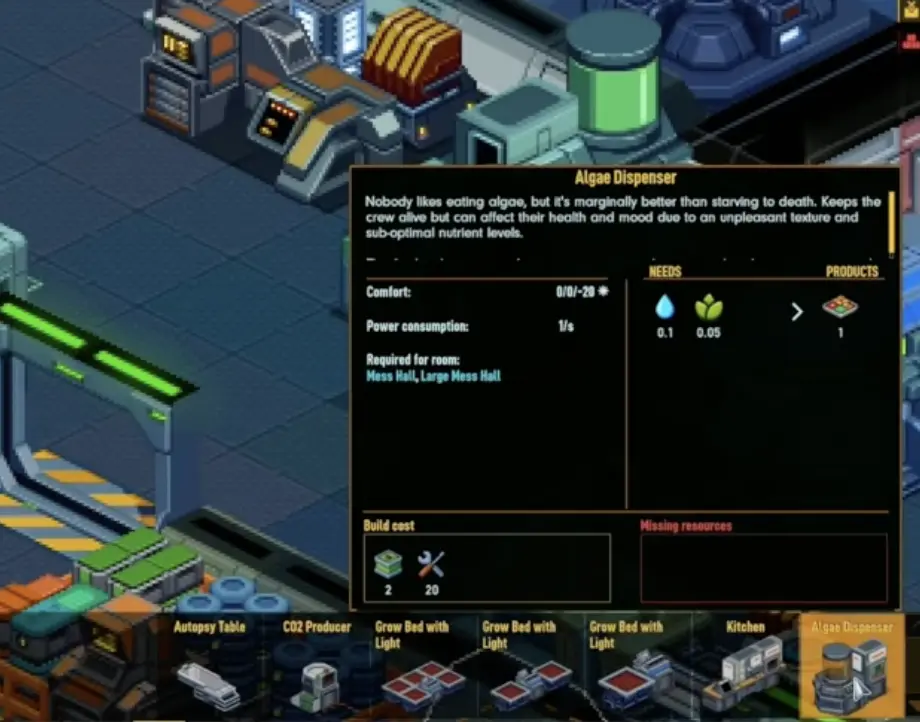
The Algae Dispenser is not glamorous, but it can save a run. Use it to survive the early game, then transition into proper meals before nutrient problems pile up.
Fast Answer
| Question | Best beginner answer |
|---|---|
| What should I do if food is running out? | Build or use an Algae Dispenser, secure water, and start a basic crop plan. |
| Is algae enough forever? | No. Algae is emergency food, not a complete long-term diet. |
| Why are my meals incomplete? | You are missing one or more nutrition categories for balanced meals. |
| What crops should I grow first? | Start with fast survival crops, then split into carbs, vitamins, fats, and protein sources. |
| How many grow beds do I need? | Use one large grow bed per 2 crew as a safe starting target, then expand toward roughly 5 active crop slots per crew if food keeps dropping. |
| Are large grow beds better than small ones? | Usually yes. Use small beds only when space or resources are tight. |
| What bottlenecks farming? | Fertilizer and water. Fertilizer becomes the big mid-game bottleneck. |
| Is Fiber worth growing? | Yes, not for meals, but as an early trade chain into Fabric. |
| What should I buy from traders? | Missing nutrition, water, ice, fertilizer, medical supplies, or emergency food. |
Food Survival Roadmap
Use this order instead of trying to build a perfect farm immediately.
| Stage | Goal | What to do |
|---|---|---|
| Emergency | Stop starvation | Use Algae Dispenser, buy food, salvage food, avoid over-recruiting. |
| Water loop | Keep food production alive | Mine ice, purify water, set production thresholds. |
| Basic crops | Reduce algae dependence | Build grow beds and assign a botanist. |
| Balanced meals | Avoid deficiency | Grow or buy multiple nutrition types. |
| Fertilizer scale-up | Make farming sustainable | Use compost early, then plan Chemical Refinery for larger agriculture. |
| Trade support | Cover shortages | Grow Fiber / make Fabric or sell surplus crops to buy missing food, water, or medicine. |
Do not jump straight from “no food” to “perfect greenhouse.” Stabilize first, then improve.
Step 1: Use Algae as Emergency Food
The Algae Dispenser is one of the best early survival tools because it turns water + biomatter / bio-waste into food.
That matters because your crew already produces waste through toilets, and water is something you can plan around with ice mining and purification.
Use algae when:
| Situation | Why algae helps |
|---|---|
| You have incomplete meals | It gives emergency calories while you fix crop variety. |
| You have water but no proper crops | It converts water and waste into edible output. |
| Your first farm is not ready | It bridges the gap until grow beds produce food. |
| Traders do not sell the food you need | It buys time until the next sector or ship visit. |
| Crew count increased too fast | It gives a temporary buffer while you expand farming. |
Algae is a bridge, not the destination. Long-term algae-only feeding can still lead to poor meals and nutrient problems. Use it to survive; do not build your whole food plan around it.
Step 2: Understand Balanced Meals and Food Types
A complete meal is not just “any food item.”
Your crew needs a mix of nutrition types. If you keep feeding them only one category, you can end up with incomplete meals or nutrient deficiency problems even when the ship technically has food.
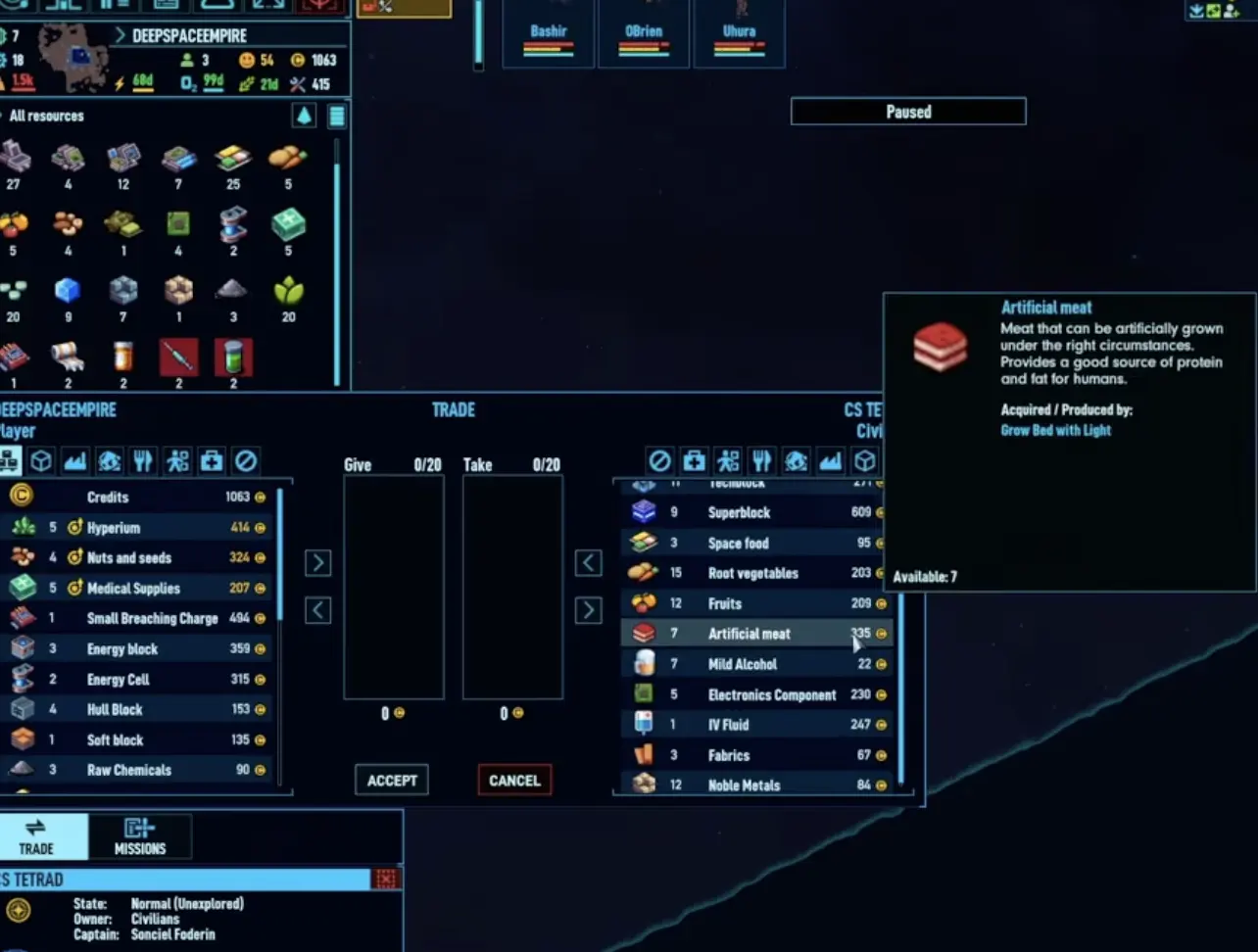
Use this simplified food map:
| Food type | Main nutrition role | Early use |
|---|---|---|
| Nuts / seeds | Fats and calorie support | Good trade item and useful meal component. |
| Root vegetables | Carbohydrates | Strong early survival crop and meal filler. |
| Fruits | Vitamins | Important for balanced meals, but not always high food value alone. |
| Meat / artificial meat | Protein | Needed for better long-term meal balance; usually harder to secure early. |
| Algae | Emergency food | Keeps crew alive but should not be the only long-term food source. |
| Fiber | Trade / fabric chain | Not food, but useful for early economy. |
Nutrient Deficiency
If your crew is eating but still getting deficiency problems, the issue is usually variety.
Common causes:
| Problem | Likely reason |
|---|---|
| Protein deficiency | No meat, artificial meat, monster meat, or protein source. |
| Vitamin deficiency | Too few fruits or vitamin-heavy foods. |
| Poor meal quality | Crew are eating emergency food or single-category meals. |
| Incomplete meals | Kitchen lacks one or more ingredients. |
| Algae dependence | Algae is covering hunger but not long-term nutrition balance. |
Emergency fixes:
- Buy the missing nutrition type from traders.
- Salvage food from derelicts if safe.
- Add a dedicated grow bed for the missing crop type.
- Research or trade toward protein sources.
- Keep algae running only as a backup, not the whole diet.
Step 3: Build the Water and Ice Loop
Food production collapses if water collapses.
Your early water chain is simple:
Ice asteroid → Water Purifier → Water storage → Algae / kitchen / grow beds
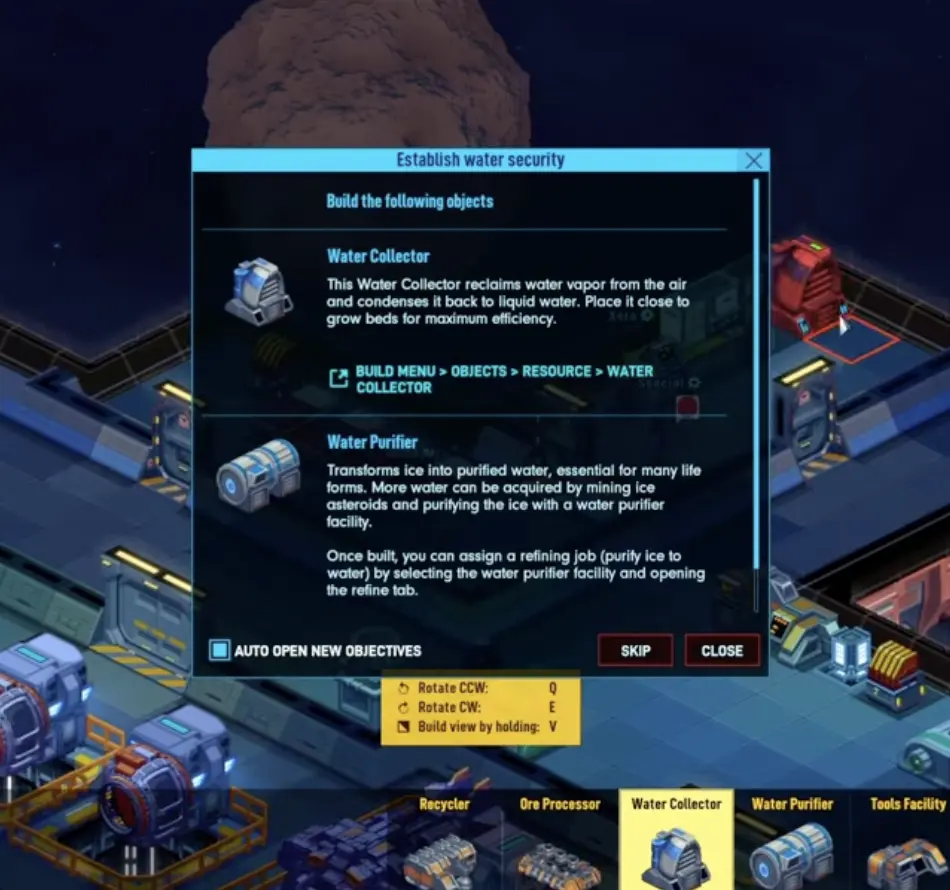
Build or use:
| Object / action | Purpose |
|---|---|
| Water Collector | Supports the early water system. |
| Water Purifier | Turns ice into usable water. |
| Ice mining | Gives the purifier input. |
| Production threshold | Stops the purifier from burning all ice immediately. |
| Water storage near food production | Reduces hauling delays. |
Set the purifier to produce water only when stock drops below a safe threshold. The exact number depends on crew size, crop count, and how much ice you have, but the principle is always the same:
Do not refine all your ice just because the machine can run.
Keep ice as a strategic reserve.
Step 4: Grow Beds — How Many Do You Need?
There is no perfect universal number because crew size, diet, crop mix, grow speed, skill, fertilizer, water, and meal rules all matter.
But players need a starting reference, so use this:
| Crew size | Safe starting target | Notes |
|---|---|---|
| 4 crew | 2 large grow beds | Enough to start moving away from algae, but keep backup food. |
| 6 crew | 3 large grow beds | Add crop variety and watch fertilizer closely. |
| 8 crew | 4 large grow beds | You need stable water and fertilizer before this feels safe. |
| 10+ crew | 5+ large grow beds | Dedicated greenhouse and production rules become important. |
Another useful rule of thumb:
Aim toward roughly 5 active crop slots per crew if food stock keeps trending down.
Start lower if you have algae, traders, or stored meals. Add beds when your food stock keeps falling over several days.
Large Grow Bed vs Small Grow Bed
Use large grow beds when you can.
| Bed type | Best use |
|---|---|
| Small grow bed | Emergency patch, tiny ship, awkward space, early temporary setup. |
| Large grow bed | Main food production, easier crop planning, better use of greenhouse space. |
A large grow bed is usually easier to manage because you can dedicate each one to a food type and set production rules around it.
One Food Type Per Bed
A practical beginner setup is:
| Grow bed | Crop role |
|---|---|
| Bed 1 | Root vegetables / carb crop. |
| Bed 2 | Fruits / vitamin crop. |
| Bed 3 | Nuts / fats and calorie support. |
| Bed 4 | Protein route when available, or more of the current missing food type. |
| Extra bed | Fiber for trade or whatever your stockpile is missing. |
Set each bed or production chain with an IF lower than X threshold once you understand your stock levels.
This keeps the botanist from overproducing one crop while another nutrition category collapses.
Step 5: Fertilizer Is the Mid-Game Bottleneck
The hardest part of farming is not always the grow bed.
It is fertilizer.
Early on, you can get some fertilizer through waste and compost systems. That helps, but it often does not scale fast enough when crew count rises or you add more grow beds.
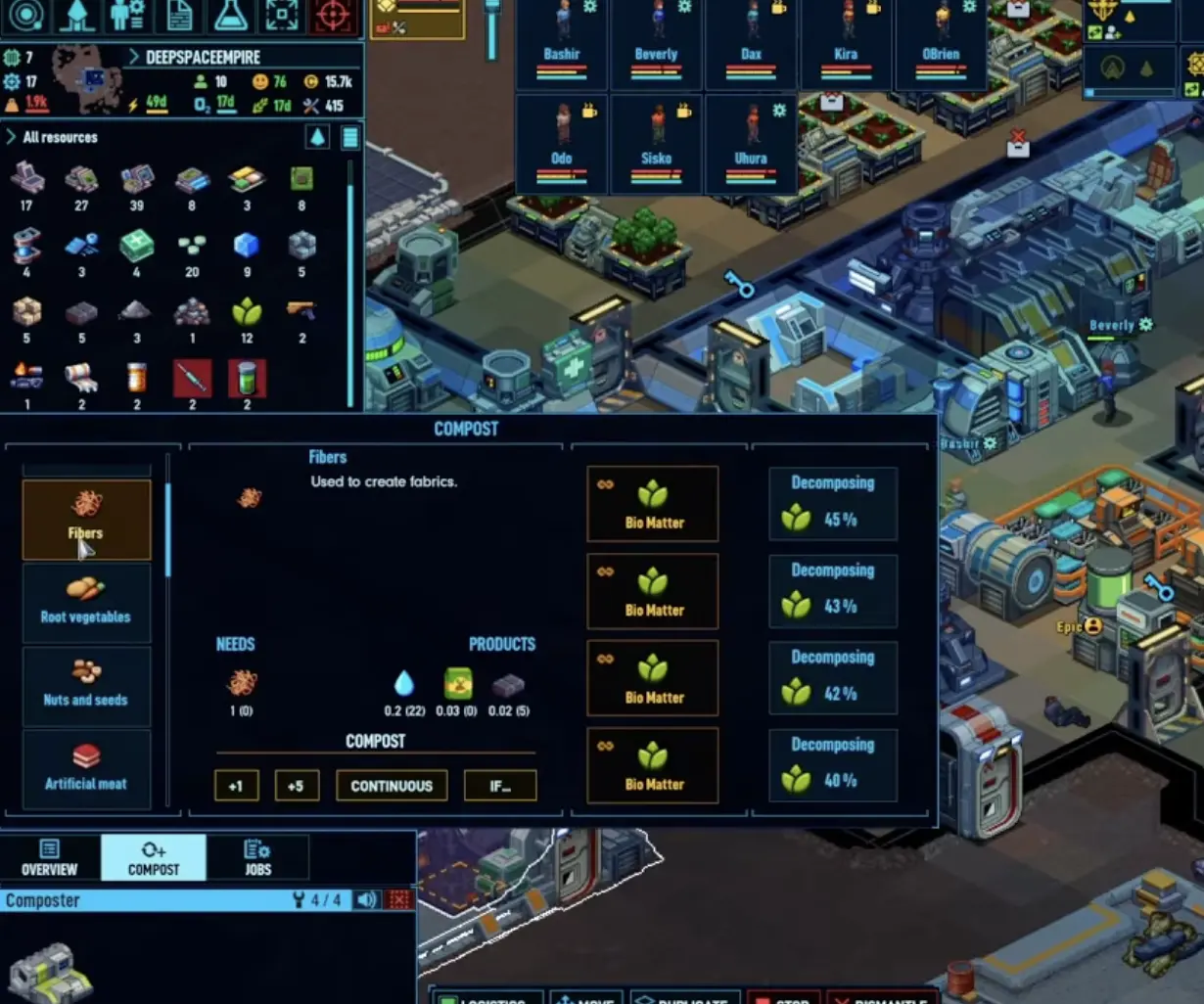
Watch for these signs:
| Symptom | What it means |
|---|---|
| Grow beds sit idle | Fertilizer, water, or crop input is missing. |
| Food stock keeps dropping | You expanded crew faster than farming. |
| Compost cannot keep up | Waste-based fertilizer is not enough anymore. |
| You have beds but no output | The bottleneck is fertilizer or logistics, not bed count. |
| You keep buying food | Your agriculture loop is not self-sustaining yet. |
The Fertilizer Progression
| Stage | Fertilizer plan |
|---|---|
| Emergency | Buy food or use algae. Do not rely on farming yet. |
| Early farming | Use compost / waste-based fertilizer to support a few beds. |
| Scaling farming | Plan research and production toward Chemical Refinery. |
| Stable farming | Balance fertilizer, water, crop variety, and storage thresholds. |
The key lesson:
Do not build more grow beds than your fertilizer supply can support.
If your composter cannot keep up, adding more beds will not solve the problem. It just creates more empty farming space.
Step 6: Fiber and Fabric as an Early Trade Loop
Fiber is not food, but it can help you survive.
If your food stock is unstable and traders are available, Fiber can become an economic crop. Grow Fiber, process it into Fabric when you can, and use the trade value to buy what your ship actually lacks.
Use Fiber / Fabric to trade for:
- missing food category
- water or ice
- medical supplies
- fertilizer
- critical blocks or components
- emergency fuel or power resources
This is especially useful when your farm is not balanced yet. Instead of trying to grow every missing food immediately, you can sell Fabric or surplus crops and buy the category you are missing.
Do not overdo it. If the crew is starving, food crops come first. Fiber is a support economy, not a meal plan.
Station Mode and Visitor Food Pressure
Station Mode changes food planning because visitors create demand spikes.
A normal ship only feeds your crew. A station that offers food or beds can suddenly attract visitors and create pressure on meals, water, oxygen, and room access.
Use this strategy:
| Station problem | Fix |
|---|---|
| Visitors drain food | Do not offer food services until crew food is stable. |
| Visitors need beds | Separate visitor beds from crew survival rooms. |
| Food demand spikes | Keep algae and trade food as backup. |
| Balanced meals run out | Buy missing categories before accepting more visitors. |
| Oxygen / access issues | Visitor rooms still need real life support and pathing. |
If your station is already low on food, do not expand visitor services. Stabilize crew survival first.
Greenhouse and Storage Notes
This guide is about food and water, not full ship layout, so keep these rules simple.
For greenhouse layout: build a separate grow room with thermal control, water access, and enough expansion space. Do not mix grow beds with bedrooms and dining long term. For full room placement, use the Ship Layout Guide.
For storage: keep food near the kitchen, water near food production, and medicine near medical care. Use storage filters so crew eat from the correct place instead of grabbing random resources. For deeper storage and idle-crew issues, use the Crew Idle Fix Guide.
Food and Water Troubleshooting
| Problem | Likely cause | Fix |
|---|---|---|
| Crew starving | No cooked meals, no algae, no emergency stock | Build algae, buy food, salvage food, reduce expansion. |
| Incomplete meals | Missing crop or nutrition category | Grow or buy the missing food type. |
| Protein deficiency | No protein source | Trade for meat/protein or research protein options. |
| Vitamin deficiency | Not enough fruits or vitamin foods | Add fruit crop or buy fruit. |
| Algae runs out | Not enough water or biomatter | Check toilets, water stock, and input delivery. |
| Grow beds idle | Missing water, fertilizer, crop input, or botanist work | Fix fertilizer and assign botany priority. |
| Water keeps disappearing | Too many grow beds / algae / crew needs | Mine ice, raise water production, reduce crop expansion. |
| Fertilizer bottleneck | Compost cannot scale with farm size | Buy fertilizer or plan Chemical Refinery. |
| Crew eat bad food | Storage rules or kitchen workflow are wrong | Fix food storage and kitchen access. |
| Visitors eat everything | Station services opened too early | Disable food service or buy more supply. |
FAQ
How many grow beds do I need per crew?
Start with about one large grow bed per 2 crew, then expand if food stock keeps falling. As a broader rule, move toward roughly 5 active crop slots per crew when trying to stabilize real farming.
Should I build small or large grow beds?
Use large grow beds for your main farm when possible. Small beds are fine for cramped ships or emergency patches, but large beds are easier to organize by food type.
Why are my grow beds not producing?
Usually because fertilizer, water, botany labor, or storage is missing. Do not add more beds until the input chain works.
What is the biggest mid-game food bottleneck?
Fertilizer. Compost helps early, but larger farms usually need a stronger production path, including Chemical Refinery planning.
Is Fiber worth growing?
Yes, if your survival food is stable enough. Fiber can become Fabric, and Fabric can help you trade for missing food, water, medicine, or other emergency supplies.
Continue Reading in the Space Haven Guide Cluster
This article is part of our Space Haven strategy cluster. Use these guides to keep learning the game's core systems and routes.
Survive the Space Haven 1.0 early game. Follow our exact first 7 days build order to set up life support, power nodes, and prep for your first jump.
Crew GuideSpace Haven Crew Not Working? Fix Idle Crew in 1.0Crew standing around in Space Haven 1.0? Use our troubleshooting guide to fix idle crew, correct work priorities, and resolve broken logistics fast.
Power GuideFix Space Haven Blackouts: 1.0 Power & Threshold GuideRunning out of power in Space Haven 1.0? Learn how to fix blackouts, set generator threshold links, manage power nodes, and produce energy rods.
Layout GuideSpace Haven Ship Layout Guide: Starter Tube and BlocksBuild a safer Space Haven ship with starter tube and mid-game block layouts, storage routes, industry rooms, greenhouse separation, and defense tips.