Thick As Thieves Game Guide
Thick as Thieves: Contracts, Exfil & Clues Guide
Learn how contracts, item collection heists, clue chains, exfil routes, stash points, failure penalties, and difficulty changes work in Thick As Thieves Game.
Contracts in Thick As Thieves Game are easy to misread because a run can show more than one layer of objective at the same time. You may have a map mission, such as an Item Collection Heist, and an active guild contract, such as stealing files related to the Vistara Diamond.
If the exfil route is not opening, or the job does not feel complete, do not search every random chest. First check whether the actual objective text has updated.
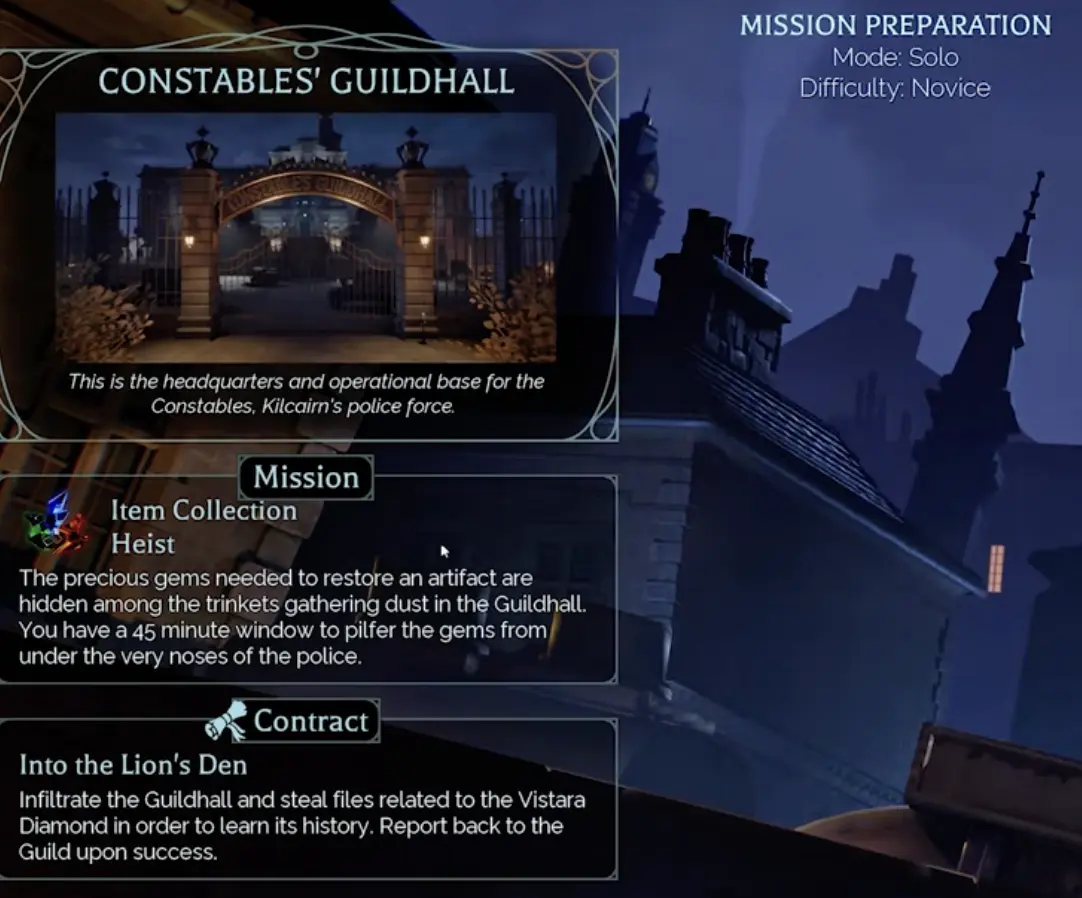
This screen is the most important anchor for understanding contracts: the mission and the active contract can be shown separately. Read both before entering the map.
Fast Answer
| Problem | Direct answer |
|---|---|
| Exfil route is not opening | You probably have not completed the required item set, clue chain, or contract objective yet. |
| You picked up loot but nothing changed | That pickup was optional loot, not the target. Required items should update the objective text or indicator. |
| You cannot find the next target | Follow clue notes and map markers instead of clearing random rooms. |
| You found a clue but still feel lost | Read the clue literally. If it names a hall, basement, wash-up, archive, or office, go there next. |
| You are carrying valuable loot | Use a stash before going deeper into danger. |
| You got knocked out | Expect carried loot and immediate progress to be at risk. Stashed loot is safer. |
| The same route stopped working | Higher difficulty can change security layouts and guard setups, so re-scout the map. |
Read next:
- Thick As Thieves Game Guide
- Elway Manor and Constables Guildhouse Map Guide
- How to Deal With Hauntstables and Security Traps in Thick As Thieves Game
Mission vs Contract: Do Not Mix Them Up
One of the first confusing screens in Thick As Thieves Game shows two different things:
| Screen label | Example | What it means |
|---|---|---|
| Mission | Item Collection Heist | The map run objective, such as finding a set of gems hidden among trinkets. |
| Contract | Into the Lion’s Den | The guild job, such as stealing files related to the Vistara Diamond. |
In the Constables’ Guildhall example, the mission says the precious gems needed to restore an artifact are hidden among the trinkets in the Guildhall. The active contract says to infiltrate the Guildhall and steal files related to the Vistara Diamond.
That means you should not assume every valuable object is progress. The run may ask you to collect a specific set, follow clue notes, or recover a file.
How Exfil Works in a Contract Run
Exfil is tied to objective progress, not to how much random loot you picked up.
In the early Constables’ Guildhall run, the job note says the escape route is available for 45 minutes, and once it appears, it remains for 8 minutes before collapsing.
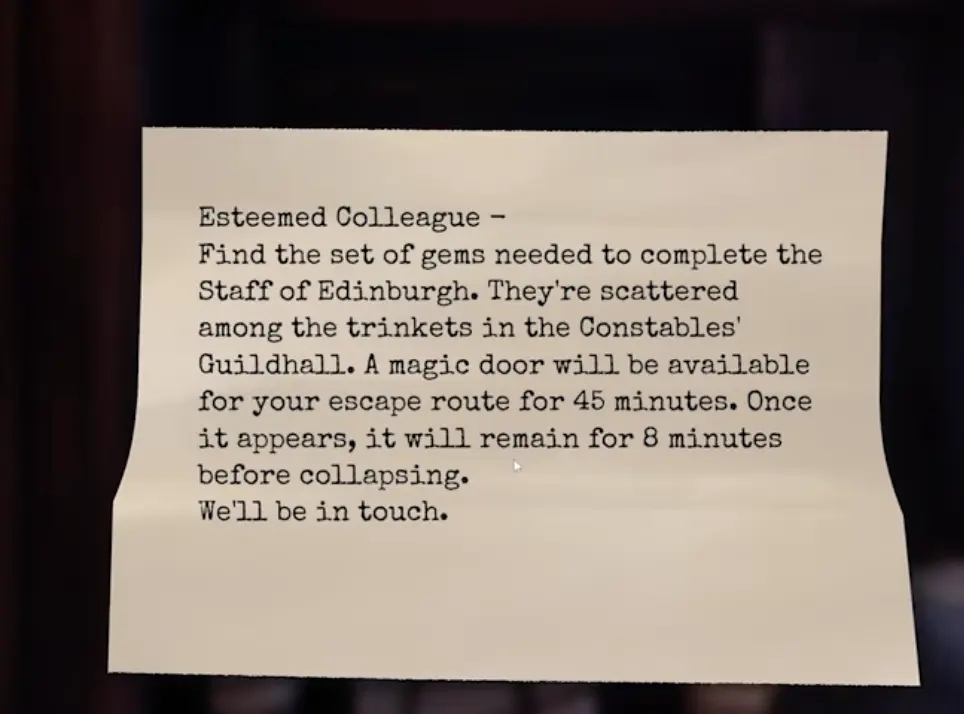
The Guildhall note gives the key timing rule: you have 45 minutes to work, and the escape route stays open for 8 minutes once it appears.
The practical flow is:
- Enter the correct map.
- Read the mission and contract text.
- Find clue notes or target information.
- Collect the required item set, file, or objective target.
- Wait for the objective indicator to update.
- Move to the exfil route before the final escape window closes.
If the route is not available, the most likely reason is that step 4 or step 5 is not done.
Exfil Route Not Opening? Here’s What to Check
This is the checklist to use when the exit feels broken.
1. Did the objective text update?
When a required item is collected, the contract text or objective indicator should update. If it does not update after a pickup, that item was optional loot, not the target.
This is the easiest way to tell whether you actually made progress.
2. Did you collect the full set?
For item collection missions, one treasure is not enough. The Guildhall example asks for gems needed to complete the Staff of Edinburg. If the job is built around a set, keep following clues until the game confirms the set is complete.
3. Did you read the latest clue note?
A clue can move the search to a new room or floor. If a note says an item was moved to the wash-up or basement hall, that is not flavor text. It is the route.
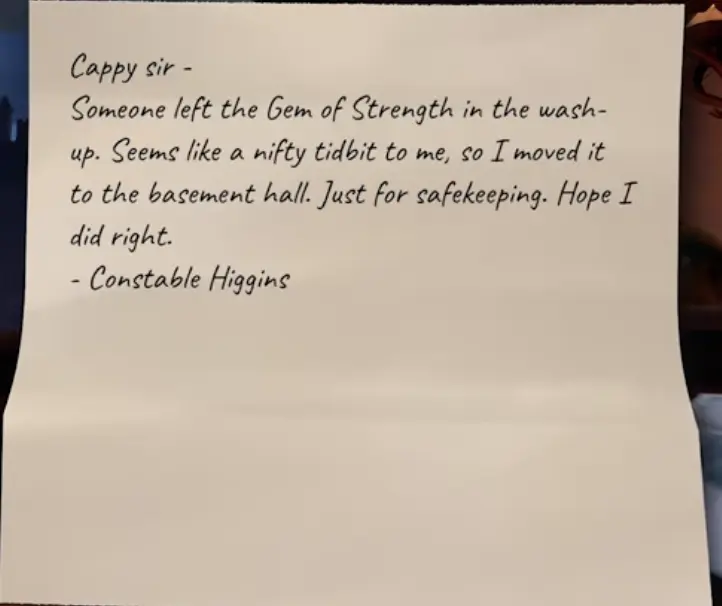
This clue points the search toward the Gem of Strength and names the basement hall. Read notes as route instructions, not background lore.
4. Are you at the right exit area?
Once the objective is complete, follow the exit indicator or return to the marked exfil route. Do not assume every door out of the building is the contract exit.
5. Did you spend too long looting?
The timer is generous when you follow the clue chain. It becomes tight when you full-clear rooms, knock out extra guards, or carry loot through routes that do not help the contract.
What Do Clues and Missives Look Like?
Clues and missives are usually readable information objects. They can look like papers, notes, messages, files, or documents placed on desks, shelves, tables, or inside rooms connected to the objective.
Check these spots first:
| Place to check | Why it matters |
|---|---|
| Desks and office surfaces | File contracts and police-related jobs often point here. |
| Shelves and archive rooms | Good places for documents, files, or official records. |
| Display rooms and trinket areas | Useful for item collection missions. |
| Side tables near valuables | Notes often point to where a target was moved. |
| Map-marked clue areas | If the map or compass points nearby, prioritize it over random loot. |
Do not treat clues like optional reading. In contract runs, a clue can be the difference between finding the target and wasting ten minutes opening unrelated chests.
Known Confirmed Objective Examples
Use these examples as anchors for reading future contracts.
Constables’ Guildhall — Item Collection Heist
The confirmed Guildhall mission type is Item Collection Heist. The mission description says the precious gems needed to restore an artifact are hidden among the trinkets gathering dust in the Guildhall.
This tells you three things:
| Detail | What it means for your route |
|---|---|
| ”Gems” | You are looking for specific required treasures, not just money. |
| ”Scattered” | Expect more than one target. |
| ”Among the trinkets” | Display rooms, shelves, and clue-linked rooms matter more than random chests. |
Into the Lion’s Den — File Recovery Contract
The active contract shown with the Guildhall run is Into the Lion’s Den. It asks you to infiltrate the Guildhall and steal files related to the Vistara Diamond.
For this type of objective, prioritize:
- offices;
- records rooms;
- desks;
- archive-looking areas;
- clue notes pointing to files or police records.
A file recovery contract should not be routed the same way as a treasure chain. Treasure chains push you toward display objects and named items. File recovery pushes you toward documents and official rooms.
Contract Types Confirmed So Far
Do not overcomplicate this. Based on the available objective screens, the two most useful confirmed categories are:
| Type | Confirmed example | How to play it |
|---|---|---|
| Item collection / treasure chain | Staff of Edinburg gems in Constables’ Guildhall | Follow clues, check trinket/display areas, collect the full set, then exfil. |
| File / information recovery | Into the Lion’s Den, Vistara Diamond files | Search desks, offices, record rooms, archives, and clue-linked document areas. |
If later runs confirm a separate loot-focused contract type, add it as a third row. For now, do not build your route around an unverified category. Treat optional loot as payout, not contract completion.
Stash: How to Protect Your Payout
The stash sends loot back to your hideout. This matters because if you are knocked out, carried loot is at risk.
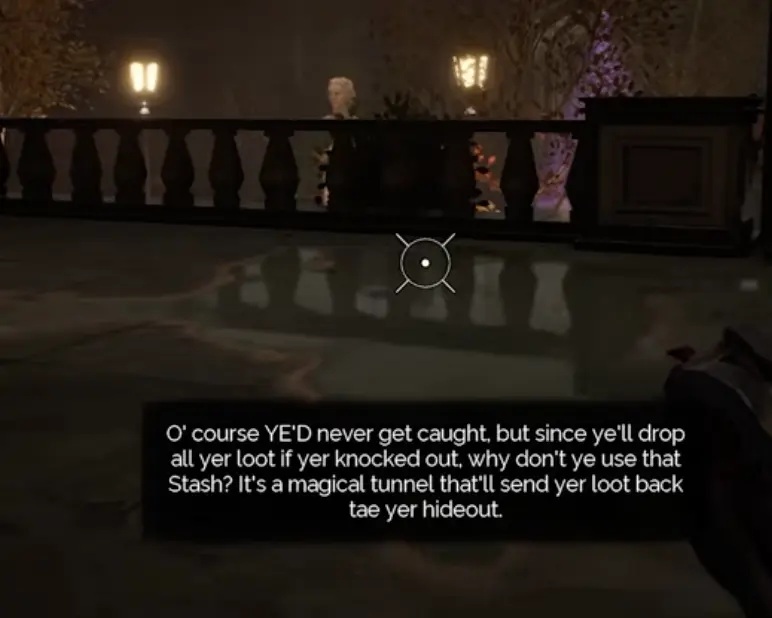
The stash is not just a convenience. It is the safest way to protect valuable loot before taking a deeper risk.
Use the stash when:
- you found a high-value item before finishing the objective;
- you still need to cross guards, turrets, or Hauntstables;
- you are about to go deeper into the building;
- you are low on health but carrying value;
- you do not know whether the next route is safe.
Do not waste a stash on tiny early loot unless you are about to take a serious risk. If the stash is limited-use in that run, using it too early makes later treasures more dangerous to carry.
What Do You Lose When You Fail?
If you get knocked out, expect carried loot and immediate route progress to be at risk. A respawn or restart does not mean everything you touched is safely banked.

If the alert turns into a chase, protect the run first. Greed matters less than whether your value is stashed and your objective is complete.
Use this rule:
If the loot is important and the next room is dangerous, stash first.
Failure usually comes from one of three things: carrying too much, ignoring the next clue, or grabbing optional loot after the objective path is already risky.
Difficulty Changes What Routes Are Safe
Higher difficulty can change security layouts and guard configurations. That means a route that worked on Novice may become worse later because the guard timing, trap coverage, or security pressure changes.

Do not treat difficulty as a number change only. It can change how safe a familiar route feels.
On higher difficulty:
- re-check guard routes before entering bright rooms;
- expect less room for unnecessary looting;
- save a tool for escape instead of spending everything early;
- do not assume a previous clue route will be free of new pressure;
- complete the required objective before exploring side rooms.
How Long Is a Contract?
Expect early contracts to put you under about 30–45 minutes of mission pressure. The confirmed Guildhall note gives a 45-minute escape-route window and an 8-minute final availability window once the route appears.
The timer is not the real enemy. Random searching is.
If you follow clue notes, the timer gives you room to work. If you loot every room before finishing the item set or file recovery, the timer starts to feel unfair.
Real Stuck Scenarios
”I picked up a valuable item, but the job did not complete.”
That item was probably optional loot. Check whether the objective text updated. If it did not, return to clue notes or target rooms.
”I found one gem, but exfil still is not ready.”
You may need the full item set. If the mission says gems or components, assume there are multiple pieces until the objective confirms completion.
”I found a note, but I still cannot find the target.”
Read the location words literally. If the note names a basement hall, wash-up, archive, office, or floor, go there instead of clearing the current room.
”I had full pockets and then got knocked out.”
Carried loot is risky. Use stash before taking a deeper route. If you already have value and the next room has turrets, guards, or Hauntstable pressure, bank the loot first.
”The route worked before, but now it is dangerous.”
Difficulty or contract variation may have changed the security setup. Re-scout the route before crossing open light, turret arcs, or guard paths.
FAQ
How do I know when the objective is complete?
Watch the contract text or objective indicator. If it updates after a pickup, you likely collected a required item. If it does not update, the pickup was probably optional loot.
Why is my exfil route not opening?
You probably have not finished the required objective set. Recheck the newest clue, confirm whether the mission asks for multiple items, and make sure the objective indicator updated.
Are clues and missives required?
They are often the fastest way to find required targets. You can sometimes stumble into the item, but clue notes are the intended route.
Where should I look for missives?
Start with desks, office surfaces, shelves, archives, side tables, and rooms that match the contract theme. For Guildhall file jobs, official rooms and record areas are especially important.
Is optional loot part of contract progress?
Not always. Optional loot increases payout, but if the objective text does not update, it probably did not advance the contract.
What does the stash do?
The stash sends loot back to your hideout, making it safer than carrying everything through the rest of the map.
Should I loot before or after the objective?
Take valuable loot if it is safe and nearby, but do not let loot replace the objective chain. If you are unsure what the job still needs, solve the clue chain first.
Does difficulty change objective locations?
Difficulty can change security layouts and guard configurations. Treat higher difficulty as a reason to re-scout, not as a reason to blindly repeat the same route.
Continue Reading in the Thick As Thieves Game Guide Cluster
This article is part of our Thick As Thieves Game strategy cluster. Use these guides to keep learning the game's core systems and routes.
Learn how to unlock Chameleon in Thick As Thieves Game, where to check the Wardrobe, what counts as guild progress, and what to do before and after Chameleon unlocks.
Enemy GuideThick As Thieves Game: Hauntstables, Turrets, Magic Eyes, and Security Tools GuideLearn how to survive Hauntstables, bypass turrets, handle magic eyes, and use Slithersap, Smoke Bomb, and Pickpocket Fairy in Thick As Thieves Game.
Map GuideThick as Thieves: Constables Guildhouse Map GuideThick as Thieves Constables Guildhouse guide: Find the Gem of Strength, Arcana, and Vistara Files with confirmed clue routes and exfil points.