Hotel Architect Guide
Hotel Architect Money Guide: Fix Debt & Negative Cash Flow
Stop losing money in Hotel Architect! Our guide covers fixing negative cash flow, managing staff costs, safe loan strategies, and recovering from bankruptcy.
Hotel Architect money problems usually do not come from one mistake. They come from a chain of small leaks: too much construction, too many staff, unfinished rooms, weak guest services, dirty laundry, poor critic feedback, and loans used to cover problems instead of fixing them.
If your hotel is losing money every day, do not panic-build more rooms. Pause the game and find the leak first.
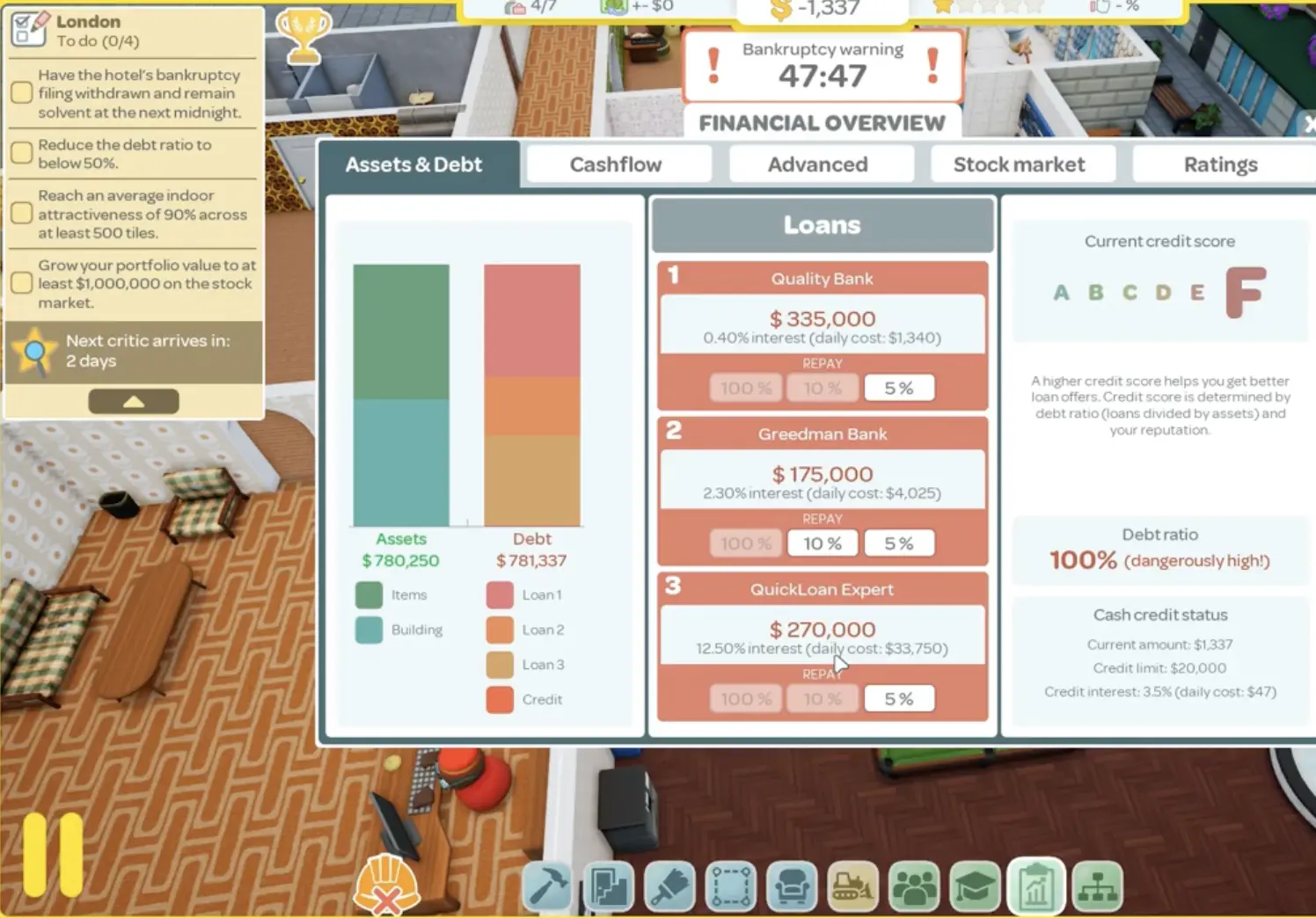
Look at the debt ratio, credit rating, active loans, and daily costs before spending anything. In debt-heavy scenarios, the finance screen matters more than the build menu.
New Scenario Day 1 Money Route
If you are starting a fresh scenario and want to avoid money problems before they happen, use this route:
- Build a small reception and only enough bedrooms to open quickly.
- Hire one receptionist, one cleaner, and one maintenance worker before adding luxury service staff.
- Finish required bedroom items before decoration.
- Add cheap seating, water or coffee, bins, and basic entertainment before restaurants.
- Do not build a kitchen, bar, or casino until room income can cover wages.
- Send builders home when the first rentable block is finished.
- Let the hotel run for a short cycle and confirm positive cash flow before expanding.
This route is not glamorous, but it prevents the most common beginner trap: spending your first budget on services that cannot pay for themselves yet. If you are already losing money, skip to the Fast Answer and Money Triage sections below.
Fast Answer
| Problem | Fast fix |
|---|---|
| Losing money every day | Stop building, check staff wages, send idle construction workers home, and make sure existing rooms are rentable. |
| Running out of cash | Finish income-producing rooms first. Do not spend on luxury decor before required services work. |
| Going bankrupt | Sell high-value nonessential items, repay the worst debt, and reduce daily expenses immediately. |
| Too much debt | Prioritize the highest-interest loan first, not necessarily the largest loan. |
| Hotel is full but still losing money | You are probably overstaffed, underpriced in value, or spending too much on services that do not pay back. |
| Casino is bleeding money | Stop adding tables, lower or pause risky games, use room profit as a bankroll, and scale only games that are positive in your own reports. |
| Bad reviews hurting income | Fix the weakest guest experience category instead of expanding blindly. |
| Construction costs too much | Build in smaller phases, use material sites on large jobs, and dismiss workers when they are idle. |
Money Triage: Diagnose the Leak
Before spending money, answer these questions in order.
| Check | Danger sign | Fix |
|---|---|---|
| Daily cash flow | Negative for several days | Stop expansion and identify the biggest cost line. |
| Staff wages | Payroll rises faster than room income | Fire duplicates, cut bad traits, delay new service zones. |
| Active loans | Double-digit interest or several simultaneous loans | Repay the highest-interest debt first. |
| Room status | Many rooms are unfinished or missing items | Finish existing rooms before building new ones. |
| Review blockers | Guests complain about basics | Add cheap seating, drinks, cleaning, bins, or entertainment. |
| Construction workers | Builders are idle or walking long distances | Send them home or place material sites closer. |
| Laundry / trash | Rooms are dirty or bins overflow | Add capacity before adding more rooms. |
| Casino report | Games are deeply negative | Stop scaling casino tables and protect hotel profit. |
A hotel with ten unfinished rooms is not a bigger business. It is a bigger bill.
Practical Money Benchmarks
These are not hard-coded game rules. Use them as operating targets while you read your own finance screen.
| Area | Healthy target | Warning sign |
|---|---|---|
| Cash buffer | At least 2–3 days of wages and loan payments | You cannot survive one bad review or repair cycle. |
| Staff cost | Roughly under 35–45% of reliable daily income | Payroll grows faster than room income. |
| Cleaner coverage | About 1 cleaner per 6–8 active rooms early | Beds, towels, and dirty rooms are constantly behind. |
| Maintenance | 1 worker for a small hotel; add when repairs lag | Broken items stay broken for long periods. |
| Reception | 1 receptionist is fine early; add only when queues form | Guests wait too long to check in. |
| Food service | Add chef / waiter only when restaurant demand is real | Kitchen wages exceed meal revenue. |
| Loan pressure | Treat 10%+ interest as urgent | Interest drains recovery faster than rooms can earn. |
| New expansion | New rooms should open soon and pay back quickly | You are paying for empty shells. |
| Casino bankroll | Keep hotel profit separate from casino risk | Casino losses force loans or room cuts. |
If your numbers are outside these targets, do not automatically expand. Fix the leak first.
Staff Costs: Ratios That Actually Help
Staff can quietly destroy a profitable hotel. A five-room hotel does not need the staff roster of a luxury resort.
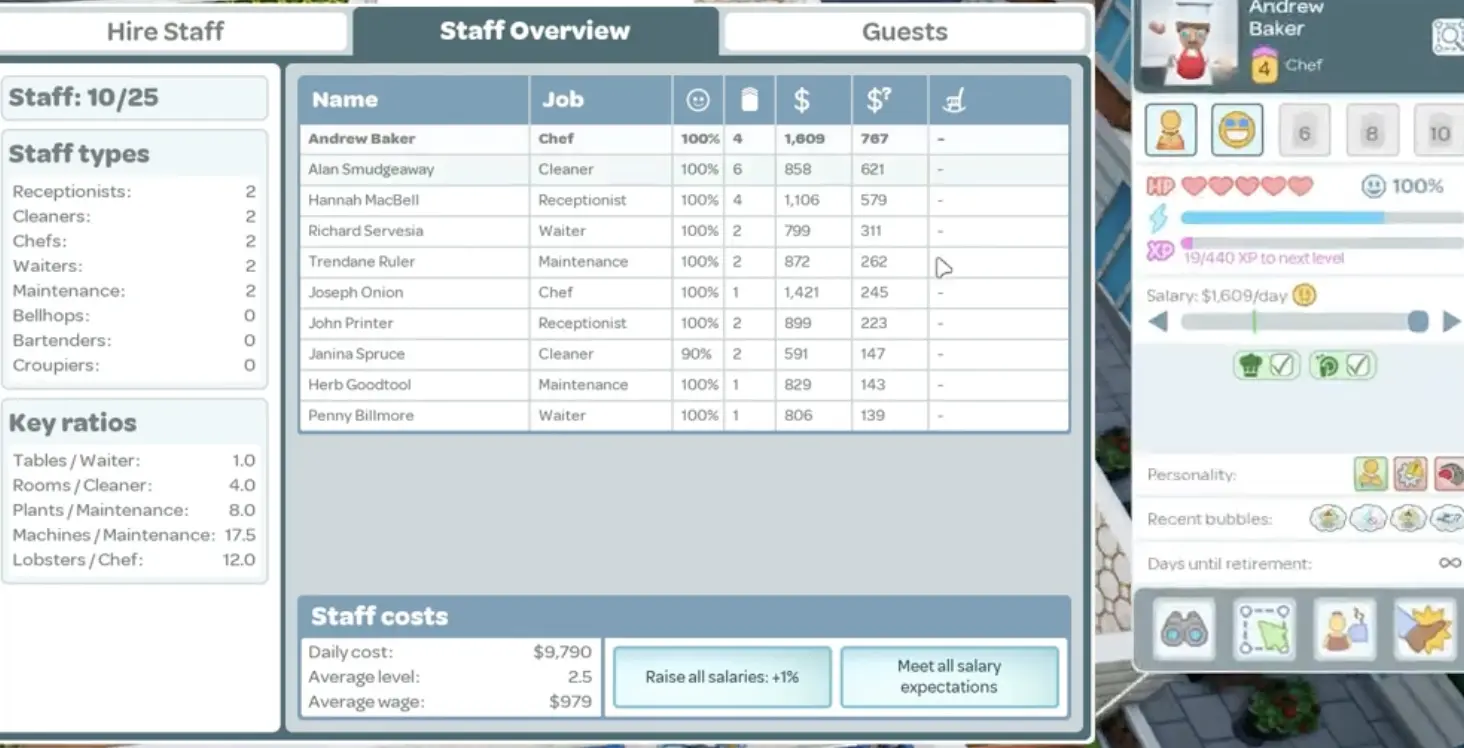
Focus on salary, role, and traits. In a debt scenario, one expensive duplicate can matter more than a small room upgrade.
Use these planning ratios.
| Staff type | Early ratio | Add more when… | Money risk |
|---|---|---|---|
| Receptionist | 1 for a small hotel | Guests queue or complaints mention check-in | Idle receptionists are pure payroll cost. |
| Cleaner | 1 per 6–8 rooms | Laundry, beds, or dirty rooms fall behind | Too few cleaners hurt reviews; too many waste wages. |
| Maintenance | 1 for a small / mid hotel section | Repairs remain pending | Broken items lower service quality. |
| Chef | Only when restaurant is open and demanded | Orders exceed kitchen capacity | Chefs are expensive if the restaurant is underused. |
| Waiter | Add after tables and orders justify it | Food service is slow | Overstaffing kills margins. |
| Croupier | Only for active casino tables | A table actually needs staffing and bankroll | Casino staff can multiply losses if tables are negative. |
| Porter / service staff | Delay until hotel complexity requires it | Travel / service bottlenecks appear | Nice to have, not always early survival staff. |
Bad traits matter too. Fire duplicate, expensive, or harmful-trait workers before cutting essential coverage. Do not fire every cleaner just because money is tight; dirty rooms can make the money problem worse.
Construction Costs: Stop Paying for Nothing
Construction workers are useful, but they are not free. If they have no active work, send them home.
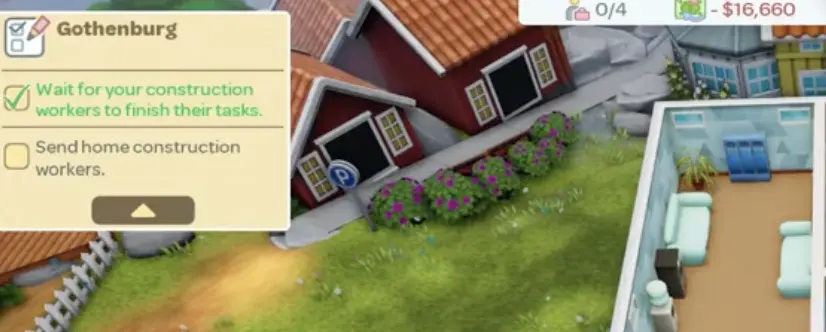
The important UI detail is not the room plan; it is whether workers are standing around while the wage clock keeps moving.
Use these rules.
| Construction rule | Why it matters |
|---|---|
| Build in phases | Finished rooms earn money faster than giant unfinished shells. |
| Send idle workers home | Workers standing around still cost money. |
| Call bigger crews only for big jobs | Large crews are useful for large floors, wasteful for small edits. |
| Avoid constant redesigns | Moving walls and redoing floors burns profit. |
| Finish required items first | An almost-finished room earns nothing if it lacks one required item. |
Material Sites: When They Are Worth It
Material sites reduce walking time when workers must travel far from the delivery point. The game does not give a simple universal “saves X%” number, because the benefit depends on distance.
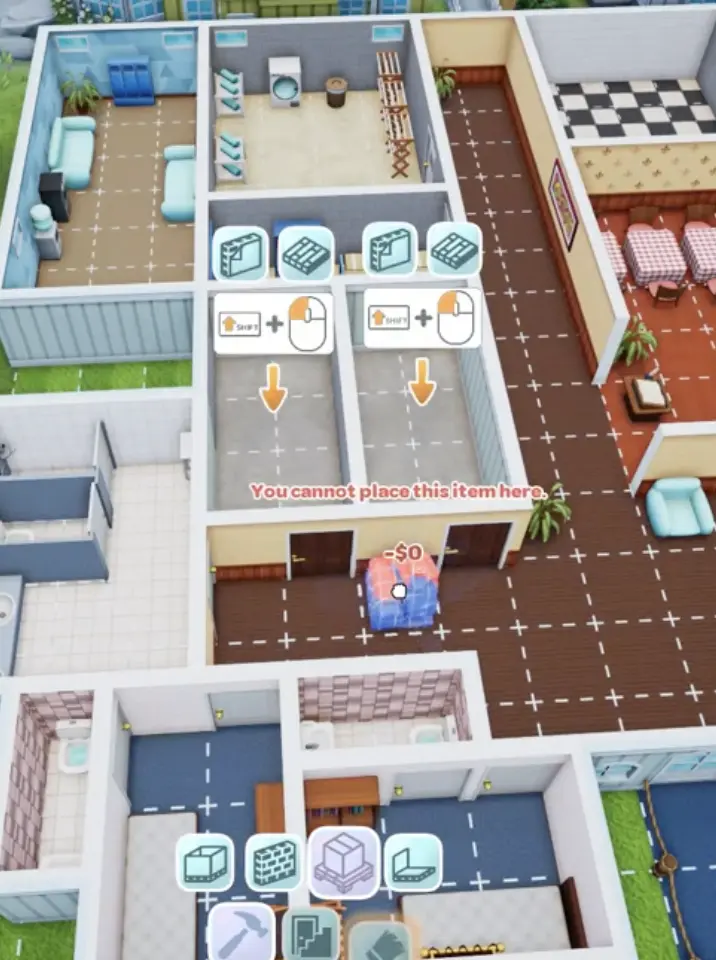
Look at worker path length. A material site is strongest when workers spend more time walking to the truck than building.
Use this rule of thumb:
| Project | Material site recommendation |
|---|---|
| Tiny edits near the road | Usually not worth micromanaging. |
| Multi-room renovation | Worth placing near the center of the work. |
| New floor build | Usually worth it. |
| Work area more than 15–20 tiles from supply | Strongly consider it. |
| Large hotel wing | Use one or more sites to cut repeated walking. |
If a material site cuts a worker’s supply walk from 30 tiles to 10 tiles, the supply-trip walking distance is roughly cut by two-thirds. That is not a fixed game bonus, but it explains why material sites become valuable on large jobs.
Loans: Good Bridge, Bad Crutch
Loans are not automatically bad. They are dangerous when they hide a broken hotel.
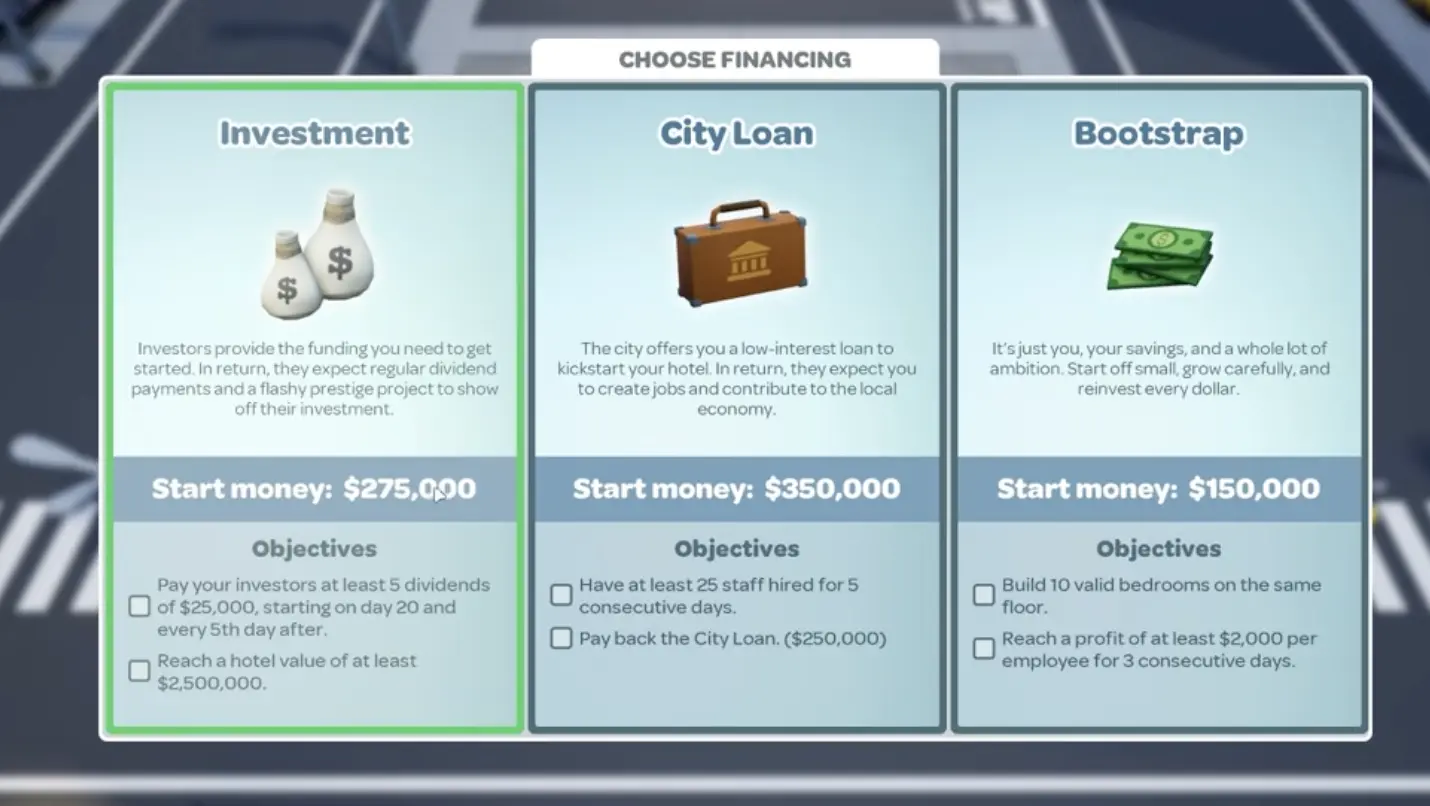
When a loan objective appears, focus on the repayment requirement and your operating buffer. Do not treat the loan as free decoration money.
Use this loan threshold.
| Interest / pressure | How to treat it |
|---|---|
| 10%+ interest | Emergency debt. Repay as soon as the hotel can survive the payment. |
| 6–10% interest | Medium pressure. Pay down after urgent service problems are fixed. |
| Under 6% interest | Lower priority unless tied to an objective. |
| Loan tied to failure condition | Treat as urgent even if the interest looks manageable. |
Take a loan if it will finish rooms that open soon, complete an urgent objective, or repay worse debt. Avoid taking a loan to fund decoration, overstaffing, oversized layouts, or services your guests do not need yet.
Repay the Worst Debt First
Do not always repay the largest debt first. Repay the debt that hurts you most.
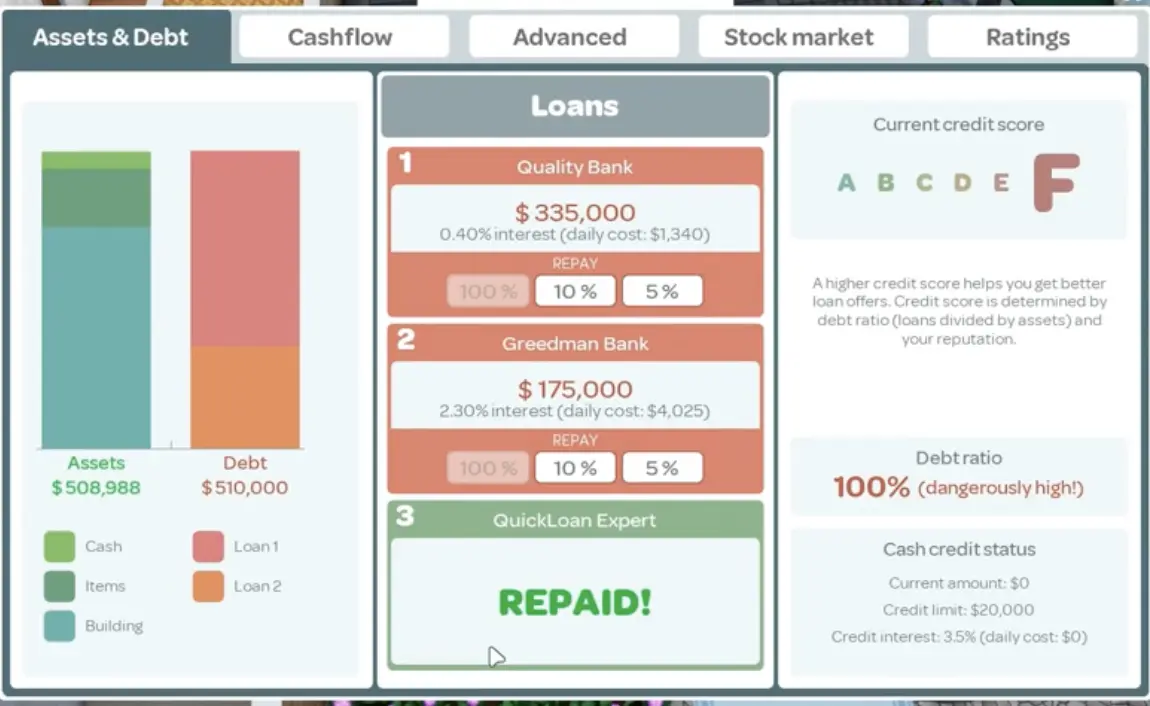
In this kind of screen, compare interest rate and daily charge before choosing which loan to pay back.
Use this priority:
| Priority | Debt type | Why |
|---|---|---|
| 1 | Highest-interest loan | It drains recovery fastest. |
| 2 | Debt tied to insolvency or scenario failure | It can end the run if ignored. |
| 3 | Medium-interest loans | Pay down once the hotel is stable. |
| 4 | Low-interest debt | Handle after cash flow is safe. |
Keep an operating buffer. Repaying a loan is good, but not if it leaves you unable to finish rooms or pay staff.
Selling Items: Cash Recovery Without Killing Asset Value
In debt-heavy scenarios, especially London, selling wasteful luxury can save the hotel. But selling everything is not smart.
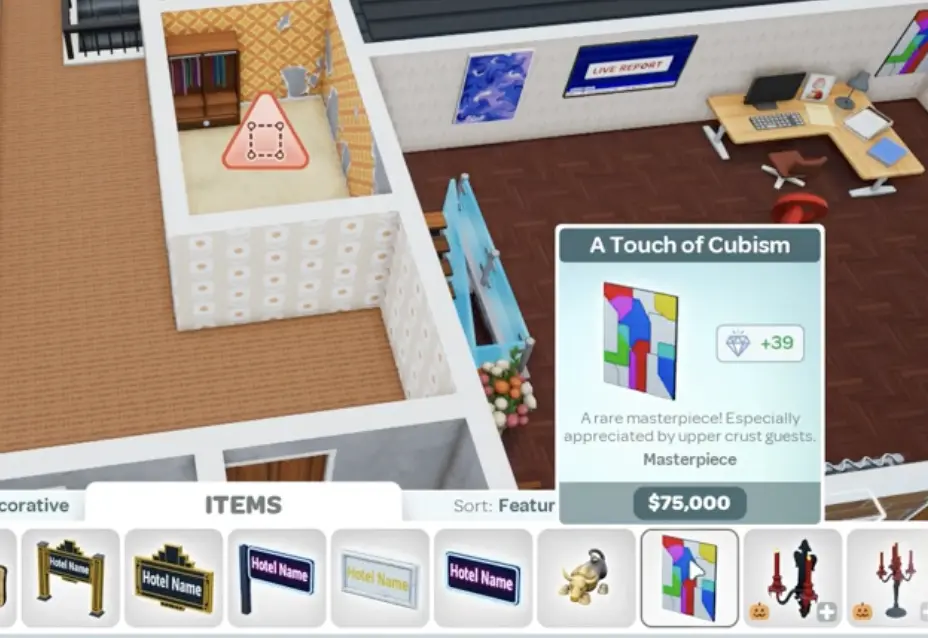
The number to watch is the item’s resale value. A single high-value artwork can matter more than deleting ten tiny decorations.
Use this sell / keep rule.
| Item type | Best action |
|---|---|
| Very high-value art in staff-only rooms | Sell first. |
| Expensive statues / fountains with no guest benefit | Sell or move if debt repayment needs cash. |
| Cheap art | Move to guest rooms or reception instead of selling for little. |
| Extra sofas and seating | Move to guest-facing areas if guests need seating. |
| Old low-quality room furniture | Replace gradually, not all at once. |
| Useful service equipment | Keep unless truly duplicate or unused. |
Do not rely on a fixed refund percentage. Check the value shown by the game, prioritize absolute sale value, and use the cash to reduce dangerous debt or activate rooms.
Room Income: The Cheapest New Revenue
If money is tight, your cheapest new income is often an unfinished room you already paid for.
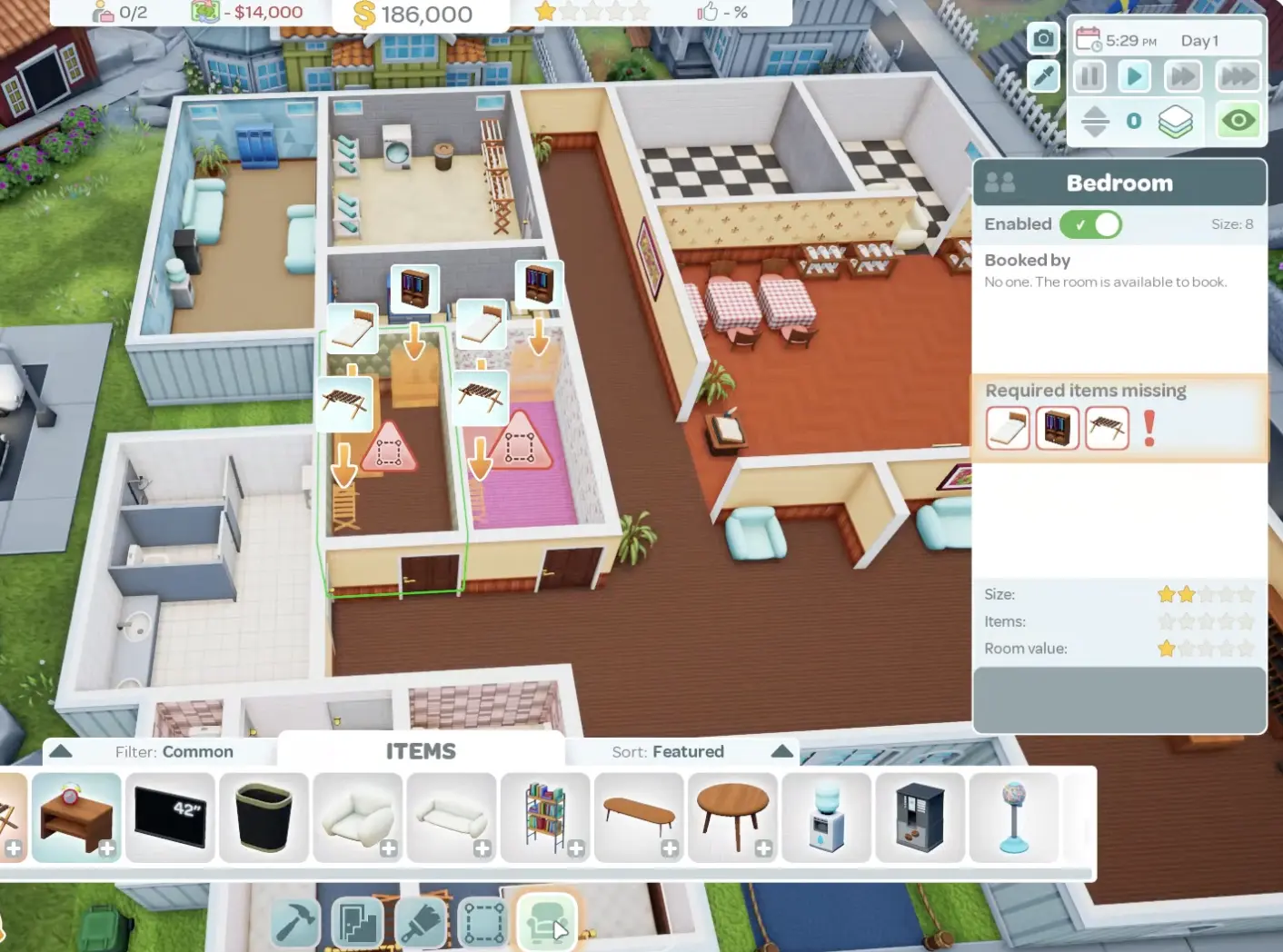
Look for missing required items. One cheap bed, wardrobe, luggage rack, door, or zoning fix can turn sunk cost into income.
Before building new rooms, inspect existing rooms for:
- missing bed
- missing wardrobe
- missing luggage rack
- missing door
- invalid zone
- missing bathroom access
- dirty sheets
- poor staff access
- no guest demand
- wrong room quality for target guest
A room that needs one cheap required item is usually a better investment than a brand-new extension.
Food, Bars, and Restaurants: Build Them When Demand Exists
Restaurants, bars, and advanced services can make a hotel better, but they add staff, equipment, stock, cleaning, and service-time costs.
Build them when:
| Signal | Meaning |
|---|---|
| Guest volume is high enough | More guests can actually buy food or drinks. |
| Reviews ask for refreshments or food | The service solves a real blocker. |
| A guest type needs it | Brats need a bar; premium guests may need better food and drinks. |
| Staff can handle the workload | Chef / waiter / bartender costs must be supported. |
| The service is near guest traffic | A hidden restaurant does not help much. |
Before that, use cheaper support: water, coffee, seating, simple entertainment, clean bathrooms, and reliable laundry.
Laundry, Trash, and Cleaning Are Money Problems
Dirty rooms are not just a review issue. They are a revenue issue.
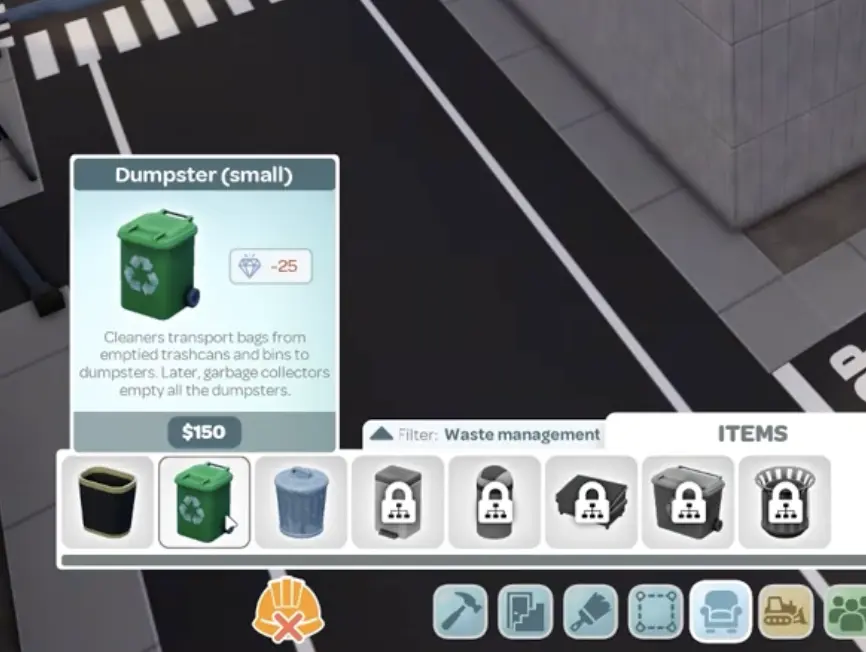
Watch laundry baskets, bins, and worker travel distance. A full hotel can still lose money if rooms turn over slowly or guests leave angry.
| System | Money problem if ignored | Fix |
|---|---|---|
| Laundry | Rooms turn over slowly or guests complain | Add cleaners, washers, drying capacity, and shorter routes. |
| Trash | Guests get angry and areas look bad | Add bins and make waste access easier. |
| Cleaning | Review score drops | Add cleaners only when workload proves it. |
| Maintenance | Broken items reduce service quality | Keep at least basic maintenance coverage. |
| Staff travel | Workers waste time walking | Move service rooms closer or add support areas. |
If your hotel is “full but bad,” fix service flow before expanding.
Critic Feedback Can Save Money
A bad critic review is frustrating, but it can stop you from wasting money.
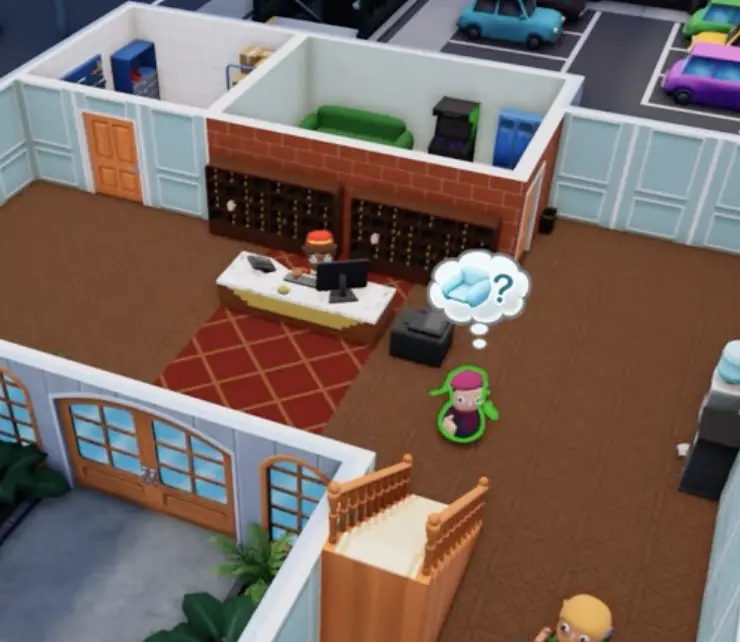
Read the lowest category first. If the review says seating or refreshments, do not answer with a giant new bedroom wing.
| Critic problem | Cheap first fix |
|---|---|
| No seating | Add benches, sofas, or chairs in guest areas. |
| Poor refreshments | Add water or coffee before a full bar. |
| Weak entertainment | Add one or two guest-appropriate activities. |
| Low sleep quality | Improve beds, room decor, and cleanliness. |
| Dirty hotel | Add bins or cleaners; check laundry routes. |
| Poor service | Check reception, waiters, staff traits, and workload. |
| Low attractiveness | Improve floors, walls, lighting, plants, and cheap art in guest-facing areas. |
Fix one clear bottleneck, then review again.
Healthy Mid-Game Cash Flow Checks
A healthy hotel does not need every revenue stream to be huge. It needs each system to justify its own cost.
| System | Healthy check | Cut back if… |
|---|---|---|
| Rooms | Room income covers core wages, cleaning, maintenance, and loan payments. | Many rooms are empty, unfinished, dirty, or too cheap for their guest tier. |
| Restaurant | Daily food revenue is at least about 1.5x chef + waiter wages before you expand the menu or dining room. | The kitchen is staffed but tables are empty or guests rarely order. |
| Bar | Drink revenue and review value justify bartender payroll. | The bar exists only because it looks nice and guests are not using it. |
| Activities | Activity rooms improve reviews or target a guest type. | You are buying machines that guests ignore. |
| Casino | Casino losses can be absorbed by room profit and spare bankroll. | Losing casino days force loans, staff cuts, or unfinished rooms. |
| Staff | Payroll stays roughly under 35–45% of reliable income. | You hire every new service role before demand exists. |
| Construction | Building happens in planned bursts and creates usable rooms soon. | Builders are always active and the new space does not earn. |
| Loans | Debt funds quick-payback rooms or scenario objectives. | Loans are covering daily operating losses. |
Use this as a practical test: if a service cannot cover its direct staff cost or solve a review / objective blocker, delay the next upgrade.
Las Vegas Casino Money Guide
Las Vegas is the most dangerous money map because the casino can swing hard. A profitable hotel can still be dragged down if the casino grows before the room business is stable.
Las Vegas is an 18x18, 8-floor, hot-climate scenario with all guest types available. The casino is introduced here, and the scenario can include objectives tied to casino profit, Brats, or specific funding choices.
Casino Minimum Reserves
Casino items need a cash reserve before they operate. Minimum reserve is not the same as a safe bankroll.
The values below are current in-game reference values from the casino item requirements. Treat them as a practical checklist, not a permanent rule: future balance updates may change the exact numbers, so always confirm against the item tooltip in your build.
| Casino item | Staff needed | Minimum reserve |
|---|---|---|
| Slot machine | No croupier listed | $50 |
| Roulette | Croupier | $300 |
| Blackjack | Croupier | $60 |
| Baccarat | Croupier | $120 |
| Craps | Croupier | $150 |
| Money wheel | Croupier | $75 |
The low Slot and Blackjack reserves compared with Roulette are not a profit ranking. They are item reserve requirements: some games need more cash held at the table because their payout and bet behavior can swing harder. If your game version shows different reserve numbers in the item tooltip, trust the in-game UI.
Use minimum reserves only to turn the item on. For real play, keep a separate casino buffer because guests can win repeatedly.
Safe Casino Start Order
Do not start Las Vegas by building a giant casino floor.
| Phase | What to do |
|---|---|
| 1 | Build a profitable room base first. |
| 2 | Add enough cleaning, laundry, and reception to keep guests happy. |
| 3 | Add a small casino zone with limited games. |
| 4 | Deposit conservative reserves and monitor each game’s profit report. |
| 5 | Adjust bet values for the guest tier you want. |
| 6 | Scale only the games that are positive in your own hotel. |
| 7 | Add Brat / Upper Crust rooms after core service and bankroll are stable. |
A safe rule is to keep at least $100,000 in hotel-side reserve before scaling casino tables seriously. If you cannot lose $50,000–$100,000 without taking a loan, the casino is too large for your hotel.
Casino Game Risk Notes
Community reports are mixed, so do not assume a fixed best game forever. Use your own reports.
| Game | Practical note |
|---|---|
| Slots | Often useful as an early low-complexity test, but Brats may prefer higher-status games. |
| Blackjack | Can produce strong positive results, but still needs croupier coverage and bankroll. |
| Money wheel | Can work well for some players and can help casino profit goals. |
| Craps | Can be positive in some hotels but swingy in others. |
| Roulette | Can swing heavily and should not be overbuilt without a bankroll. |
| Baccarat | Test slowly; do not scale until your own report is positive. |
If one game is negative for several days, lower bets, pause it, or remove some tables. Do not keep adding more of a losing game because the objective says “casino profit.”
Brats and Casino Profit
Las Vegas can ask you to earn casino money from Brats. This is harder than generic casino profit because Brats do not behave like budget guests.
To support Brat casino income:
- make sure Brats can actually book rooms,
- keep a Bar running,
- build Brat rooms on exterior walls so each room can have the required exterior window, then upgrade them toward premium room value,
- provide fun and high-status leisure,
- give them casino games they will use,
- keep casino service staffed,
- keep enough hotel profit to absorb swings.
Do not rely only on slots for Brats. If Brats avoid a game, that game cannot complete a Brat-specific casino objective.
Casino Emergency Plan
If the casino is deeply negative:
| Step | Action |
|---|---|
| 1 | Pause casino expansion immediately. |
| 2 | Check which games are negative, not just total casino profit. |
| 3 | Lower bet values or pause the worst games. |
| 4 | Keep only games that are positive or required for an objective. |
| 5 | Stop hiring extra croupiers until profit stabilizes. |
| 6 | Use room income to rebuild bankroll. |
| 7 | Add Brat / premium rooms only after basic hotel profit is safe. |
| 8 | Resume casino objectives once the hotel can survive variance. |
The casino should be upside, not the only thing keeping the hotel alive.
Scenario-Specific Money Advice
| Scenario | Money advice |
|---|---|
| Gothenburg | Learn the basics. A smaller clean hotel can beat a larger unfinished one. |
| Santorini | Heat and vacation services can cause spending spikes. Add cooling and bar support without overexpanding. |
| Paris | Prepare for stronger guest expectations, but do not chase advanced guests before the hotel can afford them. |
| St. Anton | Resort services and warmth matter. Avoid spending on rooms that do not match the guest needs. |
| New York | Profitability and vertical efficiency matter more than style. Use City Loan carefully and reserve elevator space. |
| Las Vegas | Build room profit before casino risk. Monitor each game and keep a bankroll. |
| London | Treat it as financial triage: sell waste, cut excess staff, repay expensive debt, then renovate. |
| Black Forest | Large space can tempt overbuilding. Expand only when services and cash flow can support it. |
Recovery Plan: If You Are Almost Broke
If the hotel is close to collapse, follow this order.
| Step | Action |
|---|---|
| 1 | Pause the game. |
| 2 | Cancel or stop nonessential construction. |
| 3 | Send idle construction workers home. |
| 4 | Check loans and identify the worst interest rate. |
| 5 | Sell high-value nonessential items. |
| 6 | Fire duplicate or harmful staff. |
| 7 | Lower wages if needed. |
| 8 | Finish cheap near-complete rooms. |
| 9 | Add only low-cost fixes for guest complaints. |
| 10 | Repay the most dangerous debt when you have enough cash. |
| 11 | Let the hotel run and confirm positive cash flow. |
| 12 | Expand only after daily finances stabilize. |
Expansion Readiness Checklist
Use this only after the hotel is stable and you are deciding whether to build more.
| Ready check | Expand only if… |
|---|---|
| Room base | Existing rooms are open, clean, and usually occupied. |
| Service capacity | Cleaners, laundry, bins, and maintenance are keeping up without constant warnings. |
| Guest basics | Seating, refreshments, bathrooms, and entertainment are not active review blockers. |
| Staff cost | Payroll is controlled and new hires have a clear workload. |
| Builders | No construction crew is sitting idle from the last project. |
| Debt | No high-interest loan is draining recovery. |
| Cash buffer | You can pay several days of wages, loan charges, and repairs after building. |
| Payback | The new room or facility will earn money, unlock a guest type, or complete an objective soon. |
| Casino | Any casino expansion uses spare bankroll, not survival cash. |
FAQ
Why am I losing money in Hotel Architect?
Use the Money Triage table above first. The usual leaks are overbuilding, overstaffing, unfinished rooms, dirty service flow, expensive debt, or casino losses.
How do I stop going bankrupt?
Use the Recovery Plan above. The short version is: pause, stop spending, cut the biggest daily costs, repay the worst debt, and activate near-finished rooms.
Are loans bad?
No. Loans are good when they create fast income or complete an urgent objective; they are bad when they cover daily operating losses.
Which loan should I repay first?
Repay the highest-interest loan first, unless a different loan is tied directly to a scenario failure condition.
Should I fire staff to save money?
Yes, but cut duplicates and harmful traits first. Never cut so deeply that cleaning, reception, or maintenance collapses.
Why is my hotel full but not profitable?
Check staff wages, room value, service costs, loans, and casino results. A full hotel can still lose money if overhead is larger than room profit.
How do I stop casino losses in Las Vegas?
Pause casino expansion and check each game’s profit report. Shrink negative games until room income can rebuild the bankroll.
Is decoration worth it?
Decoration is worth it when it improves reviews, attractiveness, room value, or a scenario objective. It is not worth it if your hotel is missing required items, laundry, cleaning, or basic guest services.
Continue Reading in the Hotel Architect Guide Cluster
This article is part of our Hotel Architect strategy cluster. Use these guides to keep learning the game's core systems and routes.
Struggling with bankruptcy in the Hotel Architect London scenario? Our guide covers debt recovery, lowering debt ratio below 50%, and stock market objectives.
Scenario GuideHotel Architect NY Guide: Bootstrap vs Loan vs InvestmentComplete Hotel Architect New York guide. Compare Bootstrap, City Loan, and Investment. Master the 10x10 footprint, 25-floor limit, and 10th-floor rush method.
Guest GuideHotel Architect Guide: Business & Upper Crust GuestsMaster Hotel Architect advanced guests! Learn room requirements to attract Business, Brat, and 5-star Upper Crust guests. Fix why guests aren't showing up.
Strategy GuideHotel Architect Star Guide: Fix Critics & Get 5 StarsStuck at 3 or 4 stars in Hotel Architect? Master the critic system, earn upgrade points, and learn the Bar and Spa requirements to hit a 5-star rating.