Hotel Architect Guide
Hotel Architect London Guide: Fix Debt & Avoid Bankruptcy
Struggling with bankruptcy in the Hotel Architect London scenario? Our guide covers debt recovery, lowering debt ratio below 50%, and stock market objectives.
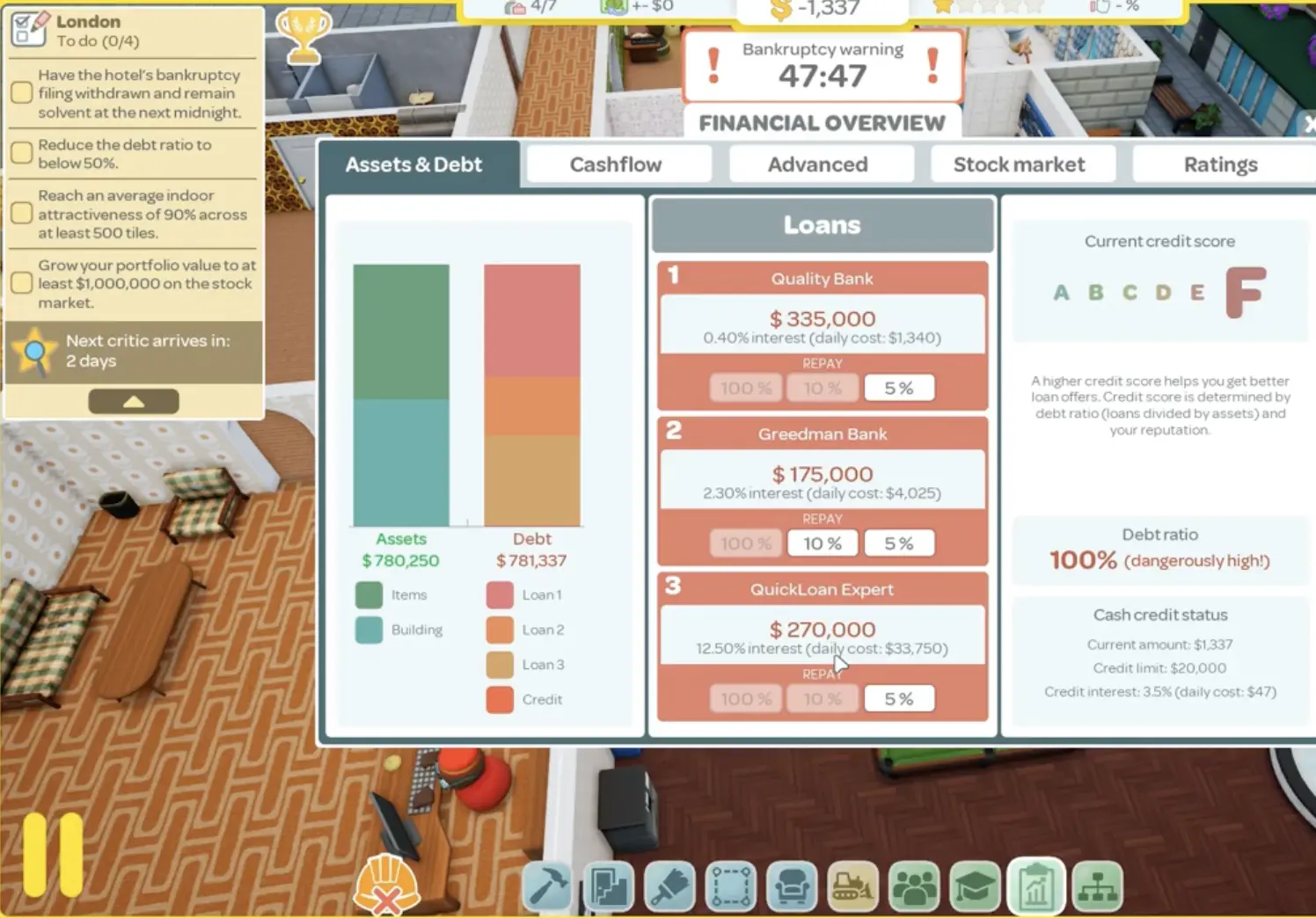
London is not a normal expansion scenario. It is a debt rescue.
You inherit an old hotel with a high debt ratio, outdated guest rooms, overpaid staff, expensive decorations in the wrong places, and a bankruptcy countdown. If you start by renovating everything, you can lose the scenario before the nicer rooms have time to earn anything.
This guide is written for Standard / Normal difficulty. On Casual, the same plan is more forgiving. On Challenging / Hard, follow the same order but spend less early: no vanity renovations, no optional expansion, and no stock market spending until the hotel is clearly solvent.
Fast Answer
| Problem | What to do |
|---|---|
| First action | Pause immediately. If a construction crew is active and not needed, send them home. Then open finances and staff. |
| Main objective | Withdraw the bankruptcy filing, stay solvent, and reduce the debt ratio below 50%. |
| First financial target | Sell enough high-value waste to repay the worst high-interest loan. |
| First staffing target | Sort staff by salary and cut expensive duplicates or harmful traits while keeping reception, cleaning, and maintenance functional. |
| First room target | Make existing rooms rentable before building new rooms. |
| First research target | Take upgrades that reduce construction, storage, laundry, or service friction. Avoid extra-credit upgrades unless you are forced. |
| Stock market target | Start after insolvency is gone and cash flow is stable. Do not invest survival money. |
| Expansion timing | Expand only after the worst loan is handled, daily finances are stable, and old rooms are earning. |
London Map and Scenario Data
Put these numbers in your head before planning the hotel.
| London rule | Value / impact |
|---|---|
| Buildable footprint | 24 x 24 |
| Maximum floors | 5 floors |
| Business tax | High, around 25% |
| Scenario type | Existing hotel recovery, not clean-slate construction |
| Main pressure | High debt ratio and bankruptcy risk |
| Debt ratio target | Below 50% |
| Early priority | Financial triage, not luxury renovation |
| Guest mix | Backpackers, Sporty guests, Sunbathers, Business guests, Brats, and Upper Crust guests |
| Special objective types | Debt ratio, indoor attractiveness, and stock market portfolio |
The 24x24 footprint looks generous, but that is a trap. London gives you space so you can rebuild later. It does not mean you should expand immediately.

London Is Harder Than Paris
If you remember Paris as another “fix an existing hotel” scenario, London is the sharper version of that idea.
| Scenario | Main lesson |
|---|---|
| Paris | Renovation and guest-experience recovery. |
| London | Renovation while under debt pressure, high tax, bankruptcy risk, and stock market objectives. |
In Paris, you can usually think about the hotel experience earlier. In London, you must treat the first day like emergency accounting. A nice lobby does not matter if your debts exceed your assets before midnight.
London Guest Priority
London supports several guest types, but you should not build for all of them at once.
| Phase | Guest priority | What they need |
|---|---|---|
| Survival phase | Backpackers and basic guests | Cheap working rooms, simple entertainment, cleaning, and basic refreshments. |
| Stabilization phase | Sporty guests | A compact gym, clean rooms, and enough basic comfort to raise reviews. |
| Growth phase | Sunbathers / Brats | Sunbathers usually care more about vacation comfort and sun/outdoor-style leisure; Brats tend to need stronger entertainment, bar, spa, or higher-comfort amenities. |
| Business phase | Business guests | Better rooms, ironing boards, minibars, conference-style services, and reliable reception. |
| Late phase | Upper Crust guests | Premium rooms, higher attractiveness, better drinks, spa/bar support, and stronger star ratings. |
For the advanced guest stage, use the Business and Upper Crust guest guide after the debt crisis is under control.
Opening 5 Minutes: Exact Route
This is the emergency opener. Do these before you start redesigning the hotel.
| Order | Action | Why it matters |
|---|---|---|
| 1 | Pause immediately. | The countdown and daily costs matter. Do not let time run while inspecting. |
| 2 | Dismiss idle builders / construction workers if they are active. | Idle workers cost money and do not help recovery. |
| 3 | Open finances and identify the worst-interest loan. | The highest-interest loan is your first repayment target. |
| 4 | Sort staff by salary. | You need to find expensive payroll waste quickly. |
| 5 | Fire expensive duplicates and dangerous traits. | Cut costs without breaking core service. |
| 6 | Locate high-value artwork and luxury waste. | A few expensive items can fund the first debt repayment. |
| 7 | Sell enough high-value waste to cover the worst loan. | Do not waste time selling tiny items first. |
| 8 | Repay the highest-interest loan. | This reduces the daily financial drain and helps stabilize the hotel. |
After this opener, move into room activation, research, attractiveness, and stock market progress.
Debt Ratio: What the Game Wants
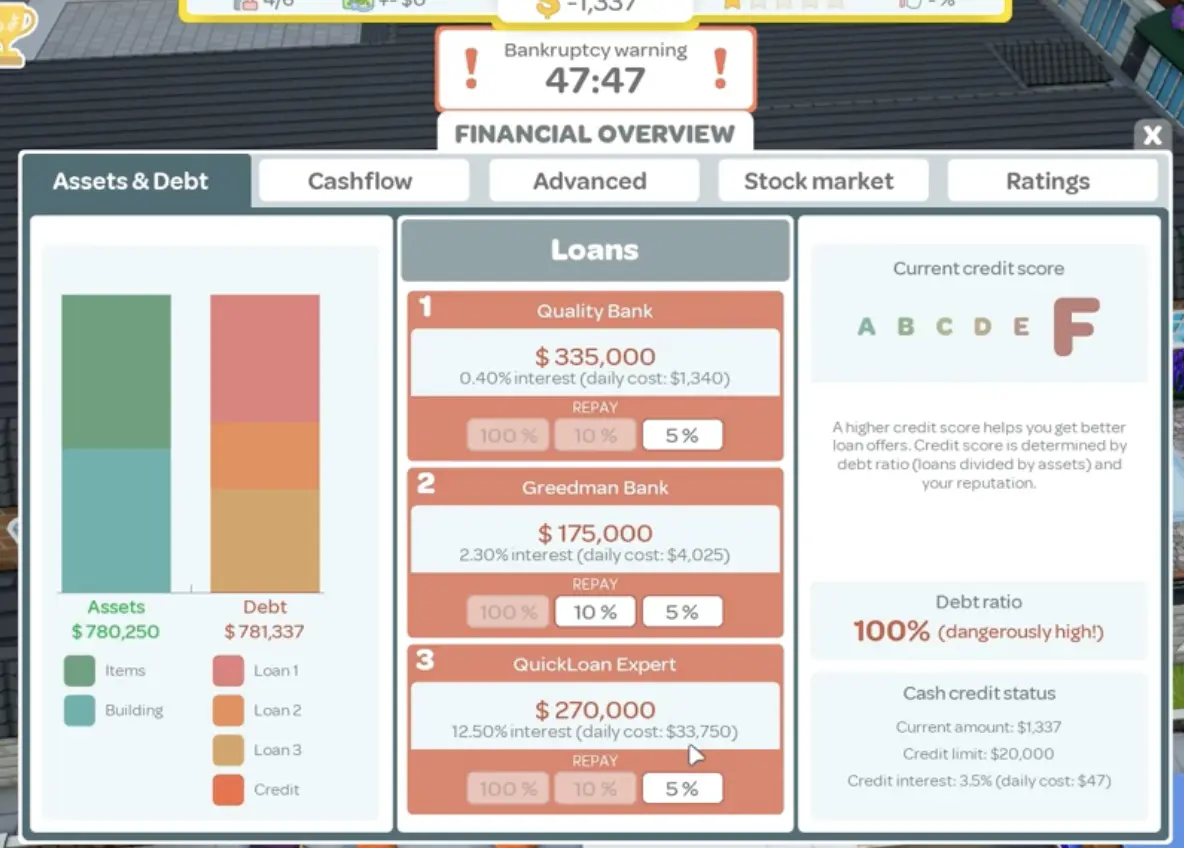
London’s debt-ratio objective is not vague: you need to bring the debt ratio below 50%.
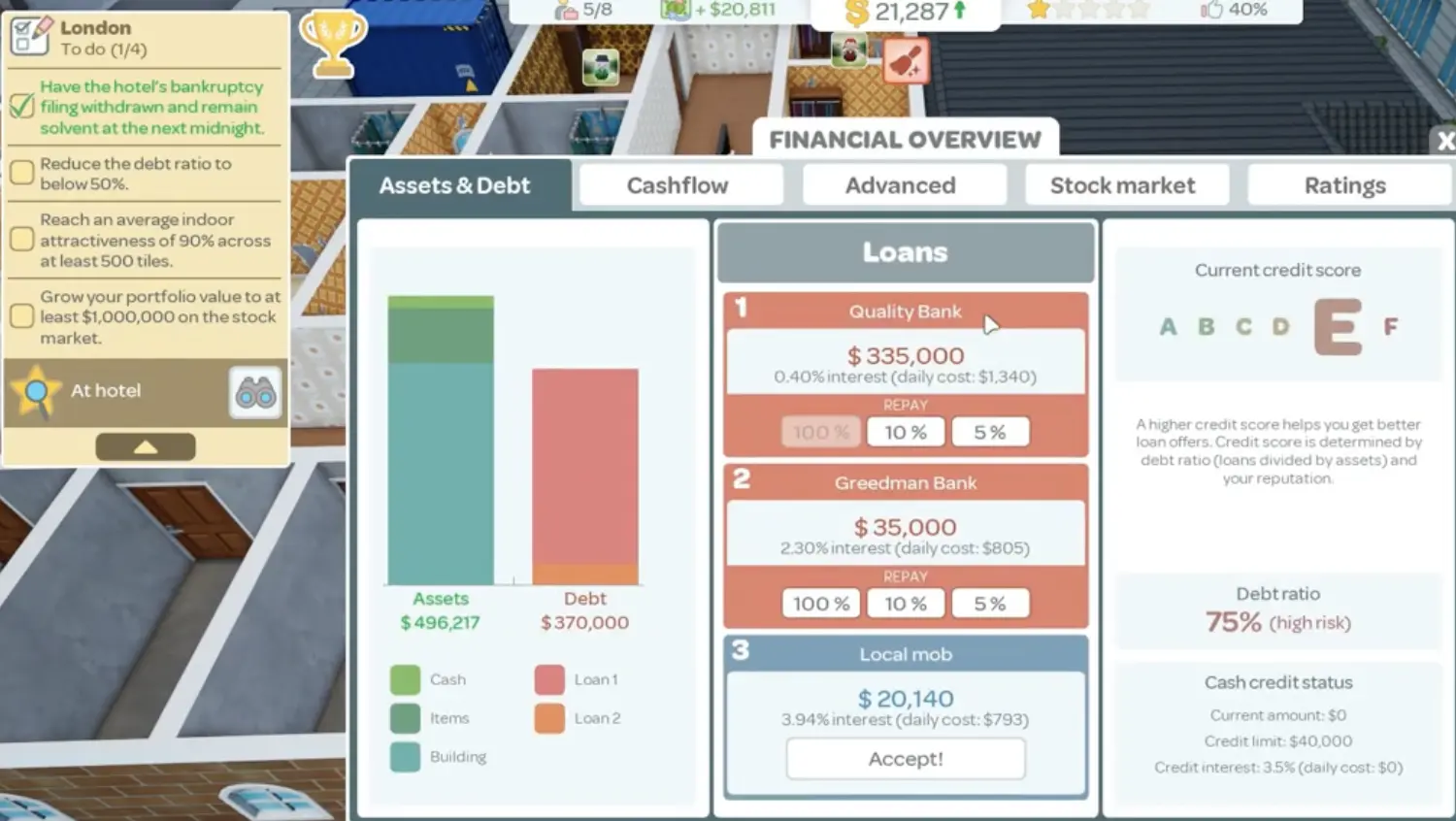
London’s objective list makes the recovery target clear: reduce the debt ratio below 50% while staying solvent.
A simple way to think about it:
Debt ratio improves when debt goes down or hotel asset value goes up.
Debt ratio gets worse when debt rises or useful asset value falls.
That means the right play is not “sell everything.” The right play is:
- sell expensive nonessential items,
- repay the worst debt,
- keep or improve assets that help the hotel earn,
- rebuild guest-facing value once the warning is under control.
Sell High-Value Waste Without Destroying Asset Value
London’s previous owner wasted money on luxury in the wrong places. That is your recovery fund, but selling items has a double effect: it gives cash, but it can also reduce hotel asset value.
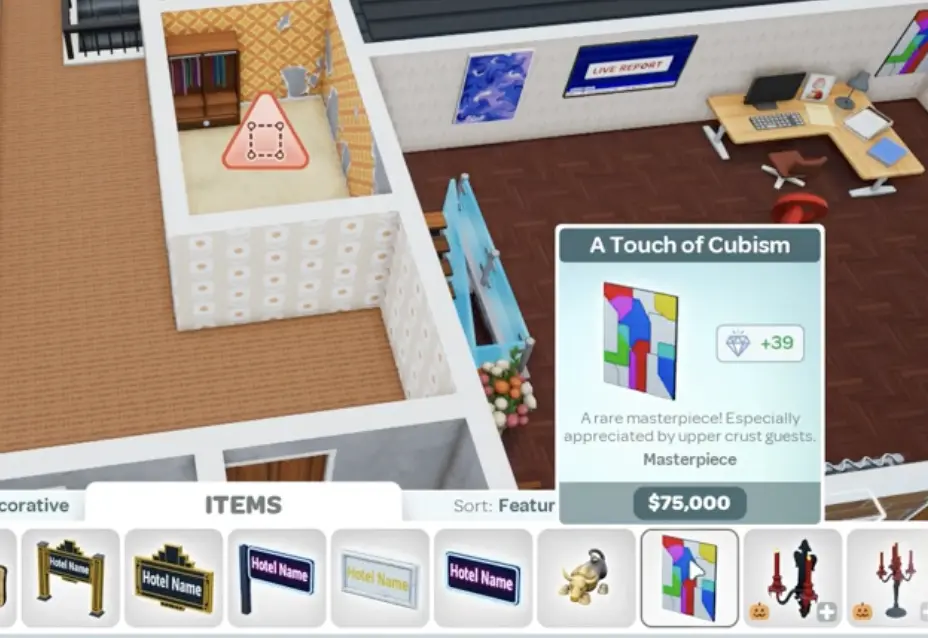
Use this sell / keep logic.
| Item | Action | Reason |
|---|---|---|
| Very expensive artwork in staff-only areas | Sell first | Big cash return and low guest value. |
| Expensive statues or fountains with no guest benefit | Sell if needed | Useful only if debt repayment needs cash. |
| Extra staff-room sofas / chairs | Move to guest areas | Seating can help guests more than staff luxury. |
| Cheap paintings | Move to rooms or corridors | Low sale value, useful attractiveness. |
| Useful kitchen / laundry / maintenance equipment | Keep | Service equipment protects reviews and income. |
| Old guest-room items | Replace gradually | Upgrading is good, but not before the worst debt is handled. |
The goal is to turn dead value into debt relief while keeping enough asset value and guest-facing quality to recover.
Repay the Highest-Interest Loan First
Do not spread repayments evenly. Do not repay the largest loan just because it looks scary. Repay the loan with the highest interest rate first.
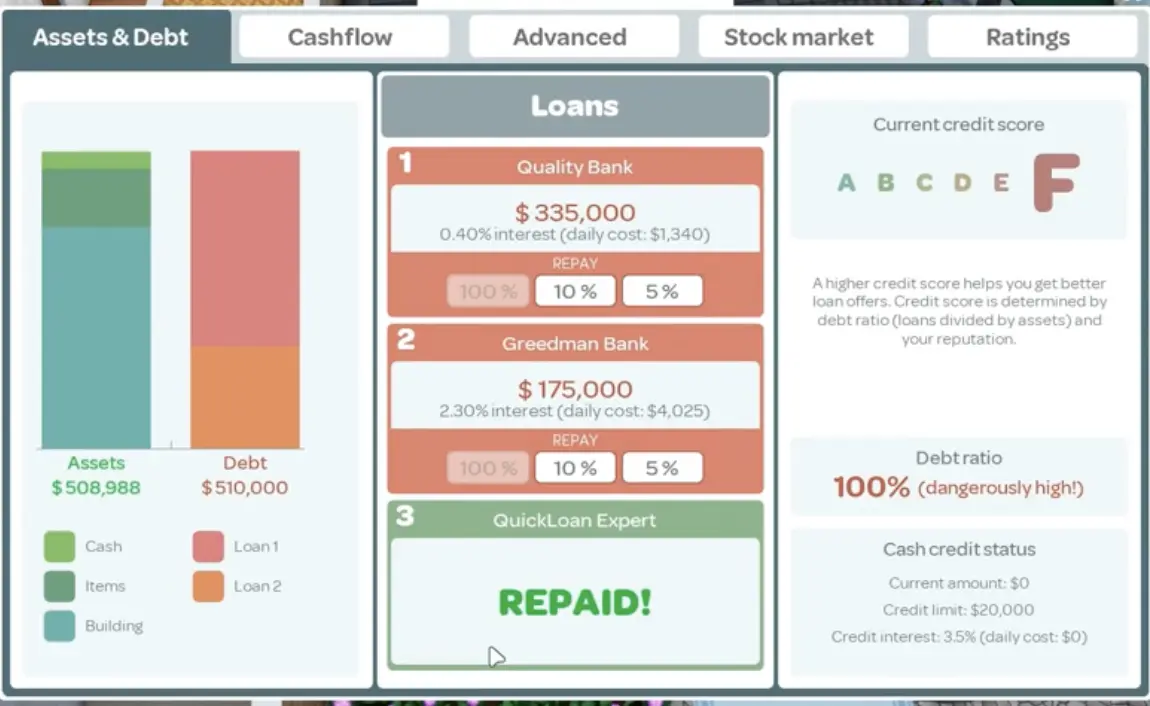
Use this priority:
| Priority | Debt type | Why |
|---|---|---|
| 1 | Highest-interest loan | It drains your recovery fastest. |
| 2 | Debt tied to bankruptcy risk | It can restart the insolvency countdown. |
| 3 | Medium-interest debt | Pay this down after the worst loan is gone. |
| 4 | Low-interest debt | Leave it until cash flow is safe. |
Keep some cash after repayment. A perfect debt payment that leaves you unable to finish rooms, pay wages, or handle a bad review can still kill the run.
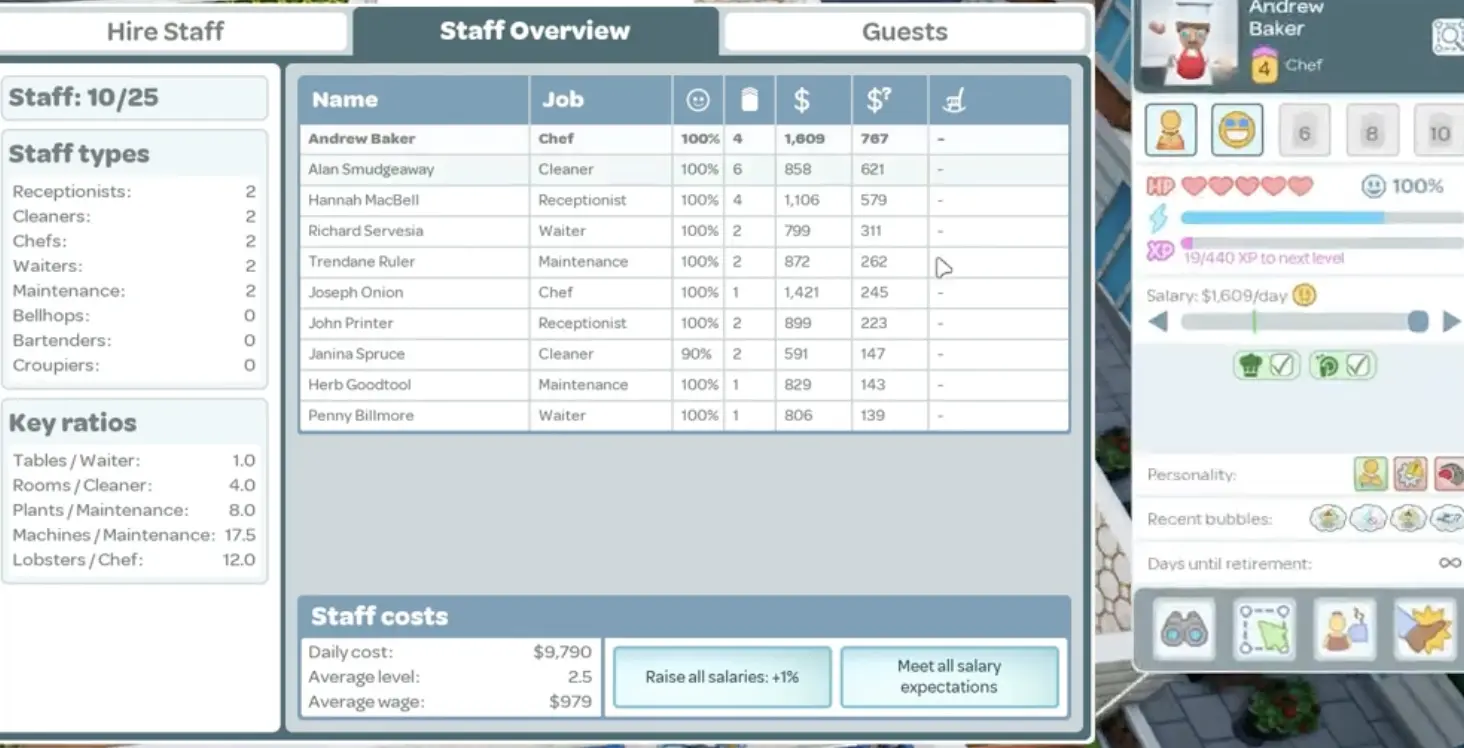
Staff Cuts and Traits
London’s starting hotel is too generous to staff compared with the guest experience. Fix that imbalance quickly.
Open the staff list, sort by salary, and ask two questions:
- Is this worker necessary right now?
- Is this worker’s trait worth paying for?
Dangerous Traits to Cut First
| Trait / behavior | Why it is dangerous |
|---|---|
| Stinky | Can upset nearby guests and staff, making service areas worse. |
| Thief | Can create hidden value loss and is not worth the risk in a debt scenario. |
| Lazy / slow worker | You pay wages but get weak output. |
| Easily distracted / lost in thought | Can slow critical service roles. |
| Bad guest-interaction trait | Risky for reception, waiters, and guest-facing service. |
| Expensive worker with no urgent role | Bad during the survival phase, even if the trait is not terrible. |
Useful Traits to Keep If Affordable
| Trait / strength | Good role |
|---|---|
| Faster bed-making / sheet-related bonuses | Cleaner / housekeeping. |
| Repair or maintenance bonuses | Maintenance worker. |
| Key / reception efficiency | Receptionist. |
| Positive mood effects | Guest-facing staff if wages are manageable. |
| Perfectionist-style quality traits | Useful later, but not always affordable on day one. |
Do not fire every cleaner. London still needs rooms cleaned, beds made, and laundry handled. Cut duplicates and bad value first, not the whole service chain.
Make Existing Rooms Earn First
After the emergency opener, inspect existing rooms.
Some London rooms are ugly but close to functional. Those are valuable. Fixing one missing required item is cheaper than building a new room.
Check:
| Room issue | Fix |
|---|---|
| Missing bed | Add the cheapest suitable bed first. |
| Missing wardrobe | Add one before decorating. |
| Missing luggage rack | Add one; this is often a cheap room activation fix. |
| Bad bathroom item | Upgrade the worst negative-value fixtures gradually. |
| No proper zoning | Re-zone the space before buying luxury. |
| Dirty room | Add cleaner capacity or give them time to catch up. |
| Old wallpaper / floor | Upgrade after the room is rentable and debt is calmer. |
A room that is plain but earning is better than a beautiful room you cannot afford to finish.
Research Tree Priority for London
Research matters in London because the right upgrade can reduce friction and save money over time.
Research / upgrade points come from guest reviews and checkouts. A useful rule of thumb is that each review gives a base amount plus more as your star level improves, so early research can feel slow until the hotel starts receiving better reviews. Do not waste those early points.
| Priority | Research / upgrade type | Why it helps London |
|---|---|---|
| 1 | Speedy Builders | Shorter construction time means less labor cost during renovations. |
| 2 | Larger Shelves / storage efficiency | Helps service rooms work in tight or awkward layouts. |
| 3 | Laundry upgrades such as drying improvements | London has many old rooms; laundry throughput prevents review problems. |
| 4 | Staff limit only if needed | Useful when cleaners or service staff are truly capped. |
| 5 | Elevator / vertical access | Useful later, but London has only 5 floors and does not need a New York-style rush. |
| 6 | Skill training | Good after finances stabilize, not before survival. |
| 7 | Credit / loan upgrades | Avoid unless you are forced. London’s goal is to reduce debt, not expand borrowing. |
If you are not sure what to pick, take upgrades that reduce time, walking, storage, laundry, or construction pressure. Delay upgrades that only let you spend more.
After the Opener: Recommended Route
This route starts after you have paused, cut obvious waste, and repaid or planned the highest-interest debt.
| Phase | Goal | Actions |
|---|---|---|
| 1 | Room activation | Fix missing required items in existing rooms so they can earn. |
| 2 | Basic guest comfort | Add cheap seating, drinks, and simple entertainment if reviews need them. |
| 3 | Research recovery upgrades | Prioritize builder speed, storage, laundry, and service efficiency. |
| 4 | Compact gym | Add a small gym once cash flow improves, especially for Sporty guests and star progress. |
| 5 | Attractiveness push | Upgrade reception, corridors, rooms, bathrooms, and dining areas. |
| 6 | Debt-ratio push | Keep paying down debt while preserving useful asset value. |
| 7 | Stock market | Invest only spare cash after survival and cash flow are stable. |
| 8 | Controlled expansion | Add rooms or floors only when existing rooms are profitable. |
| 9 | Advanced guests | Build for Business and Upper Crust guests once the hotel is stable. |
For Phase 4, keep the gym small. Build it only after the worst loan is repaid or under control, staff costs are cut, several rooms are earning, and you have enough cash to build without taking a panic loan. Reusing an oversized staff room or spare interior space is safer than expanding the building just to add fitness equipment.
The opener saves the hotel; this route rebuilds it.
Indoor Attractiveness Objective
London can ask you to raise indoor attractiveness across a meaningful number of tiles. This is not a signal to decorate every corner. It is a signal to upgrade the places guests actually see.
Upgrade these areas first:
| Area | Why |
|---|---|
| Reception | Every guest passes through it. |
| Main guest corridors | Frequent traffic means the value is felt repeatedly. |
| Existing bedrooms | Helps room value and guest experience. |
| Public bathrooms | Cheap fixture upgrades can remove obvious weaknesses. |
| Restaurant / dining area | Guest-facing and useful for review quality. |
| Activity rooms | Improves both attractiveness and guest satisfaction. |
Do not spend early attractiveness money in staff-only corners unless staff mood is a direct problem.
Stock Market Objective
The stock market objective is a mid-game task, not a day-one cash fix.
Your goal is to grow a portfolio value, but the money you invest is money you cannot use for rooms, staff, debt repayment, or emergency fixes. That makes timing more important than the exact first stock choice.
When to Start Investing
Start the stock market objective only when most of these are true:
| Recovery signal | Why it matters |
|---|---|
| The worst high-interest loan is repaid | You stopped the biggest daily drain. |
| Daily cash flow is stable or positive | Investments will not starve the hotel. |
| Rooms are clean and earning | The hotel can generate more cash while money is invested. |
| You have a cash buffer after wages and debt payments | You can survive a bad review or repair cycle. |
How to Invest Safely
Use this simple approach:
- Open the stock market only after stabilization.
- Start with a small portion of spare cash, not your operating cash.
- Keep enough cash for wages, cleaning, maintenance, and room upgrades.
- Check the portfolio objective after each investment cycle.
- Do not sell useful hotel assets just to chase stock value early.
- If the hotel becomes unstable again, stop investing and return to operations.
The stock market objective is easier when the hotel is already making money. Trying to force it during insolvency turns a recovery scenario into gambling.
Recovery Signals: When Are You Safe?
London feels stressful because it is not always obvious when the hotel is out of danger.
| Signal | Meaning |
|---|---|
| Bankruptcy filing is withdrawn | You escaped immediate failure. |
| Debt ratio is clearly moving toward below 50% | The balance sheet is recovering. |
| Highest-interest loan is gone | Daily debt pressure is much lower. |
| Daily income covers wages and loan costs | You can stop making desperate sales. |
| Existing rooms are rentable and occupied | The hotel is earning from assets you already own. |
| Cleaners are keeping up | Reviews will not collapse from dirt and laundry. |
| You can hold a cash buffer overnight | You are not one bad bill away from danger. |
| You can upgrade one room without taking a loan | Renovation is now controlled, not desperate. |
Do not expand just because the first warning disappears. Wait until multiple signals are positive.
Common Mistakes
| Mistake | Why it fails |
|---|---|
| Renovating every room immediately | You spend cash before the hotel survives. |
| Keeping high-paid staff because they look useful | Wages can kill the run before quality matters. |
| Selling cheap decor instead of expensive waste | Tiny sales do not solve the loan problem. |
| Selling useful assets without repaying debt | You lower hotel value but do not reduce the danger enough. |
| Ignoring research | You miss upgrades that reduce renovation friction. |
| Investing in stocks too early | You lock up money needed for survival. |
| Building for Upper Crust guests immediately | Premium guests need a hotel that is already stable. |
| Expanding because the map is 24x24 | The footprint is for later rebuilding, not day-one spending. |
London Checklist
Use this before you unpause for a long stretch.
| Check | Done? |
|---|---|
| Idle construction workers are dismissed. | |
| The highest-interest loan is identified. | |
| Expensive staff-only artwork is sold or marked for sale. | |
| Staff are sorted by salary. | |
| Duplicate or harmful-trait staff are fired. | |
| Enough cleaners, reception, and maintenance remain. | |
| The worst loan is repaid or has a clear repayment plan. | |
| Existing bedrooms are checked for missing required items. | |
| Basic guest-facing seating or refreshments are available if reviews need them. | |
| Research points are spent on recovery upgrades, not random luxury. | |
| Debt ratio is moving toward below 50%. | |
| You have a cash buffer before starting renovations or stock purchases. |
FAQ
What difficulty is this London guide for?
This route is written for Standard / Normal difficulty. On Casual, the same plan is safer. On Challenging / Hard, follow the same order but spend less, delay the stock market longer, and avoid optional renovation until the high-interest debt is gone.
What should I do first in London?
Pause, dismiss idle builders if any are active, open the finance screen, sort staff by salary, sell high-value waste, and repay the highest-interest loan. Do not begin with full renovation.
What debt ratio do I need in London?
London’s debt-ratio objective is to get below 50%. If you are still at 70%, 80%, or 100%, keep reducing debt while preserving useful asset value.
Why do I keep going bankrupt in London?
Your debts are too high compared with your assets, and interest is draining recovery. You may also be spending on renovation before fixing staff cost and high-interest debt.
Should I sell the expensive paintings?
Yes, if they are nonessential and especially if they are in staff-only areas. Expensive art can fund the first major debt repayment. Keep cheap decor if it can be moved into guest-facing areas.
Why not sell everything?
Because selling items can reduce hotel asset value. London’s danger is debt compared with assets, so selling useful assets without reducing debt can keep the balance sheet weak.
Which loan should I repay first?
Repay the highest-interest loan first. The largest loan is not always the most urgent if another loan is draining money faster.
Which staff should I fire first?
Fire expensive duplicates and dangerous traits first. Stinky, Thief, lazy, very slow, distracted, or harmful guest-interaction traits are bad during recovery. Keep enough cleaners, reception, and maintenance to keep the hotel functioning.
What research should I take first?
Prioritize recovery upgrades: faster builders, larger shelves, laundry improvements, and staff limit only if needed. Avoid credit upgrades unless you are forced because London is about reducing debt.
When should I start the stock market objective?
After the bankruptcy warning is gone, the worst loan is repaid, daily cash flow is stable, and you have a cash buffer. Do not invest money you need for wages or room recovery.
Which guests should I focus on in London?
Start with basic income from Backpackers and lower-cost guests. Add Sporty support with a compact gym during stabilization. Prepare Sunbathers / Brats only when objectives or facilities justify it. Bring in Business guests once cash flow and services improve. Treat Upper Crust guests as a late-stage target.
Continue Reading in the Hotel Architect Guide Cluster
This article is part of our Hotel Architect strategy cluster. Use these guides to keep learning the game's core systems and routes.
Complete Hotel Architect New York guide. Compare Bootstrap, City Loan, and Investment. Master the 10x10 footprint, 25-floor limit, and 10th-floor rush method.
Strategy GuideHotel Architect Money Guide: Fix Debt & Negative Cash FlowStop losing money in Hotel Architect! Our guide covers fixing negative cash flow, managing staff costs, safe loan strategies, and recovering from bankruptcy.
Guest GuideHotel Architect Guide: Business & Upper Crust GuestsMaster Hotel Architect advanced guests! Learn room requirements to attract Business, Brat, and 5-star Upper Crust guests. Fix why guests aren't showing up.
Strategy GuideHotel Architect Star Guide: Fix Critics & Get 5 StarsStuck at 3 or 4 stars in Hotel Architect? Master the critic system, earn upgrade points, and learn the Bar and Spa requirements to hit a 5-star rating.