Game Hub
Mechanicus 2 Beginner Guide & Faction Tips
Start Mechanicus 2 with the right faction, prologue expectations, early combat habits, Cognition, Dominion, Requisition, Vigilance, and mistakes to avoid.
Warhammer 40,000: Mechanicus II is not just the first game with a new campaign attached. If you played the original, the biggest adjustment is that you cannot rely on old Cognition habits, old mission pacing, or old ideas of what a safe Tech-Priest turn looks like. If you are new, the most important thing to know is that the two playable campaigns do not teach the same skills.
The safest way to start is simple: play the Necron campaign first if you want to learn the sequel with fewer moving parts. Pick the Adeptus Mechanicus campaign first if you specifically want the harder, more technical side with more resource pressure and unit synergy to manage.
This guide is for your first several hours. It explains the prologue, which faction to start with, how Cognition and Dominion work at a practical level, why turn order feels different, and which early mistakes will cost you the most momentum.
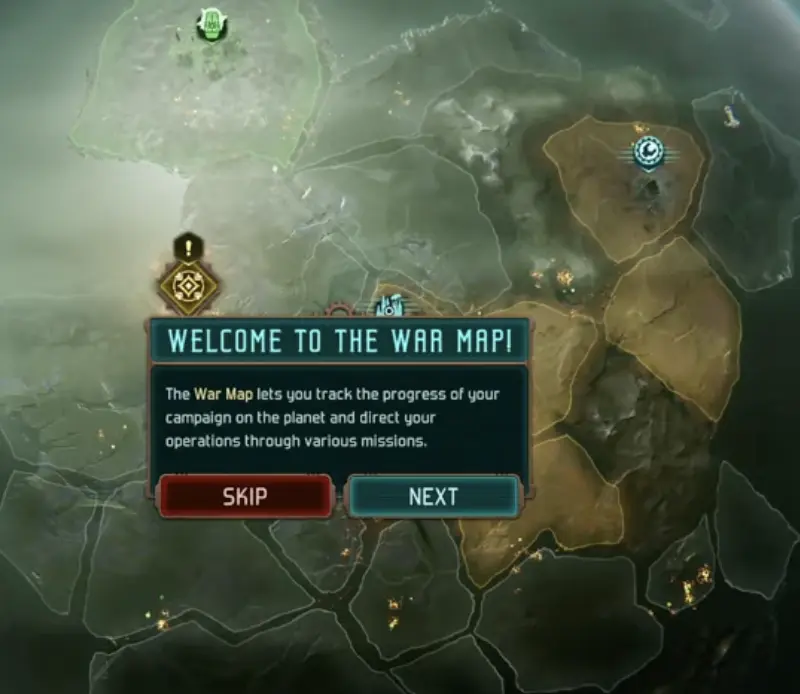
The campaign layer matters early. Do not treat missions as isolated fights; your resource choices carry into later operations.
Direct Answers
| Question | Answer |
|---|---|
| Should I play Mechanicus 1 first? | No. Mechanicus 2 follows the first game, but the new planet, dual campaigns, and tutorials make it playable without replaying the original. |
| Which campaign should I start first? | Start with Necrons if you want the smoother learning curve. Start with Adeptus Mechanicus if you want the more complex tactical side first. |
| Does the game let me try both sides first? | Yes. The opening prologue gives you a short taste of both factions before the larger campaign choice fully matters. |
| Are the two factions just reskins? | No. Necrons and Adeptus Mechanicus use different campaign resources, recruitment logic, combat tempo, and tactical priorities. |
| Is Cognition the same as Mechanicus 1? | No. Cognition returns, but units now generate and spend it differently enough that old habits can mislead you. |
| What is Dominion? | Dominion is the Necron momentum system. Damage builds the gauge, and higher Dominion levels unlock or improve combat tools. |
| What is Vigilance? | Vigilance is an enemy pressure meter. Stratagems can give bonuses, but they raise Vigilance and can add enemies if pushed too far. |
| What is the biggest beginner mistake? | Committing too much before understanding the next mission: Requisition, Lord availability, recovery, and territory pressure all carry forward. |
Beginner Rules
If you only remember three things before starting, make them these:
- Use the prologue as your practical faction preview. The opening lets you feel both sides briefly, so pay attention to which combat rhythm feels clearer.
- Do not assume old Mechanicus 1 habits still work. Cognition, turn sequencing, cover usage, and campaign pacing have changed enough that returning players need to relearn the basics.
- Treat every early mission as part of a campaign economy. Requisition, Lord availability, Reanimation, unit recovery, and city control all affect what you can do next.
Do You Need to Play Mechanicus 1 First?
No. If you are coming in fresh, you can start with Mechanicus 2.
The sequel follows events and characters from the first game, so returning players will notice more names, grudges, and faction context. But the core campaign is on a new world, and the dual-faction structure makes the sequel easier to enter than a direct lore dump would be.
For old players, the better question is not whether you need a lore refresher. The better question is: what habits should you leave behind?
Mechanicus 1 rewarded a very specific kind of Cognition planning. Mechanicus 2 still rewards sequencing, but it splits the experience across two faction systems. Necrons build pressure through Dominion and Reanimation. Adeptus Mechanicus still care about Cognition, but the way units generate and spend it has changed enough that you should not expect the same rhythm.
The Prologue: Use It Before Choosing a Campaign
Before you settle into a full campaign, Mechanicus 2 gives you a short practical preview of both sides. You are not making a blind faction choice from a menu with no context. The opening throws you into the conflict from both perspectives, letting you feel the difference between Adeptus Mechanicus coordination and Necron counter-pressure.
Use that prologue as a test:
| During the prologue, notice… | What it tells you |
|---|---|
| You prefer direct pressure and durable units | Necrons are probably the smoother first campaign. |
| You enjoy layered setup and ability timing | Adeptus Mechanicus may be more satisfying first. |
| You feel overwhelmed by AdMech resource and positioning demands | Start Necrons, then return to AdMech second. |
| You enjoy solving the harder tactical puzzle immediately | Start AdMech and accept the steeper opening curve. |
The prologue does not show the full depth of either faction, but it gives enough of a preview to make the campaign choice less abstract.
Which Campaign Should You Start First?
The best first campaign for most players is Necrons.
That does not mean the Necron campaign is shallow. It means the early rules are easier to internalize. Necron units tend to be more self-sufficient, their Lord identities are easier to read, and Dominion gives you a clear direction: deal damage, build power, unlock stronger options during the fight.
Adeptus Mechanicus is the better first campaign only if you already know you want a more complicated start. Their strength comes from synergy, resource control, randomized mission recruitment options, cover discipline, and careful Cognition spending.
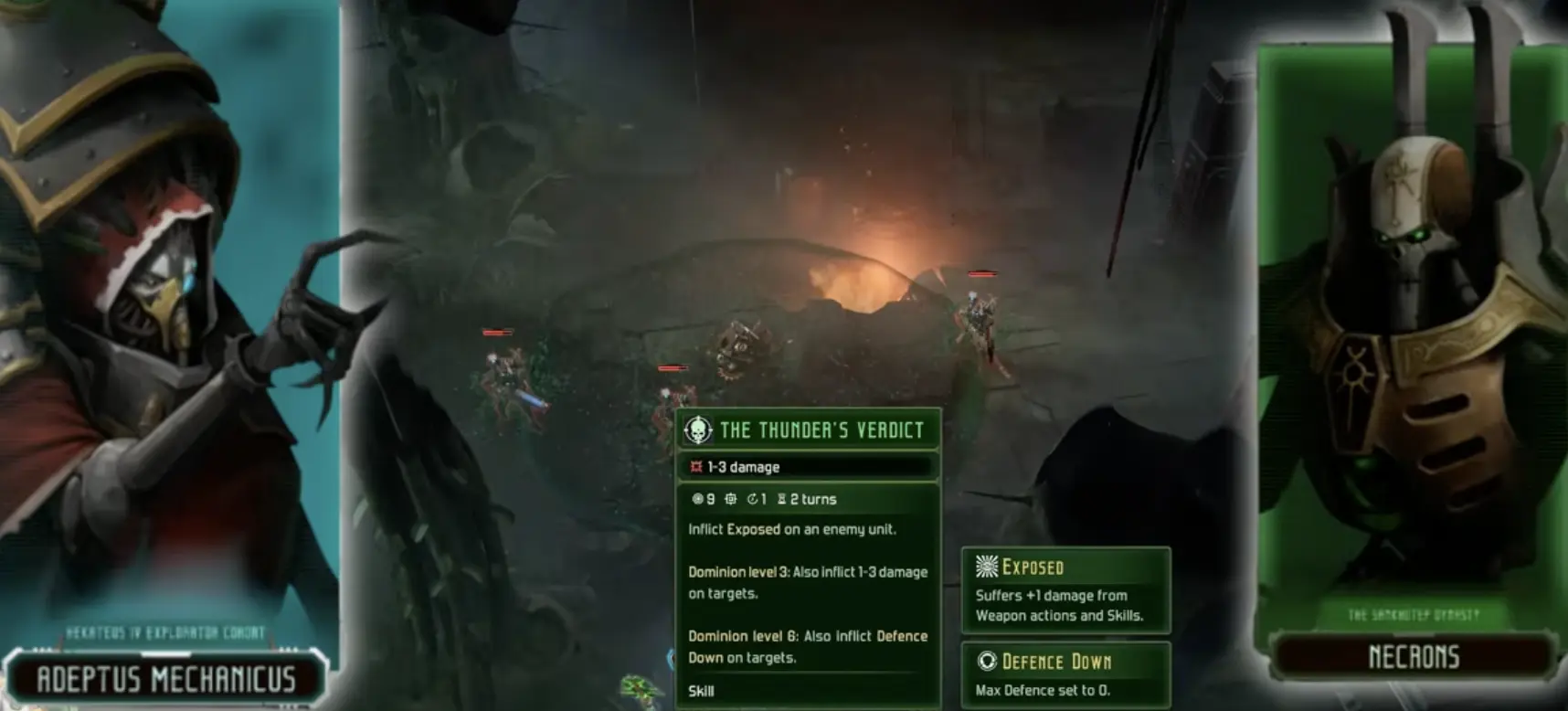
The two campaigns share the same war, but they do not play like the same faction with different models.
For the full decision breakdown, use the Which Faction Should You Play First? guide. The short version is:
- Pick Necrons first if you want a cleaner learning curve, clearer momentum, and a more direct first campaign.
- Pick Adeptus Mechanicus first if you want higher synergy, more resource pressure, and a harder technical opening.
- If you are unsure after the prologue, start with Necrons and return to AdMech after the campaign rhythm makes sense.
Necrons: What to Learn First
Necrons are built around Reanimation, Dominion, and Lord-specific unit identity.
The most important early lesson is that losing a normal Necron unit does not always mean it is gone forever. Destroyed units can enter Reanimation, then return after a countdown or through skills that speed up the process. That changes how you judge trades. You can sometimes accept damage or temporary losses if the fight gives you enough time to rebuild pressure.
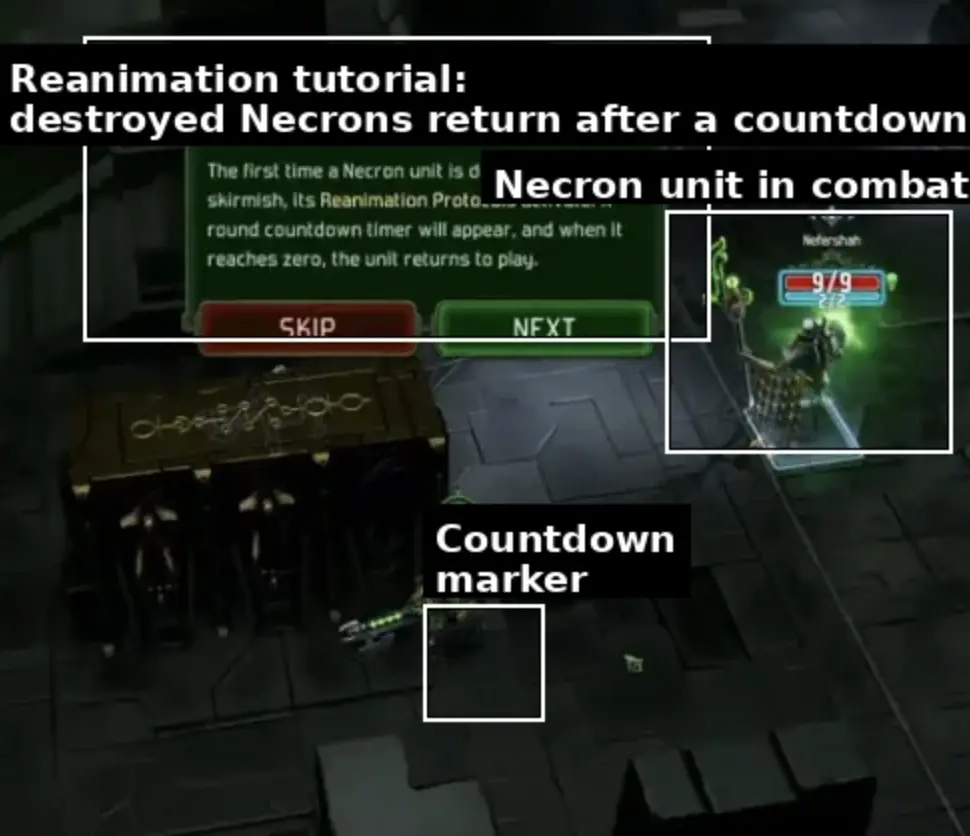
Reanimation is not free healing. It is a tempo tool: the unit may return, but you must survive while it is off the board.
Dominion Explained
Dominion is the Necron power curve inside combat. When Necron units deal damage, the Dominion gauge fills. When the gauge fills completely, you gain a Dominion level, and certain weapons, skills, or army effects can become stronger or become available.
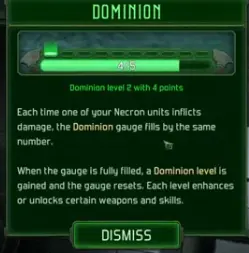
Dominion rewards pressure. Early on, your goal is to keep dealing damage so the fight opens stronger options.
For beginners, the practical rule is:
| Dominion habit | Why it matters |
|---|---|
| Keep attacking instead of waiting passively | Damage builds Dominion. Passive turns slow your faction down. |
| Check skill requirements before moving | Some options only matter after you reach a specific Dominion level. |
| Use weaker enemies to build momentum | You can turn small kills into higher Dominion before the tougher target becomes the priority. |
| Do not panic when Dominion resets early | The system starts modestly, then becomes stronger as campaign upgrades improve it. |
The Necron campaign becomes more satisfying once you stop thinking of Dominion as a resource to hoard. It is more like a battle tempo meter. If you are dealing damage, you are moving the faction toward its stronger state.
Adeptus Mechanicus: What to Learn First
Adeptus Mechanicus is built around Requisition, Cognition, Stratagems, and careful deployment.
This side is less forgiving early because your units do not simply walk into every fight as a fixed army. You spend Requisition to bring units into a mission, and the available unit cards can vary. That means you need to think about the Leader, mission type, cost, cover, and what you can afford to lose before the fight begins.
Requisition Is Not Just Mission Money
Requisition is generated by your forge cities and later by other key structures, then spent to recruit units for deployment.
The beginner trap is spending too much because a mission looks important. If you overcommit early, you may win the immediate fight but limit your options when the next operation asks for a different answer.
Use this rule:
| Situation | Early choice |
|---|---|
| First mission with simple enemies | Bring enough to win, not everything you can afford. |
| Unknown objective | Keep the force flexible instead of spending on one expensive answer. |
| High Vigilance risk | Avoid stacking extra pressure unless the reward is worth it. |
| Low Requisition reserve | Use basic units and protect your key Leader. |
| Strong reward mission | Spend more only if the reward solves a real campaign problem. |
Stratagems and Vigilance
At the start of some missions, you can choose Stratagems. They give bonuses, but they raise enemy Vigilance. When Vigilance gets too high, the enemy response becomes more dangerous and can add additional enemies.
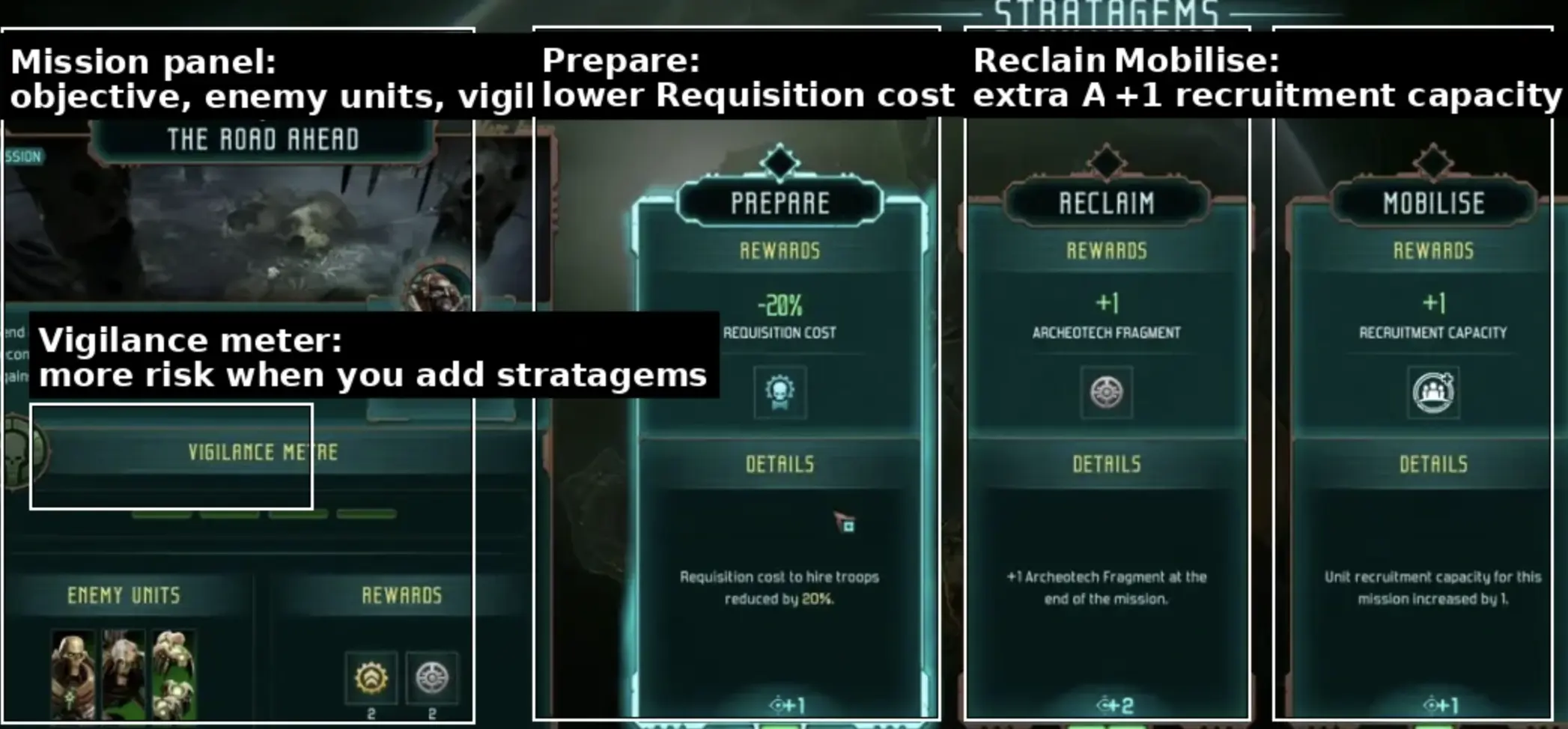
Stratagems are not free bonuses. Every point of Vigilance is a risk you choose before the mission starts.
Stratagem Rule for Beginners
Do not pick three Stratagems just because the game lets you.
Start with one useful bonus and learn how much enemy pressure it creates. Once you know how comfortable you are with the mission structure, you can take bigger risks for better rewards.
| If you are… | Stratagem approach |
|---|---|
| Learning a mission type | Take zero or one Stratagem. |
| Low on Requisition | Avoid making the fight longer or messier. |
| Confident in your Leader and units | Take one strong reward-focused Stratagem. |
| Farming a specific resource | Take the bonus only if you know the exit condition. |
| Already struggling with reinforcements | Stop raising Vigilance until your tactics improve. |
Cognition vs Dominion
This is the most important old-player adjustment.
| System | Faction | What it rewards |
|---|---|---|
| Cognition | Adeptus Mechanicus | Tactical setup, unit-specific generation, and deliberate spending. |
| Dominion | Necrons | Damage, momentum, and escalating combat power. |
Cognition is not just the old resource again. Different AdMech units can generate it in different ways, and Leaders spend it through different tools. Rangers may reward safe-distance shooting. Servitors may create value by absorbing pressure. A Leader who empowers attacks creates different priorities from a Leader who disables or weakens enemies.
Dominion is easier to understand at first because it mainly asks you to keep damaging enemies. But that does not make it brainless. The skill comes from knowing when to build Dominion on weaker targets, when to push into a key enemy, and when to protect a unit that is about to return through Reanimation.
Simple Rule
If you are playing AdMech, ask:
How do I generate Cognition this turn, and what is the best way to spend it?
If you are playing Necrons, ask:
How do I keep damage flowing so Dominion reaches the next useful level?
Early Combat Habits That Matter
Mechanicus 2 is still a tactics game first. Strong campaign choices help, but bad turns will still punish you.
1. Choose Your Activation Before Spending Actions
Mechanicus 2 puts more emphasis on choosing which unit acts now. Do not just click the unit that looks most obvious. Ask which activation improves the rest of the turn.
For example, if a Ranger can generate Cognition from safe distance, activate that Ranger before the Leader who wants to spend Cognition. If a Servitor needs to block pressure first, move the Servitor before exposing your Leader.
2. Do Not Overextend Your Leader
Leaders are powerful, but they are also the easiest units to overcommit because they feel safe early. If your Leader walks too far ahead, you may spend the next two turns repairing a mistake instead of controlling the fight.
3. Use Terrain as a Plan, Not Decoration
Cover, lanes, elevation, and destructible terrain are part of the fight. AdMech generally benefits from using terrain to stabilize the line. Necrons can be more comfortable breaking through or forcing the issue, especially once Dominion starts climbing.
4. Kill With a Purpose
A kill is not always the best move if it leaves your key unit exposed. Sometimes the better turn is weakening the enemy who acts next, building Dominion, generating Cognition, or forcing an enemy to waste movement.
Example: one enemy is already low enough that your ranged unit can finish it next turn, but another enemy is about to attack your Leader. In that situation, chasing the low-health enemy may be worse than damaging, disabling, or body-blocking the threat that acts next.
5. Keep One Recovery Option
For AdMech, that may mean keeping Requisition and unit choices conservative. For Necrons, it may mean understanding which units can come back and how quickly. Either way, do not play every early mission like the current turn is the last turn that matters.
Common Beginner Mistakes
| Mistake | Why it hurts |
|---|---|
| Starting AdMech and expecting Mechanicus 1 muscle memory to carry you | Cognition and campaign flow have changed enough to punish old assumptions. |
| Ignoring what the prologue teaches you | The opening preview gives real clues about which faction rhythm feels better. |
| Treating Necrons as slow and weak too early | Their power curve improves as Dominion and Lord options open up. |
| Spending too much Requisition in early AdMech missions | You can win one fight and make the next one harder. |
| Taking too many Stratagems | Vigilance turns optional greed into real enemy pressure. |
| Ignoring side-task opportunity costs | Sending a Lord away can reward you, but that Lord is unavailable while assigned. |
| Building around one favorite unit too early | Early availability and mission needs can change your best deployment. |
| Forgetting campaign consequences | Forge cities, tomb pressure, resources, and mission timing all connect. |
Best First Path
For most players, the cleanest first path is:
- Play through the prologue and pay attention to which faction rhythm feels clearer.
- Start the Necron campaign.
- Learn positioning, target priority, Reanimation, and Dominion.
- Do not judge Necrons only by the first few fights; their momentum system improves.
- After the basic campaign rhythm makes sense, start or switch to Adeptus Mechanicus.
- Treat AdMech as a synergy puzzle, not as the exact sequel to your Mechanicus 1 playstyle.
If you are a returning player who specifically wants the harder tactical puzzle first, it is fine to start with AdMech. Just do not overuse Stratagems, do not overspend Requisition, and do not assume every Cognition habit from the first game still applies.
Suggested Reading Path
Use this hub as the starting point, then move into the guide that matches your next decision.
| Next question | Guide |
|---|---|
| I still do not know which campaign to start. | Which Faction Should You Play First? |
| I played the first game and want the major changes. | Mechanicus 2 vs Mechanicus 1 |
| I started Necrons and need early campaign help. | Necron Campaign Tips |
| I started AdMech and need Requisition and Vigilance help. | Adeptus Mechanicus Campaign Tips |
| I am worried about wasting resources. | Best Early Upgrades and Resources |
FAQ
Does the prologue force you to try both factions?
The opening gives you a short taste of both sides before the larger campaign choice fully matters. Use it as a practical preview rather than deciding entirely from the menu.
Can I switch campaigns midway?
Yes, but for a cleaner first experience, stay with one side long enough to understand its economy and combat rhythm before jumping to the other campaign.
Are Necrons easier than Adeptus Mechanicus?
In the early game, yes. Necrons are easier to understand because they have stronger individual unit identity, Reanimation, and a clearer momentum system. Adeptus Mechanicus has more synergy and a higher ceiling, but it asks more from you.
What is the most important AdMech resource?
Requisition is the first one to respect. It controls what you can recruit for missions, and careless spending can reduce your options later.
What is the most important Necron mechanic?
Dominion. It rewards damage and turns pressure into stronger weapons, skills, and army effects as the fight develops.
Should I use every Stratagem available?
No. Stratagems increase Vigilance, and high Vigilance can make a mission harder. Use one good Stratagem before you start stacking risk.
Is this a full build guide?
No. This is a first-hours guide. Full Lord builds, unit tier lists, and achievement routes should come after more campaign testing and patch stability.
Warhammer 40000 Guide Cluster
Explore the main Warhammer 40000 guides, from beginner strategy to builds, tiles, Gambits, bosses, and first-win routes.
Choose your first Mechanicus 2 campaign with a clear Necrons vs Adeptus Mechanicus breakdown for difficulty, story perspective, combat, and resources.
Returning Player GuideMechanicus 2 vs Mechanicus 1: What ChangedSee what changed in Mechanicus 2 for returning players, including factions, cover, terrain destruction, Cognition, Dominion, turn order, and campaign scale.
Faction GuideMechanicus 2 AdMech Guide: Cognition & UnitsDominate AdMech missions in Mechanicus 2. Learn to generate Cognition, manage Vigilance, deploy the best units, and utilize powerful Stratagems.
Faction GuideMechanicus 2 Necron Guide: Dominion & ReanimationLearn the Mechanicus 2 Necron campaign with practical tips for Dominion party-wide buffs, Reanimation, Lords, terrain destruction, units, and early mistakes.
Resource GuideMechanicus 2 Early Upgrades: Resources, Lords & DominionPrioritize early upgrades in Mechanicus 2 with concrete AdMech Requisition rules, Forge-Temple logic, Necron Lord routing, and Dominion thresholds.