Black Jacket Guide
Guide to Black Jacket Mechanics: Whisper, Drain & More
Confused by Black Jacket mechanics? Learn how Sleeves, Soul Coins, Hollow, Whisper, Demand, Awaken, and tie-breakers work in our complete game guide.
Black Jacket is easy to understand at the table level: get close to 21 without going over. The confusing part is everything the game adds on top of blackjack: sleeve cards, coin pressure, forced bets, table slots, awakened cards, Demand, boss curses, Soul Coins, and strange card keywords like exploit, insight, whisper, drain, burn, and break.
This guide explains those mechanics from a player’s point of view. It is not a full card list or wiki. It is the page you want open when you are asking:
“What did that effect just do, and should I use it?”
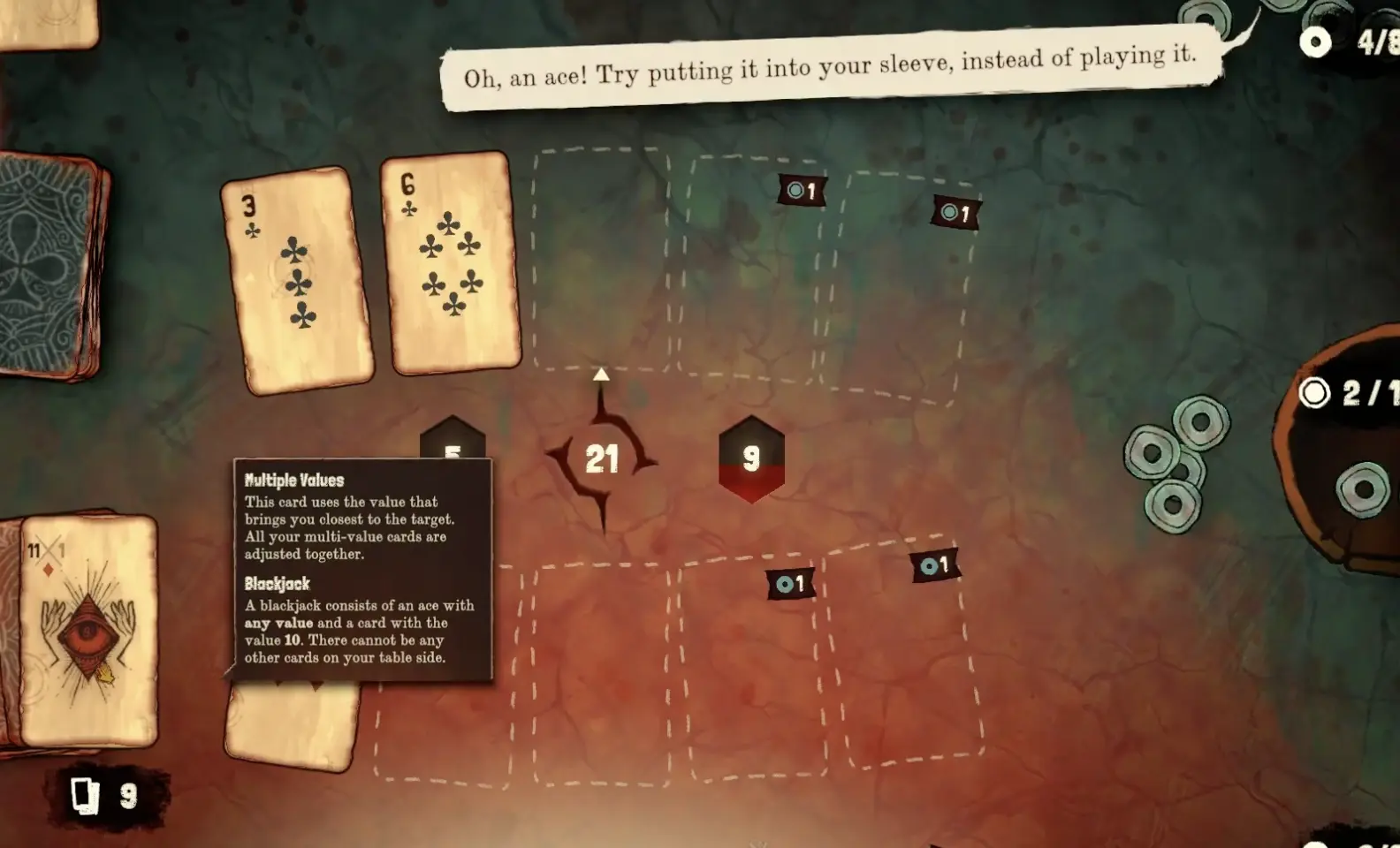
Quick mechanics summary
| Mechanic | What it means | Beginner advice |
|---|---|---|
| Blackjack | Ace + 10-value card. Beats a normal 21. | Strongest basic hand. Do not confuse it with any 21. |
| Bust | Your total reaches 22 or higher. | Avoid drawing when only a few safe cards remain. |
| Tie breaker | If totals match, highest card wins unless blackjack is involved. | A tied total is not always safe. |
| Coins | Your survival, economy, and betting resource. | Protect them like health. |
| Forced bet | Some plays and slot effects force coins into the bet. | Always check whether you can afford to lose the round. |
| Winner’s pot | Coins lost during rounds build up there. | A bigger pot is only good if you can actually win it. |
| Soul Coin | A special boss reward tied to progression. | Do not confuse it with normal coins. |
| Sleeve | Save a card for later instead of playing it now. | Powerful, but it costs coins. |
| Demand | Asks for the type of card named in its text, such as “Demand an awakened card.” | Read the card text before using it. |
| Exploit | Usually forces the opponent to commit coins. | Best when you already have the stronger hand. |
| Insight | Look at upcoming cards and control draw order. | One of the safest beginner effects. |
| Whisper | Triggers when a card is played into this card’s Hollow slot. Whisper effects are not optional. | Do not stack onto a Whisper card unless you want the effect to fire. |
| Drain | Decreases the target card’s value to zero, then adds that value to the Drain card’s highest value. | Strong, but always recalculate before confirming. |
| Hollow | Allows another card to be played on this card while both card values remain active. | Useful for stacked plays, but it can raise your total quickly. |
| Burn | Remove a card from your deck. | Helps thin weak cards. |
| Awaken | Upgrade or change a card with an extra effect. | Build around simple, reliable effects first. |
| Put a Card | Puts the named card somewhere in the target deck until the end of the encounter. | Strong for disruption, especially when the card hurts the opponent’s future draws. |
| Break | Can flip or alter card values, often creating negative values. | Useful, but always recheck your total. |
| Curse | A boss or encounter rule that changes the fight. | Read it before committing to a plan. |
If you are new, focus on coins, forced bets, sleeve, exploit, insight, and boss curses first. Those systems explain most early losses.
What does “Black” mean in Black Jacket?
The “Black” in Black Jacket is not just a title flourish. It points to the game’s rule-bending card mechanics: special cards, awakened effects, hidden interactions, and table rules that let you break away from normal blackjack logic.
In regular blackjack, your main choices are simple: draw, stand, or compare totals. In Black Jacket, cards can look ahead in the deck, force coins into the bet, stack other cards, change values, demand specific effects, break cards into negative values, or punish the opponent’s side of the table.
That is the real hook of the game:
you are not just playing blackjack — you are bending blackjack until the table breaks in your favor.
Blackjack vs normal 21
The most important rule is simple:
Blackjack beats a normal 21.
A blackjack means an Ace plus any 10-value card. If you reach 21 through several cards, value changes, or stacked effects, that is still strong, but it is not the same as blackjack.
| Your hand | Opponent hand | Winner |
|---|---|---|
| Ace + 10 | 21 from several cards | You |
| 21 from several cards | Ace + 10 | Opponent |
| 20 | 19 | You |
| 22 or higher | Any non-bust hand | Opponent |
| Same total | Same total | Highest card breaks the tie |
This matters because many early mistakes come from treating every 21 as equal. In Black Jacket, how you reached 21 can matter as much as the number itself.
Tie breaker explained
If neither side has blackjack and both totals are equal, the game checks the highest single card.
That means a hand with the better top card can win even when both players are sitting on the same total.
Beginner example:
| Player | Total | Highest card |
|---|---|---|
| You | 20 | 10 |
| Opponent | 20 | 8 |
You win because your highest card is stronger.
But if the opponent has a true blackjack, tie breaker logic does not save you. Blackjack wins first.
Coins, forced bets, and the winner’s pot
Coins are not just money. Coins decide whether you can keep playing.
You spend them through blinds, sleeve plays, slot costs, forced betting effects, and opponent pressure. You earn or recover them by winning rounds and taking the pot. If you go broke, even a good deck cannot save the run.
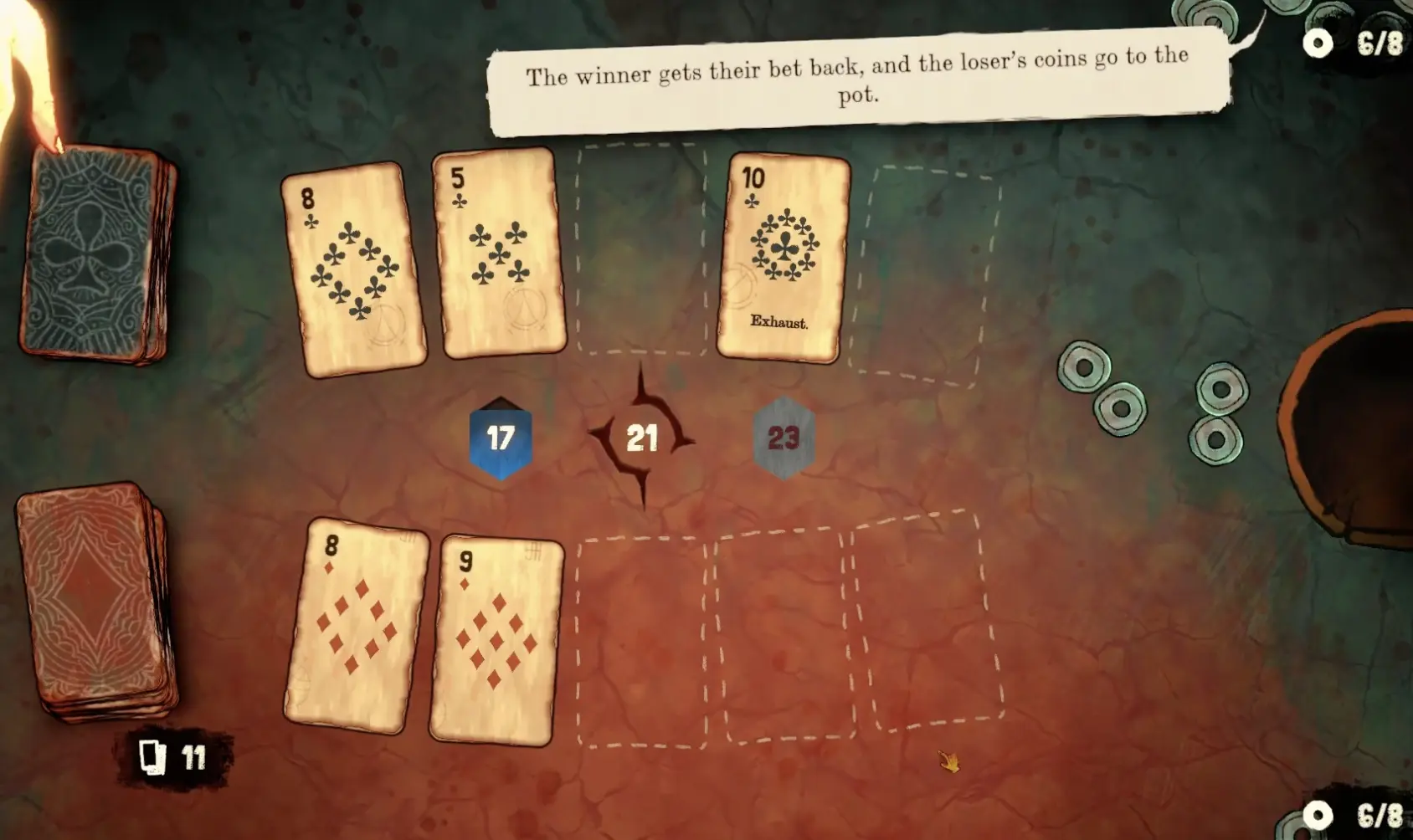
A key difference from normal blackjack is that Black Jacket can force coin commitments as part of the table flow. After the blind and later card plays, some slots or card effects can push more coins into the bet.
That means every card has two costs:
- Card risk: will this card bust or improve your hand?
- Coin risk: can you afford the bet if this round goes wrong?
Use this rule:
Before you activate an effect, ask whether you can afford to lose the round.
If the answer is no, do not raise the pot just because the effect looks strong.
Winner’s pot explained
The winner’s pot holds coins that are lost during an encounter. The pot can become a huge swing point.
A bigger pot is good when:
- you have a strong hand,
- the opponent is almost broke,
- you can force them to commit their last coins,
- you have a safe blackjack or high total,
- you know your next draw through insight.
A bigger pot is bad when:
- your hand is weak,
- your table is unstable,
- the opponent already passed with a better total,
- you are spending your last coins,
- a boss curse is about to punish your plan.
The beginner trap is thinking “more coins in the pot means more reward.” That is only true if you are favored to win.
Soul Coins explained
Soul Coins or golden boss coins are different from normal coins.
Normal coins keep your current encounter and journey alive. Soul Coins are tied to bosses, memories, story progress, and longer-term unlocks.
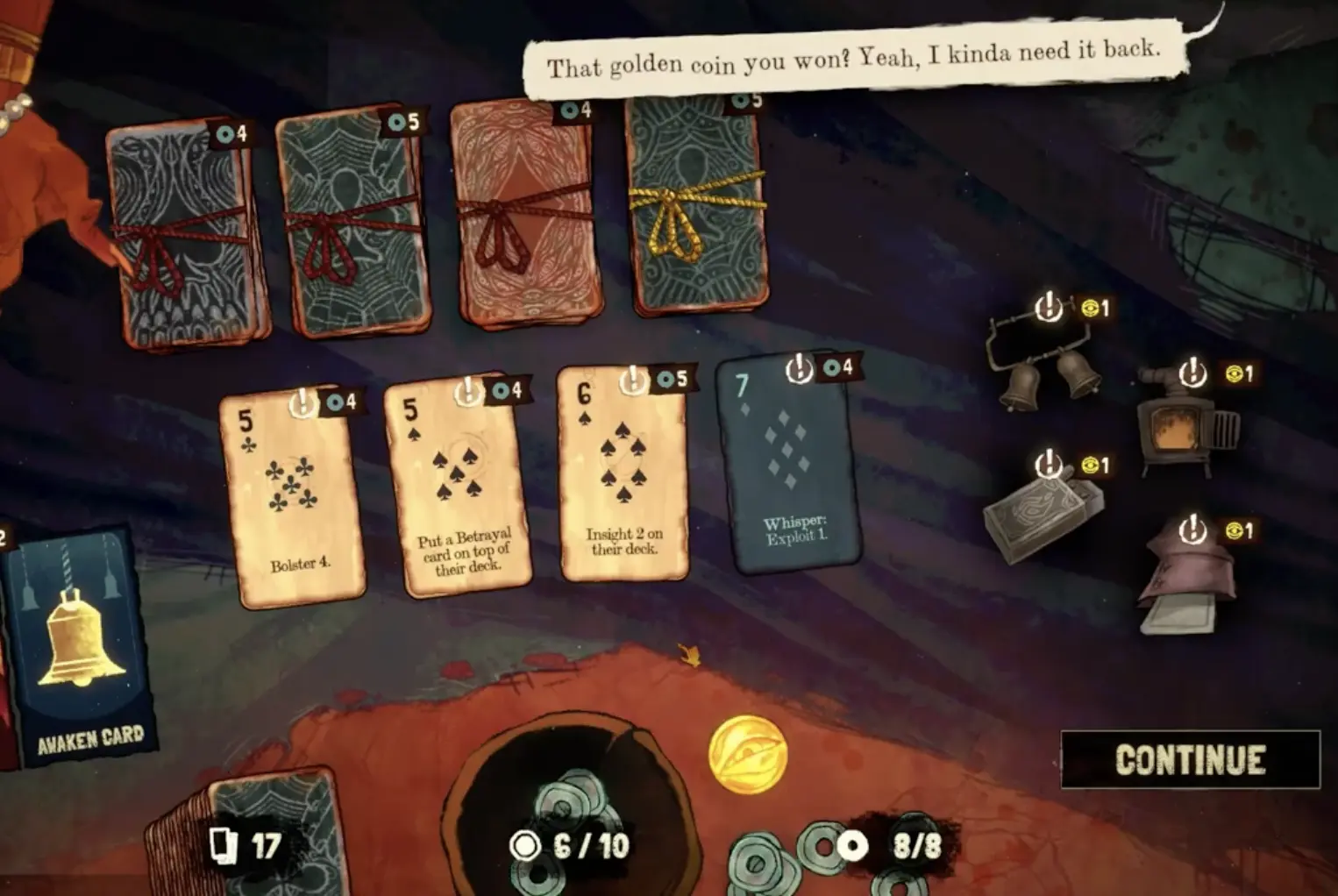
For beginners, the distinction is:
| Coin type | Main purpose |
|---|---|
| Normal coins | Blinds, bets, sleeve costs, shops, and survival. |
| Winner’s pot coins | Encounter swing reward. |
| Soul Coins / golden coins | Boss progression and long-term rewards. |
Do not play normal rounds as if every coin is a Soul Coin. Spend normal coins when they help you survive, improve your deck, or win the current journey.
Sleeve mechanic explained
The sleeve lets you hold a card for later instead of playing it immediately. This is one of the most important mechanics in Black Jacket because it lets you save a key card for a better round.
Sleeve is powerful because it gives you timing control. It is dangerous because it costs coins.
When should you sleeve a card?
Sleeve when the saved card gives you a real future plan.
| Situation | Sleeve? | Why |
|---|---|---|
| You draw an Ace but cannot safely use it | Yes | It can become a future blackjack. |
| You draw a 10 while already at 17 | Usually yes | Playing it would bust. Saving it may win later. |
| You have a face card combo piece | Maybe | Sleeve can help complete a Royal Set or Face Trio setup. |
| You are almost out of coins | Usually no | The sleeve cost can kill your economy. |
| Boss curse exhausts sleeved cards | Be careful | The card may disappear before you use it. |
| You are only avoiding a decision | No | Sleeve should be a plan, not panic. |
Do not treat the sleeve as a free storage slot. It is a delayed play that spends real coin pressure.
Demand explained
Demand asks for the type of card named in its text. For example, a card can say “Demand an awakened card.”
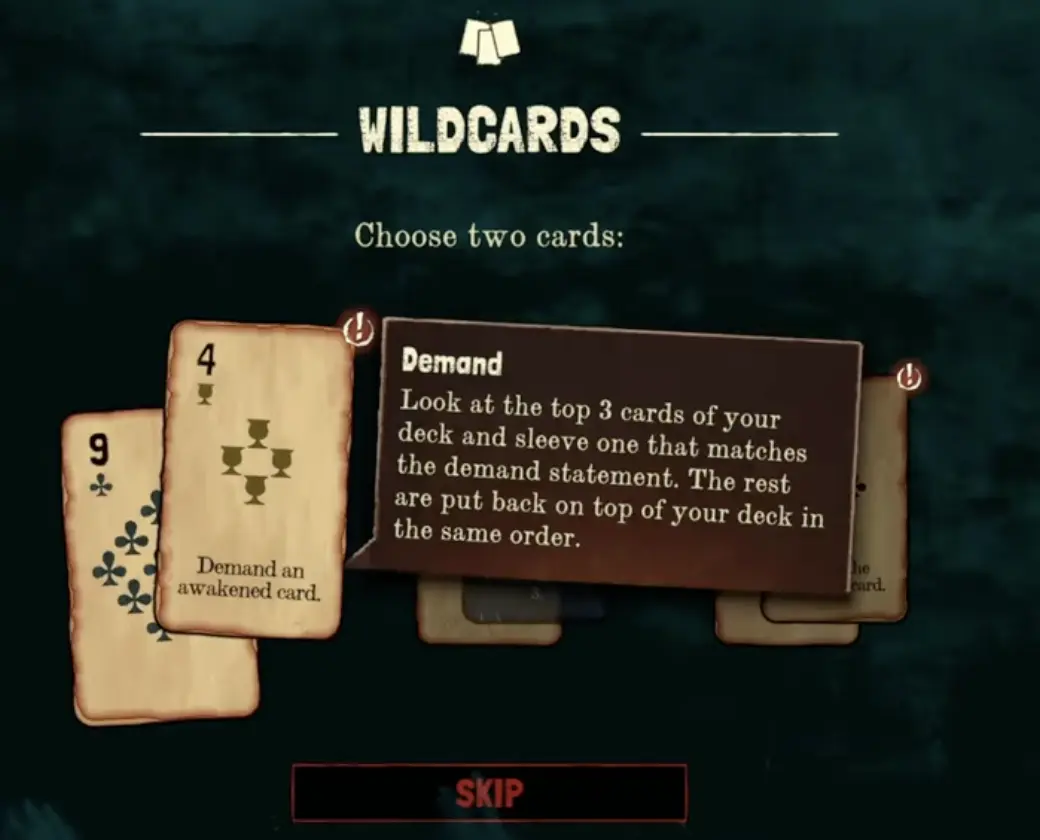
The important point is that Demand is not one single universal action. It depends on what the card is demanding.
Use Demand when:
- you understand the full card text,
- the demanded card type helps your current hand or deck plan,
- you can afford the coin risk,
- you are not already close to busting.
Avoid Demand when:
- you are guessing what it does,
- the demanded card type does not help your build,
- a boss curse may punish the extra card or effect,
- the play would leave you broke.
Demand is one of the mechanics that makes Black Jacket different from normal blackjack. It lets cards ask for specific card types or effects instead of relying only on natural draws.
Exploit explained
Exploit is a coin-pressure effect. In early tutorial examples, playing into an exploit slot forces the opponent to put coins into the bet.
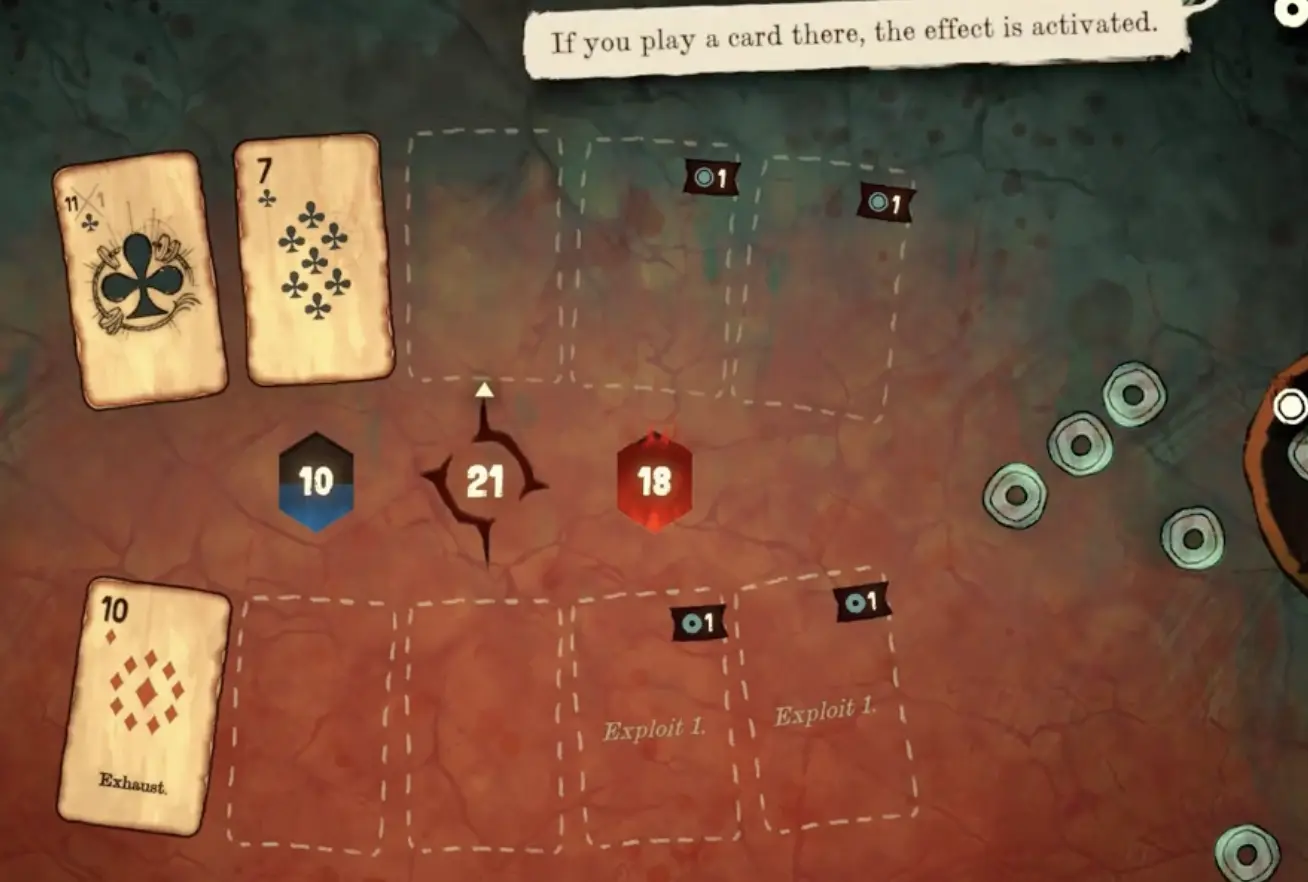
Exploit is strongest when the opponent is already low on coins. It can turn a good hand into an encounter-ending hand.
Use exploit when:
- the opponent has only one or two coins left,
- your total is already safe,
- you are holding blackjack or a strong 20,
- the opponent is likely to bust,
- you want to force the boss into a final round.
Avoid exploit when:
- you are behind on total,
- you are nearly broke,
- your hand still needs a risky draw,
- the opponent has already passed with a strong hand,
- the boss curse may change what a “safe” round means.
The question is not “Can I exploit?”
The question is:
“Do I want more coins at stake right now?”
Insight explained
Insight lets you look at upcoming cards. Depending on the card or effect, you may be able to move cards to the top or bottom of the deck.
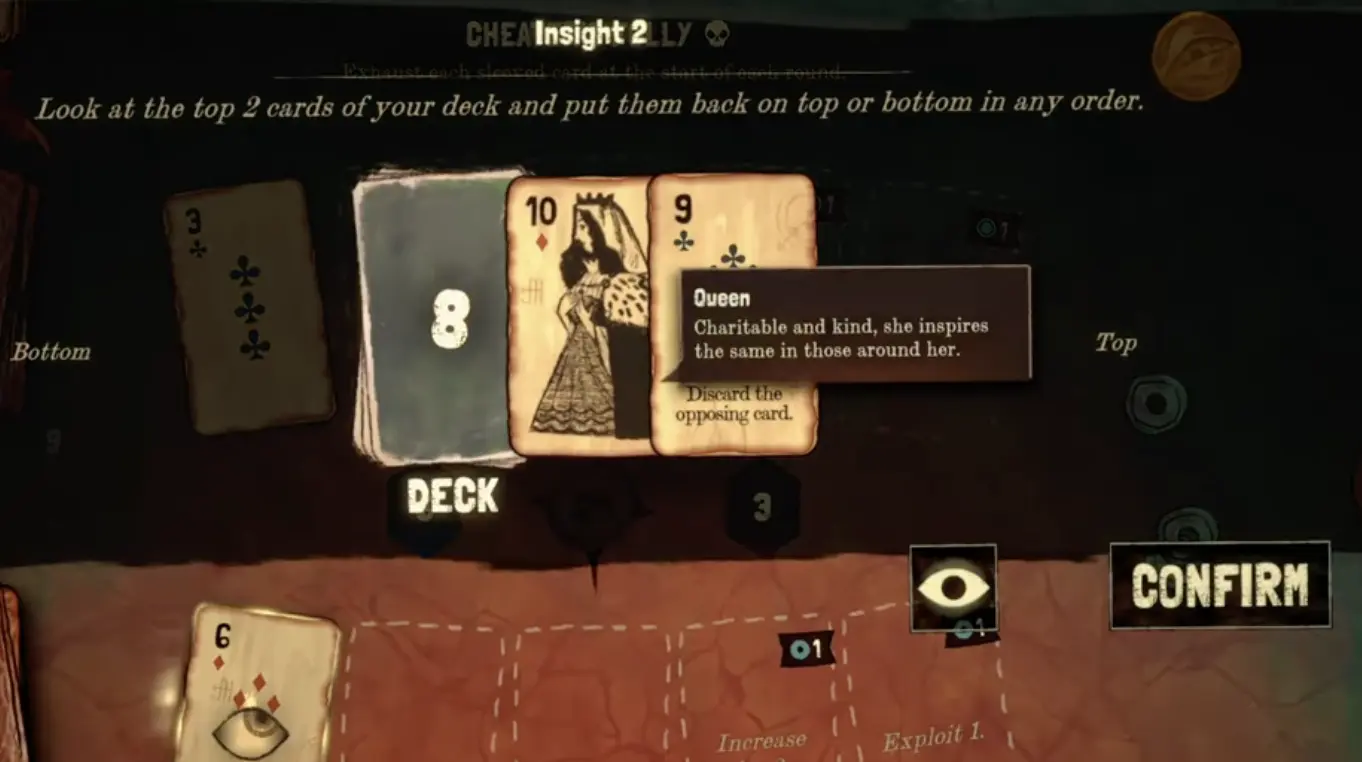
This is one of the best beginner mechanics because it reduces blind gambling.
Use insight to:
- avoid drawing into a bust,
- set up a future 21,
- place bad cards on the bottom,
- check whether a risky draw is worth it,
- plan a sleeved card around the next round,
- protect yourself before raising the bet.
Insight is especially useful when you are sitting at totals like 13–17. Those hands often look playable, but one bad draw can ruin the round. If insight shows only dangerous cards, passing is often correct.
Whisper explained
Whisper is not the part that lets you stack cards. That part is Hollow.
Whisper is the effect that triggers when a card is played into this card’s Hollow slot. The game also makes one key rule clear:
Whisper effects are not optional.
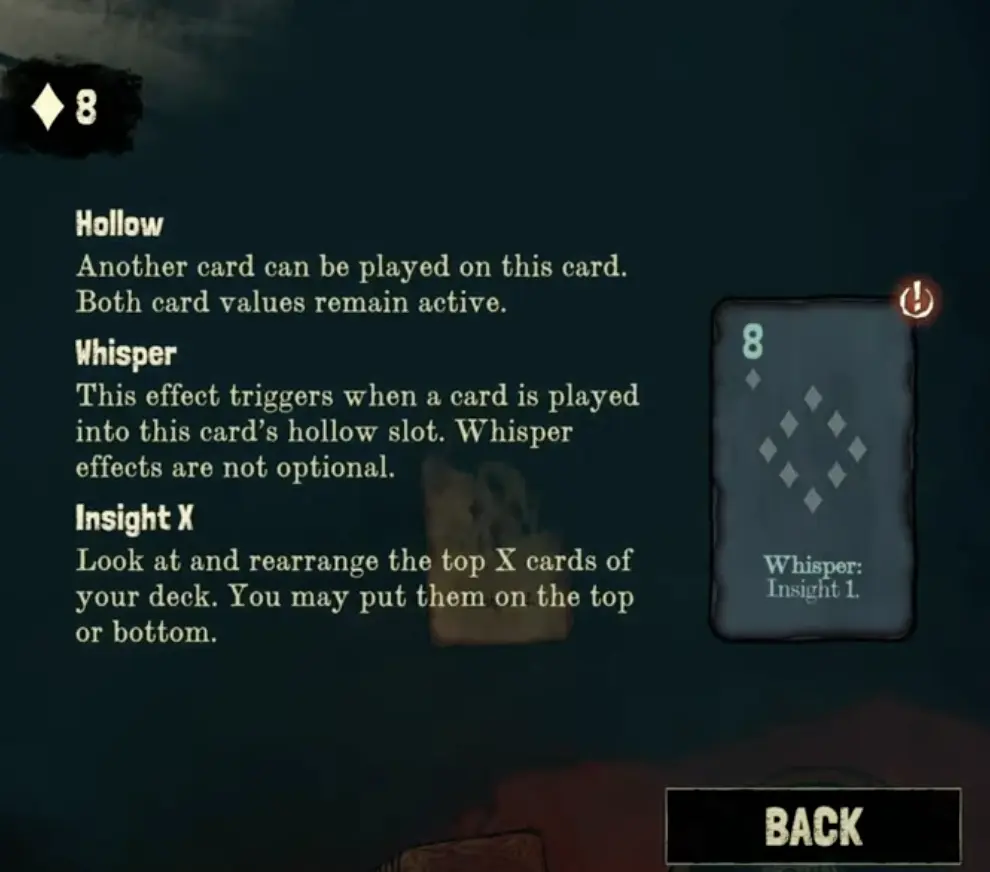
That means you should only play into a Whisper card’s Hollow slot when you actually want the Whisper effect to happen.
Whisper is good when:
- the extra card helps your total,
- the Whisper effect supports your plan,
- you want to trigger Insight, Exploit, or another attached effect,
- you can afford the value change from both active cards,
- you understand what will happen after the stack.
Whisper is risky when:
- you are already near 21,
- the stacked card will push you toward bust,
- you forgot that both card values remain active,
- you do not want the Whisper effect to trigger,
- a boss curse punishes stacked or altered cards.
The beginner mistake is thinking Whisper is just “play another card here.” The accurate rule is:
Hollow lets you stack. Whisper triggers when you stack.
Hollow explained
Hollow is the mechanic that lets another card be played on top of a card. When this happens, both card values remain active.
This is important because Hollow is not free space. If you stack a high card onto a Hollow card, both values can affect your total. That can help you reach 21, but it can also push you toward busting faster than expected.
Hollow matters most when paired with Whisper, because Whisper triggers when another card is played into the Hollow slot.
Drain explained
Drain decreases the target card’s value to zero, then increases the Drain card’s highest value by the same amount.
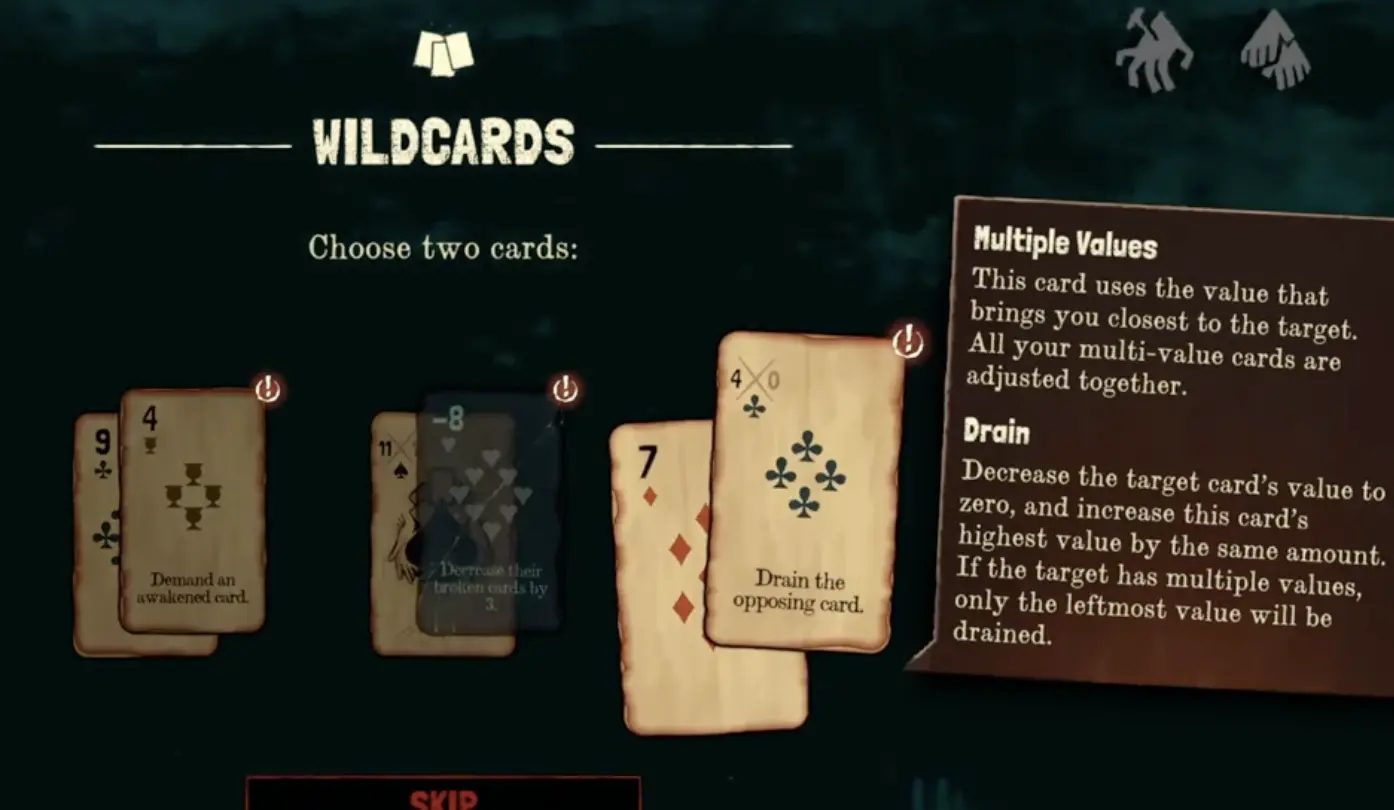
The key detail is this:
If the target has multiple values, only the leftmost value is drained.
That matters a lot with multi-value cards. You may expect Drain to take the value you care about, but the card text specifies that only the leftmost value is used.
Use Drain when:
- it creates a safe 20 or 21,
- it lowers an opposing card enough to win the round,
- it prevents a bust,
- you understand which target value will be drained,
- the transferred value improves your card without creating a worse total.
Avoid Drain when:
- the target has multiple values and you have not checked the leftmost value,
- you are guessing how much value will move,
- the round is already stable,
- the effect costs your last coin,
- a boss curse may change the table after Drain resolves.
Drain is powerful because it changes both sides of the value equation: the target gets weaker, and your Drain card gets stronger. It is also one of the easiest effects to misplay if you do not read the full tooltip.
Why did my card value change?
Card values can change in Black Jacket because many effects bend or rewrite normal blackjack math.
Your card value or expected draw may change because of:
- Drain reducing a target to zero and transferring that value,
- Break turning positive values into negative values,
- Hollow keeping both stacked card values active,
- Whisper triggering a non-optional effect after a stack,
- Put a Card placing named cards into a target deck,
- boss curses adding or altering cards,
- slot effects changing cards after placement,
- opponent effects manipulating your table,
- multi-value cards automatically choosing the safest value.
This is also where effects like swaps, peeks, forced plays, and value manipulation can make a hand feel like it changed “without warning.”
When this happens, slow down and check three things:
- Did a card effect trigger?
- Did a table slot effect trigger?
- Did the boss curse change the rule?
If a hand suddenly looks wrong, it usually means an effect resolved after the card was played.
Put a Card explained
Put a Card means the named card is placed somewhere in the target deck. The card is removed at the end of the encounter.
This is a disruption mechanic. Instead of only improving your own hand, you can make the opponent’s future draws worse by putting an unwanted card into their deck.
Use Put a Card effects when:
- the named card hurts the opponent’s future draws,
- the opponent is close to busting,
- you want to disrupt a boss or difficult soul,
- you have Insight or another way to understand the target deck,
- the encounter will last long enough for the disruption to matter.
Avoid it when:
- the encounter is almost over,
- the card you put into their deck will not matter,
- you need immediate value instead of future disruption,
- the coin cost is too high for a delayed effect.
This mechanic is one reason Spades-style disruption can be strong. You are not only playing your own hand — you are changing what the opponent may draw later.
Burn explained
Burn removes a card from your deck. It sounds less exciting than a flashy combo, but it is one of the most important deckbuilding tools.
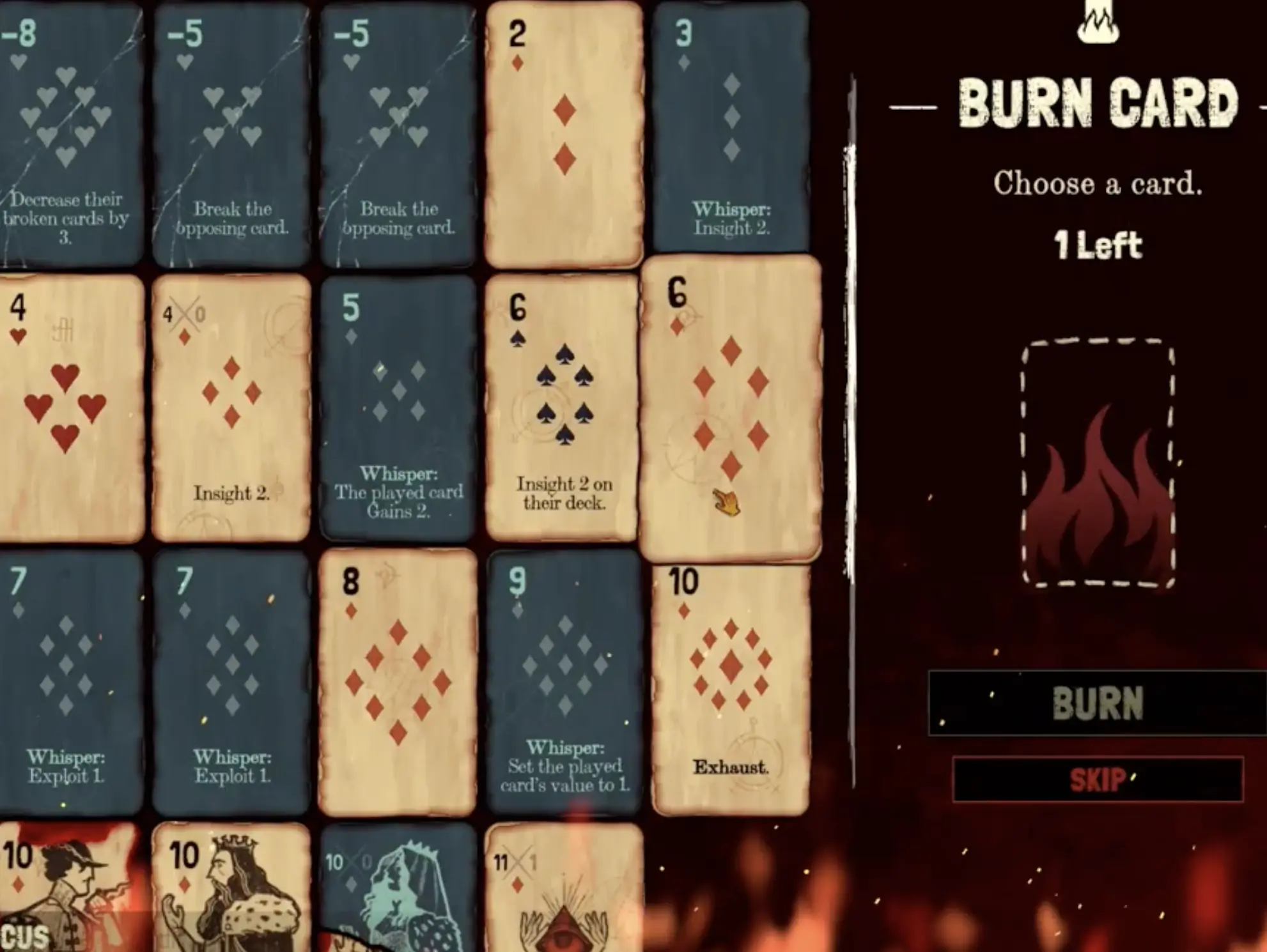
Burn is good because every weak card you remove makes your good cards easier to find.
Burn cards when:
- the card has low value and no useful effect,
- the card keeps ruining your draw odds,
- your deck is getting too large,
- you need to improve consistency before a boss,
- the card does not support your current suit or combo plan.
Do not burn cards just because they are low numbers. Some low cards are excellent if they have insight, exploit, whisper, demand, drain, or value-changing effects.
The goal is not a tiny deck at all costs. The goal is a deck where most draws are useful.
Awaken explained
To awaken a card is to upgrade or change it with an additional effect. Awakened cards can become the core of your run because they turn normal card values into tools.
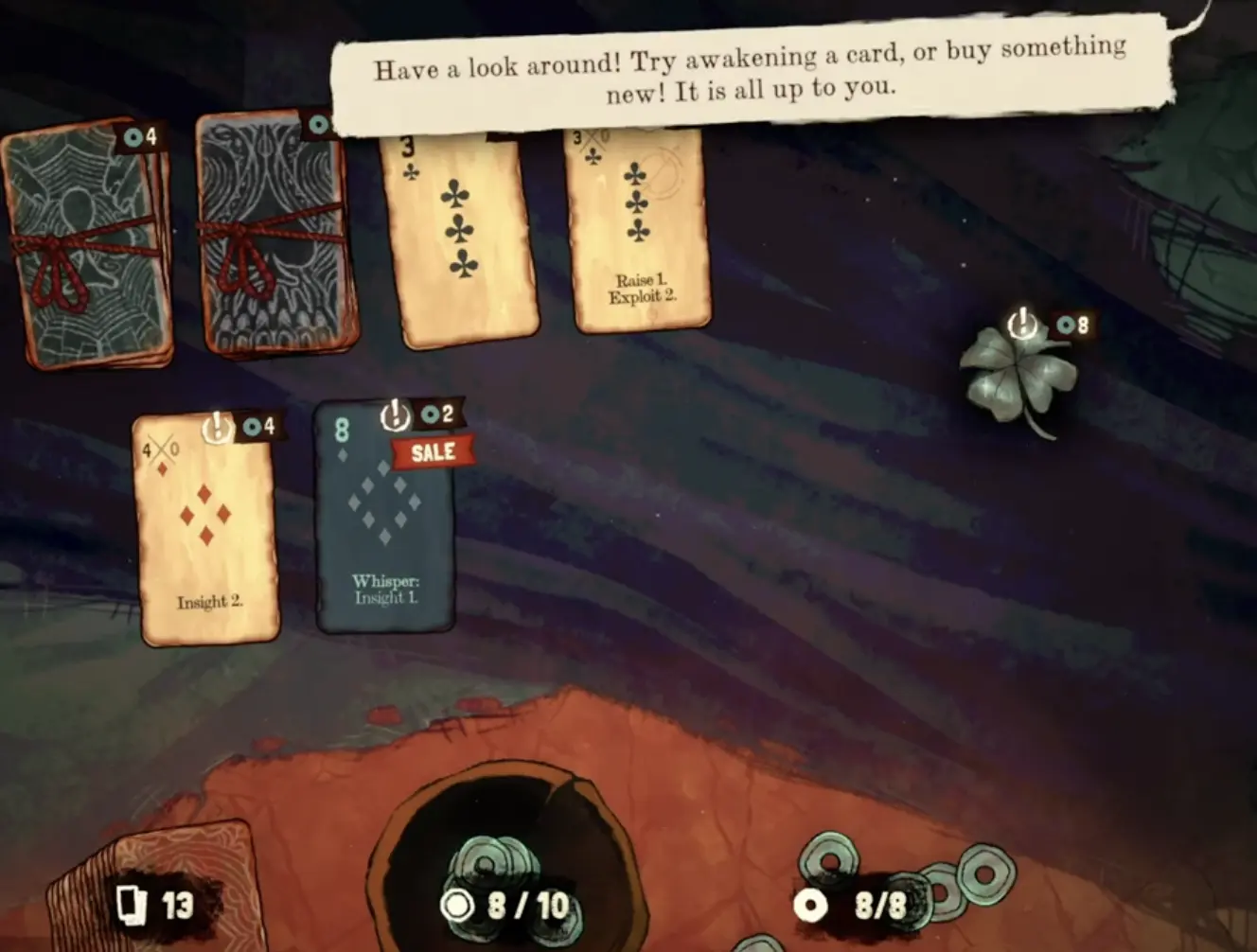
Awakened cards can help you:
- look at upcoming cards,
- discard or move cards,
- change card values,
- demand specific card types,
- add cards to a target deck,
- trigger Hollow or Whisper synergies,
- force coin pressure,
- create safer hands,
- build around special keywords.
For beginners, the safest awakened cards are the ones that give information or flexibility.
Good early awakened effects:
| Effect type | Why it is beginner-friendly |
|---|---|
| Insight | Helps avoid bad draws. |
| Flexible value | Makes it harder to bust. |
| Discard / control | Can remove an opposing threat. |
| Simple exploit | Converts strong hands into coin wins. |
| Sleeve support | Helps save key cards for future rounds. |
Riskier awakened effects are not bad, but they need a plan. If a card sounds powerful but you cannot explain when to use it, do not build your whole run around it yet.
Break and negative values explained
Some cards and effects can break cards or create negative values. This can look strange at first because a card that used to help you may suddenly reduce your total or change the math of the hand.
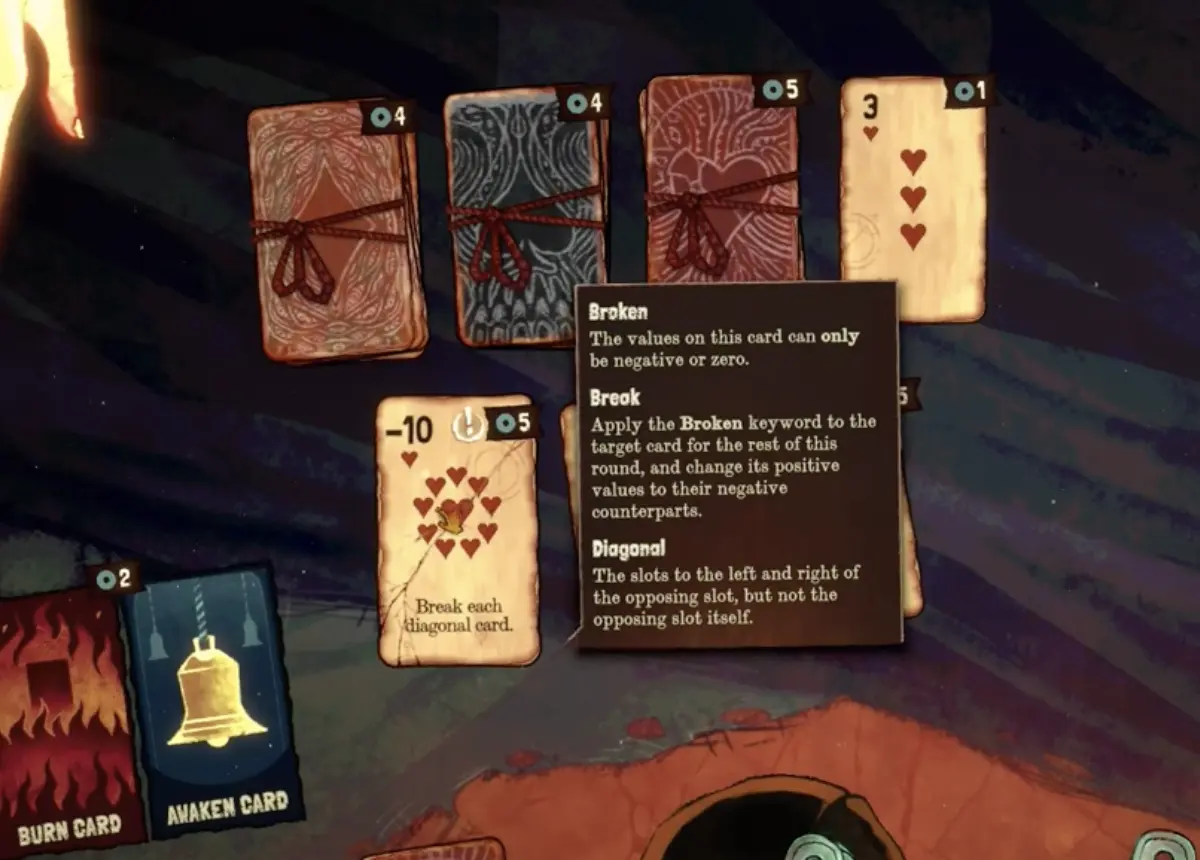
Negative values can be good or bad depending on the situation.
They can help when:
- you are about to bust,
- lowering your total lets you safely draw again,
- the opponent gets stuck with a negative card,
- a broken card disrupts the boss.
They can hurt when:
- you needed that value to reach 20 or 21,
- the value change happens after you already planned the round,
- the boss adds negative cards to your side,
- you forget that a card has been broken.
When broken or negative cards appear, slow down. Recalculate the total before playing another card.
Curses explained
A curse is a special rule that changes a boss fight or encounter. Curses are dangerous because they can invalidate a habit that worked in normal rounds.
Example curse types include:
- exhausting sleeved cards,
- adding negative cards,
- changing card values,
- increasing slot costs,
- forcing awkward table decisions,
- punishing certain card placements.
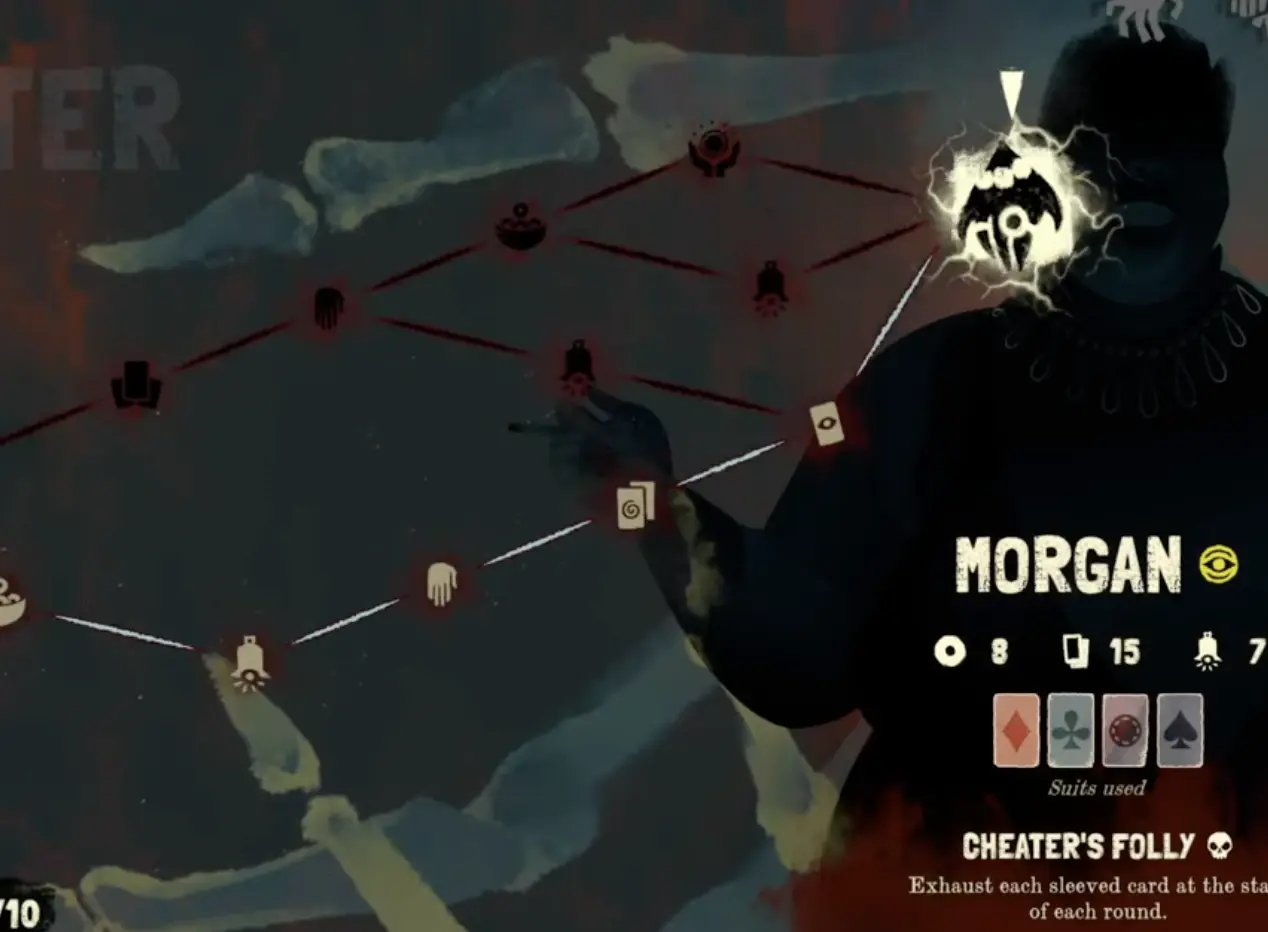
Before entering a boss fight, read the curse and ask:
- Does this punish sleeve?
- Does this punish high card values?
- Does this punish a large deck?
- Does this punish slow combo setups?
- Do I have enough coins to survive a bad opening round?
A boss curse is not flavor text. It is the fight.
For boss-specific preparation, read the Black Jacket Boss Guide.
Face cards, Face Trios, and Royal Sets
The game tells you early that your deck comes with face cards and that you should try playing them next to each other.
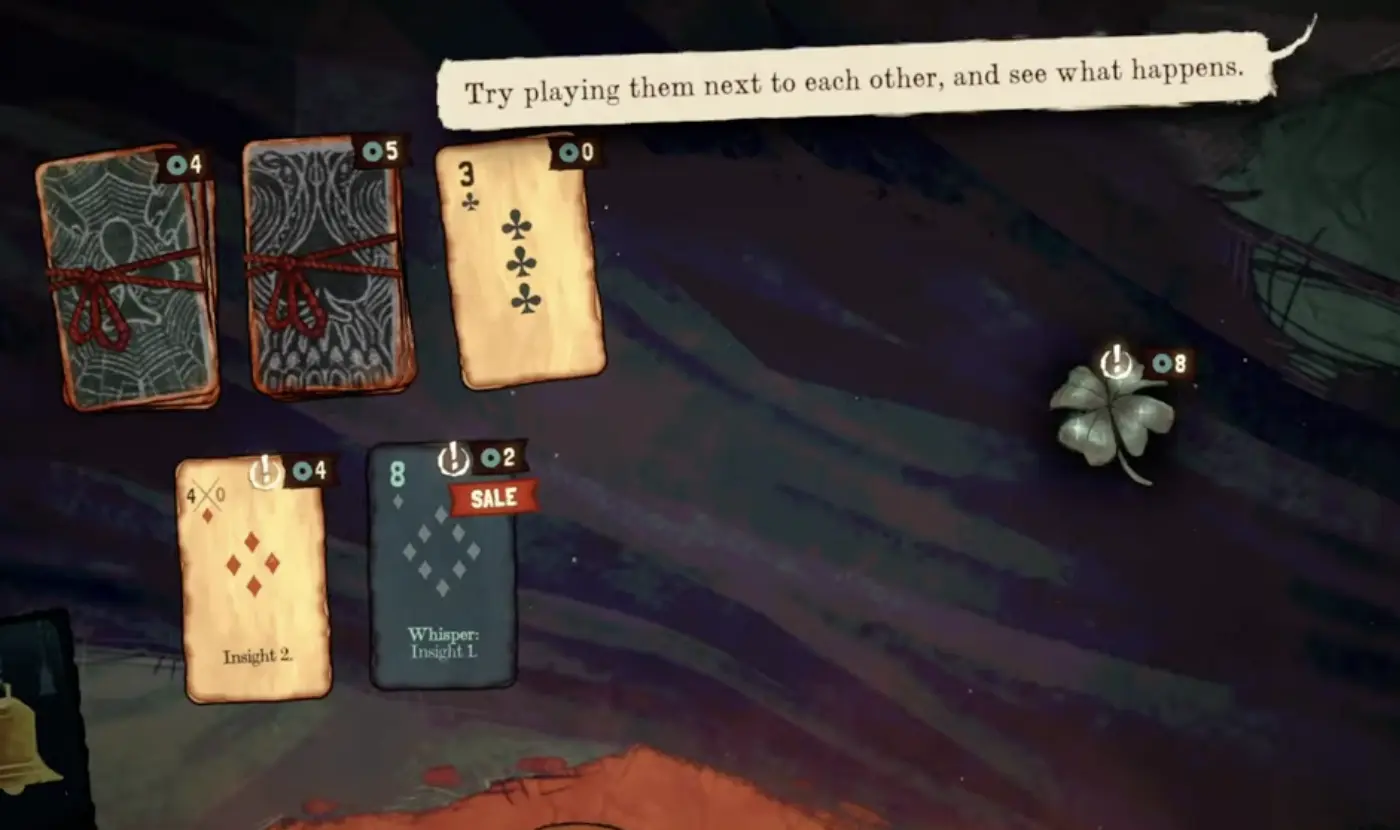
The beginner lesson is:
face cards are not just 10-value cards.
They are strong because they can help form blackjack, but they may also create special interactions depending on placement and combination.
You may see these interactions discussed as Face Trios, Royal Sets, or face-card combos. The exact effect depends on which face cards are involved and how they are placed.
When using face cards:
- avoid burning them too early,
- test them next to other face cards,
- remember that they still count as strong high cards,
- use sleeve to save one if you are waiting for a matching combo piece.
For full build planning, read the Black Jacket Deck Building Guide.
Which mechanics should beginners learn first?
Do not try to master every keyword in one run. Learn them in this order:
| Priority | Mechanic | Why |
|---|---|---|
| 1 | Coins / forced bets / winner’s pot | Most early deaths are economy deaths. |
| 2 | Blackjack / tie breaker | Prevents basic rules mistakes. |
| 3 | Sleeve | Saves key cards, but costs coins. |
| 4 | Exploit | Teaches when to pressure the opponent. |
| 5 | Insight | Makes risky draws safer. |
| 6 | Demand | Helps you understand card-specific rule bending. |
| 7 | Awaken | Starts real deckbuilding. |
| 8 | Burn | Improves deck consistency. |
| 9 | Whisper / drain / break | Stronger, but easier to misread. |
| 10 | Curses | Required for boss fights. |
| 11 | Soul Coins / long-term progression | Matters more after you start beating bosses. |
If you are losing early, the answer is probably not “I need a more advanced combo.” It is usually:
you spent too many coins, drew when you should have passed, or used sleeve/exploit without checking the pot first.
Common mechanic mistakes
| Mistake | Why it happens | Fix |
|---|---|---|
| Sleeving every good card | You want future options | Sleeve only when the future value is worth the coin cost. |
| Using exploit during a boss curse you do not understand | You assume winning the current round is all that matters | Read the curse first; some bosses punish what looks like a winning play. |
| Ignoring insight | You think drawing is faster | Use insight to avoid busts and plan future turns. |
| Using Demand without reading the card | You assume every Demand effect works the same | Check the full card text before committing. |
| Burning low cards blindly | Low numbers look weak | Keep low cards if their effects are useful. |
| Misreading drain | The value transfer is not obvious | Recalculate before confirming. |
| Forgetting boss curses | Normal rounds feel comfortable | Read the curse before playing the first card. |
| Treating Soul Coins like normal coins | Both use coin language | Normal coins are survival; Soul Coins are progression. |
Beginner FAQ
What does sleeve do in Black Jacket?
Sleeve lets you save a card instead of playing it immediately. You can use it later, but sleeving costs coins by moving some of your money into the bet.
Should I use sleeve often?
No. Sleeve important cards like Aces, 10-value cards, face cards, or combo pieces. Do not sleeve weak cards just because you are unsure what to play.
What does Demand do in Black Jacket?
Demand asks for the type of card named in its text, such as “Demand an awakened card.” The exact result depends on the card, so read the full card text before using it.
What does exploit do?
Exploit usually forces the opponent to commit coins. It is best when you already have a strong hand or when the opponent is almost out of coins.
What does insight do?
Insight lets you see upcoming cards and sometimes move them to the top or bottom of the deck. It helps you decide whether drawing is safe.
What does Hollow do in Black Jacket?
Hollow allows another card to be played on top of that card, and both card values remain active. It is the stacking mechanic that often works together with Whisper.
What does Drain do?
Drain decreases the target card’s value to zero, then increases the Drain card’s highest value by the same amount. If the target has multiple values, only the leftmost value is drained.
What does Put a Card do?
Put a Card places the named card somewhere in the target deck until the end of the encounter. It is useful for disrupting the opponent’s future draws.
What does burn do?
Burn removes a card from your deck. Use it to remove weak or off-plan cards so your important cards show up more often.
What does awaken do?
Awaken upgrades or changes a card by adding an effect. Awakened cards can reveal cards, discard cards, change values, increase bet pressure, or support combos.
Why did my card value change?
A card value can change because of Drain, Break, boss curses, slot effects, opponent effects, or multi-value card logic. Recheck the card text and active curse before drawing again.
What are Face Trios or Royal Sets?
Face Trios and Royal Sets refer to special face-card combinations or interactions. Try placing face cards next to each other and watch for special effects.
Why did I lose with 21?
You may have had a normal 21 while the opponent had blackjack. A true blackjack, made with an Ace and a 10-value card, beats a normal 21.
Why did I lose a tie?
If both players have the same total and neither has blackjack, the highest single card decides the winner.
Continue Reading in the Black Jacket Guide Cluster
This article is part of our Black Jacket strategy cluster. Use these guides to keep learning the game's core systems and routes.