I can’t believe I just paid $4 to watch a tarot card scream “NOPE!” in my face again—like I’m the clown and the Wheel is the entire circus.
Verdict up front: Wheel of Fortune isn’t “secretly nerfed.” It’s 25% honest, but it’s also seed-deterministic and random-target, which turns “1 in 4” into “1 in forever” for anything that actually matters. If you don’t have (a) a locked endgame board or (b) Oops! All 6s, most of the time Wheel is -EV junk with a comedy sound effect.
If you’re reading this, you probably feel like the Wheel is bugged, rigged, or personally targeting you. Why does “1 in 4” feel like “1 in 100”? Because your brain isn’t gambling on “success.” Your brain is gambling on success + good edition + correct Joker… and that’s where the pain lives.
1. The “Truth” Is Boring: It’s Not Bugged, It’s Just Brutal Math
You think you’re gambling on a 25% chance. You aren’t. You’re gambling on a stack of conditions and the game only pays when they all line up.
The Probability Breakdown (Two-Step Roll)
Wheel resolves in two steps:
- Step 1: Success Roll
- Success: 25% (1/4)
- Fail: 75% (3/4) → instant “Nope!” with zero consolation prize.
- Step 2: Edition Roll (only if Step 1 succeeds) These are weighted outcomes, and the weights matter:
| Edition | Effect | True Probability (Per Wheel) |
|---|---|---|
| Foil | +50 Chips | 12.5% |
| Holographic | +10 Mult | 8.75% |
| Polychrome | x1.5 Mult | 3.75% |
Reality check: Polychrome isn’t “1 in 4.” It’s 3.75%—about 1 in 26.7 Wheels. And that’s before the next punch in the mouth: random Joker targeting.
The Math Your Feelings Keep Lying About (Streaks)
Humans are allergic to variance. We see 3 NOPEs and think the 4th is “due.” Nope. Independent rolls don’t care about your coping mechanisms:
- Fail 4 times in a row: (0.75^4 = 0.3164) → 31.6% (common)
- Fail 8 times in a row: (0.75^8 \approx 0.1001) → 10.0% (normal)
- Fail 12 times in a row: (0.75^{12} \approx 0.0317) → 3.17%
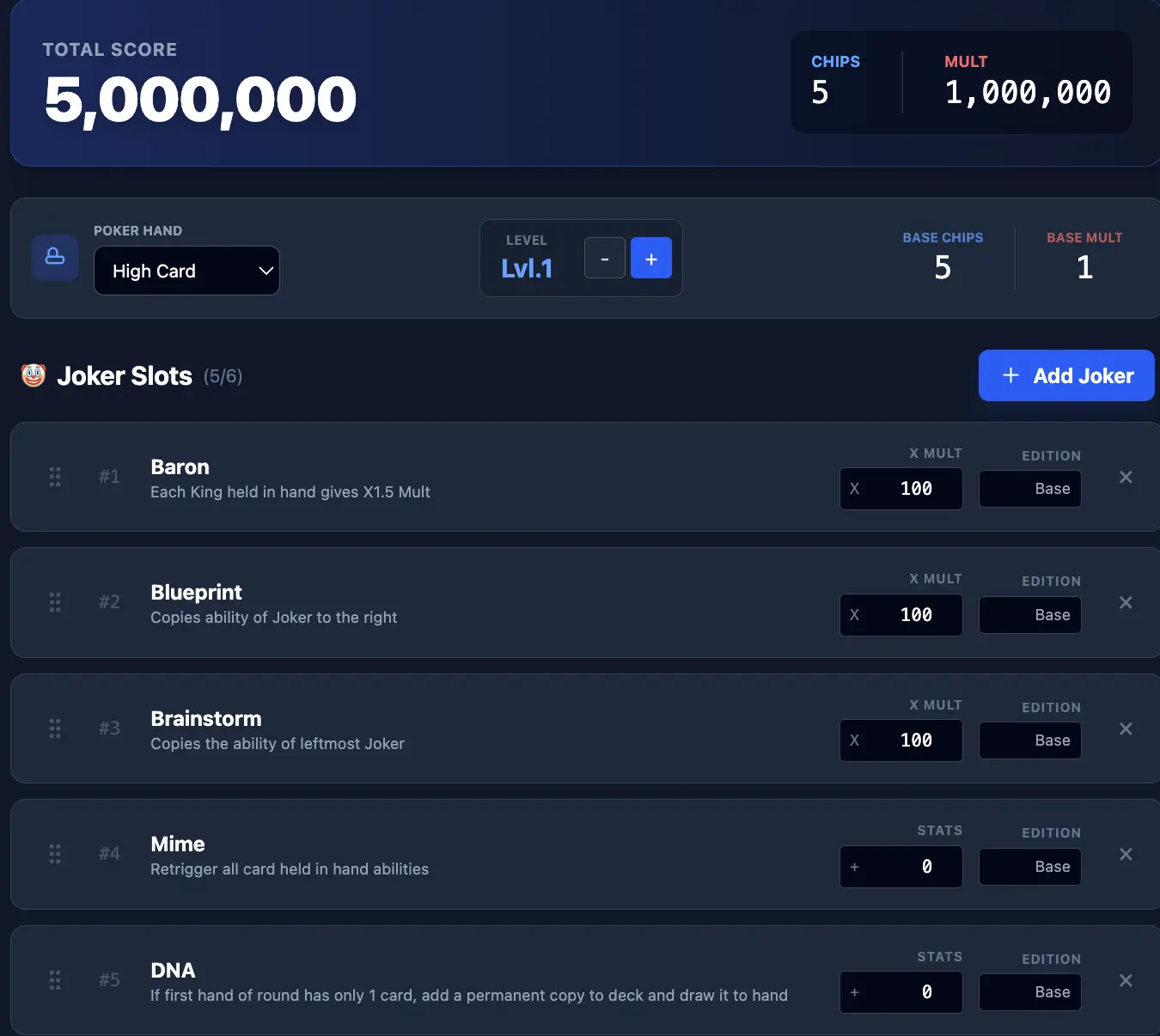
That last one is the cruel joke: failing 12 straight is roughly the same order of magnitude as hitting one Polychrome. If this makes your head hurt, same—This numeric soup is a nightmare. Honestly, stop trying to do mental math for everything. You can’t control the odds, but you can verify the payout. Save your brain cells and use our Balatro Score Calculator to see if a Polychrome hit is mathematically worth the risk.
[
2. The Real Villain Is the Seed: You Are “Pre-Doomed”
This is why Wheel feels rigged even when the odds are legit: deterministic RNG.
How Seeds Actually Make You Suffer
When you start a run, the seed effectively creates a queue of outcomes. The game already “knows” things like:
- Which Wheel will succeed/fail,
- Which Joker slot gets targeted on success,
- Which edition you get.
So you end up with reality like:
- Wheel #1: FAIL
- Wheel #2: FAIL
- …
- Wheel #15: SUCCESS → Foil on Joker slot 3
Why Save Scumming Doesn’t Work
Use Wheel → get NOPE → reload → use Wheel again in the same spot → still NOPE. You’re not “rerolling.” You’re replaying the same tape.
Advanced Tech: “Burning RNG” (Changing the Timeline)
Can you change fate? Sometimes, but it’s not magic—it’s bookkeeping.
- Use Wheel → FAIL
- Reload/Restart
- Change inputs: open a pack, roll shop, use a different tarot/planet—anything that consumes RNG
- Use Wheel again
Warning: This doesn’t guarantee a hit. It just moves you to a different point in the RNG stream—which might also be a fail. It’s the only “control” you have, and it’s still shaky.
Hardcore takeaway: seed determinism doesn’t make Wheel fairer. It makes it emotionally nastier, because you can’t bargain with streaks, and there’s no pity system to rescue your ego.
3. The Hidden Scam: “1 in 4” Isn’t the Bet You’re Actually Making
Here’s the 10% extra truth most guides ignore: the real roll you care about is “Polychrome on a core Joker.” That number is tiny.
The Only Odds That Matter: Polychrome-on-Core
Let:
n= number of Jokers you currently havek= number of Jokers you actually want to upgrade (core / eternal / endgame)
Then:
- Chance of Polychrome on a core Joker (per Wheel): (0.0375 \times (k/n))
Example (the most common pain):
- You have 5 Jokers, but only 2 are real cores → (k/n = 2/5 = 0.4)
- Polychrome-on-core = (0.0375 \times 0.4 = 0.015) → 1.5% That’s about 1 in 66.7 Wheels.
So when someone says “Wheel feels like 1%,” they’re not crazy. They’re just subconsciously measuring the only outcome that matters: the one that actually wins the run.
And it gets worse: even Holographic can be “wasted” if it lands on a Joker you plan to sell, a rental you’re replacing, or a food Joker that’s about to expire. Random targeting is the silent killer.
4. Opportunity Cost: Even When It Hits, You Still Might Lose
Wheel’s biggest crime isn’t the 75% fail. It’s that it competes with tarot that give controlled, immediate power.
The Cost-Per-Hit Reality
-
Card cost: ~$3–$4
-
Expected cost per any hit: ~4× that → ~$12–$16
-
Expected cost per useful hit: higher, because:
- random target can whiff,
- Foil can be irrelevant late,
- Polychrome is rare.
If you have a board with 2 core Jokers and 3 junk/temporary (food, placeholders, rentals), there’s a 60% chance Wheel buffs something you won’t even keep. Landing Polychrome on a Joker with 1 round left is the kind of pain that makes you question your life choices.
Why This Loses to “Boring” Tarots
Other top tarots (the ones people actually pick) generally share one trait: they let you aim.
- They upgrade specific cards,
- they transform hands/suits with intent,
- they create reliable value now.
Wheel is the opposite. It’s a slot machine that charges you premium currency to maybe buff the wrong thing. In high stakes, control beats lottery.
5. The Only Savior: “Oops! All 6s” (The Wheel Becomes a Real Card)
This guide would be lying if it didn’t mention the one Joker that flips the script:
- Oops! All 6s doubles listed probabilities.
The New Math
- Success rate: 50% (1/2)
- Polychrome rate: 7.5%
And our “only odds that matter” formula becomes:
- Polychrome-on-core with Oops! (0.075 \times (k/n))
Same example as before (2 core out of 5):
- (0.075 \times 0.4 = 0.03) → 3% (about 1 in 33.3) Still not “free,” but now it’s at least in the range of “I can justify this without hating myself.”
My rule: If I have Oops! All 6s, I buy Wheel way more often. If I don’t, I treat Wheel like radioactive waste unless I’m already rich or already doomed.
6. The Decision Matrix: When to Actually Buy It
Do not treat Wheel as “strategy.” Treat it as a luxury tax or a Hail Mary button.
❌ The “Never Buy” List (Most Runs)
- You are poor (<$25): if buying Wheel costs you interest, you’re losing money twice.
- Unstable board: rentals/perishables/food you’ll sell soon = Wheel’s favorite victims.
- Early game (Ante 1–3): you need flat power and consistency, not a 3.75% dream.
- Survival mode: if the next blind kills you, take guaranteed value (planets/real upgrades) over cope RNG.
✅ The “YOLO” List (When It’s Actually Correct)
- You have Oops! All 6s: Wheel becomes a coin flip instead of a prank.
- Infinite money: your econ is capped and you’re shopping for ceiling.
- Locked board: 2–3 Jokers and they’re all permanent endgame pieces → targeting risk is basically zero.
- The Hail Mary: you’re dead next round unless you spike power now. At that point? Spin it. You were dying anyway.
TL;DR Summary
- Is it rigged? No—it’s 25%, but seed-deterministic and random-target makes it feel rigged.
- Why does it feel personal? Because the real roll is Polychrome-on-core, and that can easily be ~1–3%.
- When do I buy it? When I’m rich, locked, desperate, or holding Oops! All 6s. Otherwise? Skip the clown wheel.