If you are debating whether to take Cavendish because of the “1 in 1000 chance to destroy” text, let me save you some time: Buy it.
The Short Answer: Cavendish is the single best Common Joker in Balatro, period. It offers Legendary-tier power (X3 Mult) with absolutely no deck-building conditions. Despite the fear-mongering on Reddit, the destruction risk is statistically negligible compared to the guaranteed wins it provides.
But to truly master this card, you need to understand the “Banana Cycle”—because most players are playing Gros Michel completely wrong.
The “Banana Cycle”: You WANT Gros Michel to Die
There is a massive misconception among new players that Gros Michel (+15 Mult, 1/6 chance to break) is a card you need to protect. This is wrong. You should treat Gros Michel like a disposable booster rocket.
The Mechanic (How to Unlock Cavendish)
Cavendish cannot appear in the shop until Gros Michel has been destroyed (gone “Extinct”) in the current run. This is a hard-coded evolution mechanic. As long as Gros Michel is safe in your Joker slot, Cavendish effectively doesn’t exist.
The Strategy: Aggressive Disposal
You aren’t trying to save Gros Michel. You want it to break as soon as your economy is stable (usually around Ante 3 or 4).
💡 Pro Tip: How to kill your Banana faster
- Never make it Eternal: If you put an Eternal Sticker (Black Stake+) on Gros Michel, it cannot be destroyed. This effectively locks you out of getting Cavendish for the entire run.
- Don’t copy it: Don’t waste a Blueprint or Brainstorm on it unless you are desperate for survival. You want the original to break, not to keep it around for scoring.
If Gros Michel breaks during Ante 2, don’t panic. Celebrate. You just unlocked your win condition for Ante 8.
The Math: Why X3 Mult is “Insane Value”
Why is a Common Joker ranked higher than many Rares? It comes down to Additive vs. Multiplicative scaling.
Scenario A: The “Additive” Trap (Basic Jokers)
Let’s say you have a base Mult of 10.
- Hand: High Card
- Jokers: Gros Michel (+15 Mult) + Popcorn (+20 Mult)
- The Math: Base (1) + 15 + 20 = 36 Mult
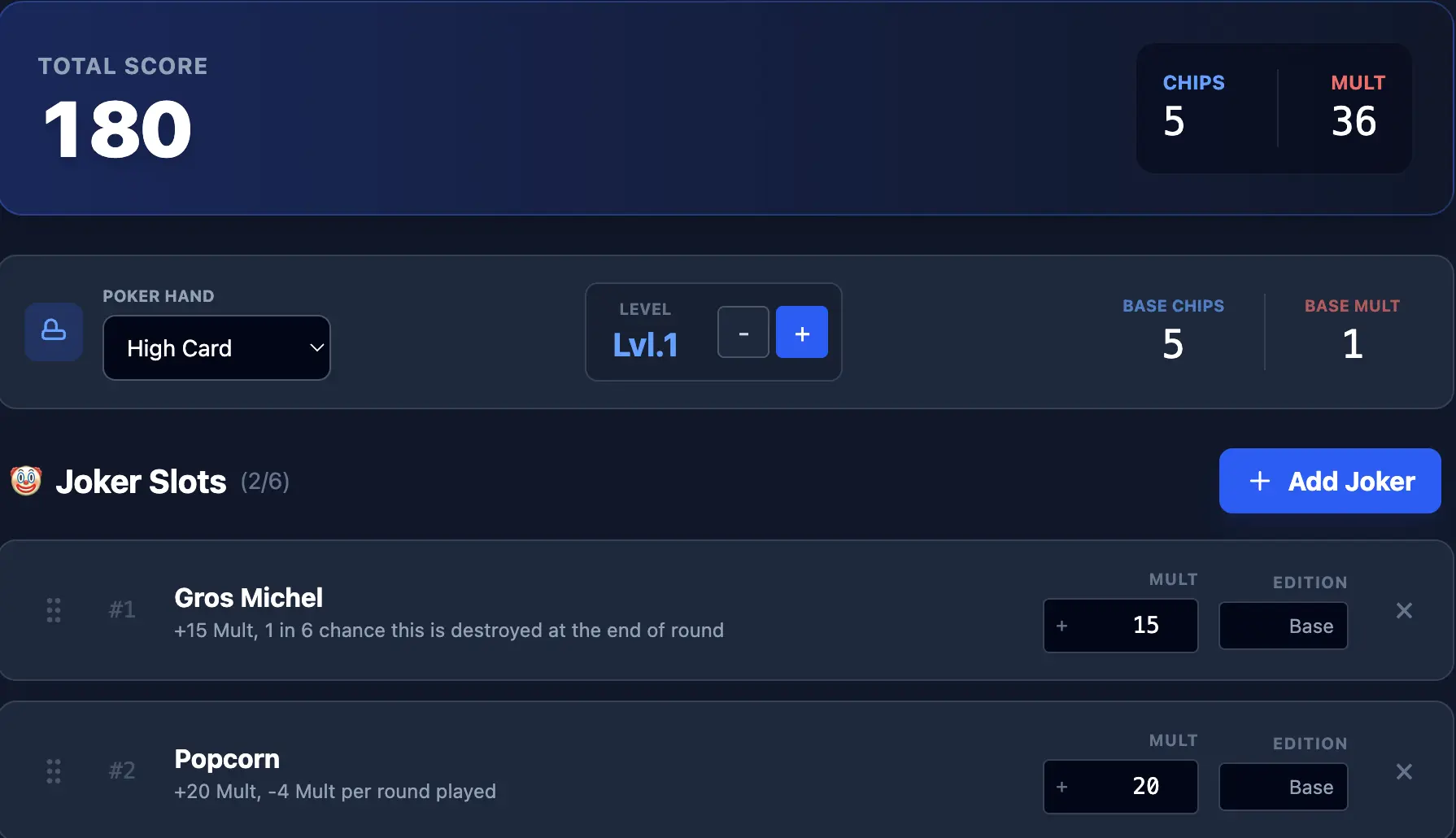 Result: It looks safe, but this flat scaling won’t survive Ante 8.
Scenario B: The Cavendish Difference
Now, let’s say your Gros Michel breaks and you swap it for Cavendish.
- Hand: High Card
- Jokers: Popcorn (+20 Mult) + Cavendish (X3 Mult)
- The Math: (Base (1) + 20) × 3 = 63 Mult
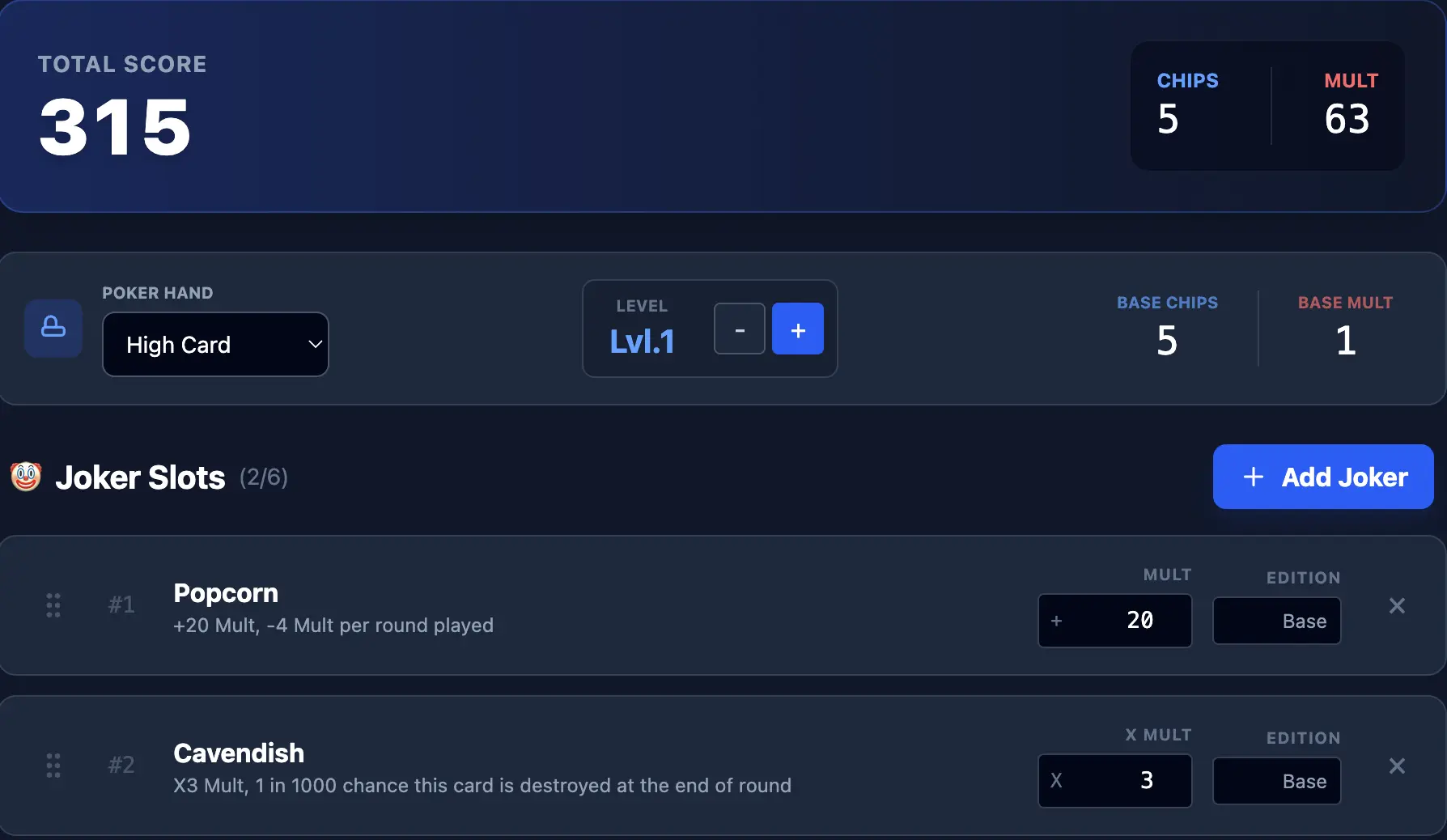 Result: You almost doubled your score just by swapping one card. This is the power of Multiplicative Scaling.
💡 Don’t trust your mental math? Use our Balatro Score Calculator to simulate your deck instantly and see if Cavendish beats your current setup.
Why It beats Rare Jokers
Most X3 Jokers have annoying conditions:
- Blackboard: Requires all cards in hand to be Spades/Clubs. (Blocks you from holding Steel/Gold cards).
- Card Sharp: Requires playing the hand type twice. (Bad for Bosses like The Needle).
- The Trio/Duo: Locked to specific hand types.
- Cavendish: No conditions. It works on High Card, Flush, Straight, anything. It is universal.
The Fear of 1/1000: A Statistical Reality Check
“But what if it breaks during the final boss?” This is the most common comment I see. Let’s look at the actual probability math to silence the fear.
Cavendish has a 1 in 1000 chance to destroy itself after each round. To beat Ante 8 from the moment you likely pick it up (Ante 4-5), you will play roughly 30 to 50 hands.
The Survival Formula:
$$ \text{Survival Probability} = \left( \frac{999}{1000} \right)^{50} \approx 95.1% $$
Putting it in Perspective (The “Glass Card” Test)
Do you use Glass Cards?
- Glass Card Break Chance: 1 in 4 (25%)
- Cavendish Break Chance: 1 in 1000 (0.1%)
If you are willing to play a Glass Card to win a blind, you should be willing to play Cavendish. You are 250 times more likely to break a Glass Card than you are to lose your Cavendish in a single round.
The Verdict: You have a 95%+ chance that Cavendish survives the entire run. To put that in perspective: You are far more likely to lose a run because you drew a bad hand (RNG) or hit a hard-counter Boss Blind (like The Plant) than you are to lose Cavendish.
Real Player Experience: “I’ve been playing for over 500 hours, and I’ve seen Cavendish break maybe twice. Once was on the very first round I bought it—which is just comedy—but usually, it carries me to Ante 11 without a scratch.”
Real-World Case Studies: When Cavendish Saves Runs
To prove it’s not just theory, here are two scenarios from my recent Gold Stake runs where Cavendish outperformed “better” cards.
Case Study 1: The “High Card” Pivot
- The Situation: I was running a Card Sharp build relying on playing Pairs twice.
- The Problem: I hit The Eye (Boss Blind: “No repeating hand types”). My Card Sharp was instantly useless because I couldn’t play Pair twice.
- The Save: I sold a support Joker and bought Cavendish. Because Cavendish doesn’t care what I play, I switched to playing High Card -> Straight -> Flush just to survive. The X3 Mult applied to everything, allowing me to clear the blind without my main synergy.
- Takeaway: Cavendish offers flexibility. Rare jokers often force you into a corner; Cavendish lets you pivot.
Case Study 2: The “Blackboard” Anxiety
- The Situation: I had a Blackboard (X3 Mult if hand is Spades/Clubs).
- The Problem: I was spending all my money on Tarot cards to change suits, and I couldn’t hold onto Gold Cards for economy because they were the wrong suit.
- The Save: Gros Michel broke, and Cavendish appeared. I swapped Blackboard for Cavendish.
- The Result: Same damage (X3), but suddenly I could hold Steel and Gold cards again. My economy skyrocketed, and I won easily.
- Takeaway: The hidden value of Cavendish is mental bandwidth. You stop fighting your own deck and start playing the game.
Comparison: Cavendish vs. The Competition
| Joker | Multiplier | Rarity | Condition | Verdict |
|---|---|---|---|---|
| Cavendish | X3 | Common | None (1/1000 risk) | God Tier. Instant pick. Best ROI in game. |
| Card Sharp | X3 | Uncommon | Must play hand twice | Risky vs The Eye / Needle. |
| Blackboard | X3 | Uncommon | Hand must be Spades/Clubs | Annoying. restricts hand holding. |
| Vampire | Scales | Rare | Must suck enhancements | Takes time to ramp up & expensive ($10). |
| Obelisk | Scales | Rare | Weird reset mechanic | Brain damage to play effectively. |
Expert Playbook: How to optimize your Banana
Early Game (Ante 1-3)
- Buy Gros Michel immediately. Even if you have a better Joker, buy it to start the “death timer.”
- Economy First: Don’t reroll for Cavendish yet. Build your interest cap ($25).
Mid Game (Ante 4-6)
- The Trigger: The moment Gros Michel breaks, the pool opens.
- Aggressive Reroll: If your economy is strong ($50+), this is the time to dig. Finding Cavendish in Ante 5 ensures an easy coast to Ante 8.
Late Game (Ante 7-8)
- Sit Back: Enjoy the X3 Mult.
- Boss Killing: Use the raw power to one-shot blinds.
- The “Curse” Protocol: If Cavendish does break (that 1/1000 chance), don’t get mad. Just screenshot it and post it on Reddit for karma. That’s your consolation prize.
Final Take: Don’t Fear the Risk—Embrace It
Don’t let the 1/1000 risk deter you. The statistical odds are overwhelmingly in your favor. The real risk isn’t that Cavendish breaks; the real risk is reaching Ante 8 without enough scaling because you were too scared to take the best Common Joker in the game.
Play smart, let the banana die, and enjoy the easiest wins of your Balatro career.